
Many businesses still treat software maintenance as an afterthought, only to face downtime, security gaps, and rising costs later.
This challenge grows in 2026 as systems become more complex and risks increase. At RAAS Cloud, we see this firsthand while delivering 60+ projects with 95% client satisfaction.
This guide breaks down the true software maintenance cost and shows how businesses can plan smarter and avoid long term surprises.
| 💡 Before we start: How RAAS Cloud approaches software maintenance At RAAS Cloud, we work with businesses at every stage of the software lifecycle, from development to long term maintenance and optimization. Software maintenance costs stay controlled when systems are built right, monitored continuously, and improved proactively. Our software development and support services focus on reducing technical debt, preventing failures, and aligning technology with real business needs. 👉 Software development services |
Why is software maintenance necessary for businesses?
1. Business operations rely on stable software systems
Daily business activities often run entirely on software systems. When these systems slow down or fail, teams cannot complete tasks, deadlines slip, and customers feel the impact. Ongoing maintenance keeps systems dependable and reduces the chance of sudden outages.
By addressing issues early, businesses avoid costly downtime and maintain smooth operations across departments.
2. Data security depends on continuous system updates
Software security is not a one-time setup. As threats evolve, older software becomes easier to exploit. Regular maintenance strengthens defenses by closing vulnerabilities and improving access controls.
This ongoing protection is critical for safeguarding customer data, internal records, and financial information. Companies that neglect maintenance expose themselves to breaches, penalties, and long-term trust issues.
3. Technology changes can break unmaintained software
Modern software connects to browsers, operating systems, cloud platforms, and third-party services. When any of these change, unmaintained systems often stop working as expected. Maintenance helps software adapt to these external updates and remain compatible.
This prevents sudden failures and reduces the risk of rushed fixes that disrupt business continuity.
4. Performance declines as systems handle more load
What works well at a small scale often struggles as usage grows. Increased data volume and user activity place more strain on software over time. Maintenance focuses on performance improvements that keep systems responsive. Faster systems support employee productivity and improve customer experience as the business expands.
5. Business needs evolve faster than original software designs
Software is usually built around current business needs, not future ones. As processes change, new requirements appear.
Maintenance allows teams to refine features, adjust workflows, and support new use cases without rebuilding from scratch. This flexibility helps software stay aligned with real business operations instead of becoming outdated.
6. Long term costs rise when maintenance is ignored
Skipping maintenance may seem cost effective at first, but problems accumulate quietly. Over time, systems become harder to update, fix, or scale. Regular maintenance keeps code manageable and reduces technical debt. This lowers future development costs and helps businesses avoid expensive emergency repairs.
7. User trust depends on reliability and ease of use
Users notice when software becomes slow, confusing, or unreliable. Poor experiences reduce adoption and increase support requests. Maintenance improves stability, usability, and consistency. When software works as expected, users trust it more and rely on it for critical tasks.
How much does software maintenance cost?
Software maintenance typically costs 15% to 30% of the original software development cost per year. This range applies to most business software, including web apps, mobile apps, SaaS platforms, and enterprise systems.
For example, if software development costs $100,000, annual maintenance usually ranges from $15,000 to $30,000. This covers bug fixes, security updates, performance improvements, compatibility updates, and minor feature changes.
However, the exact cost depends on software complexity, code quality, technology stack, security needs, number of users, and third-party integrations. A well-built software costs less to maintain, while complex or poorly maintained systems fall at the higher end of the range.
Tip: Expect to budget one-fifth to one-third of development cost each year for software maintenance.
What are the types of software maintenance and their cost impacts?
Each type of software maintenance serves a clear purpose and affects long-term maintenance cost differently. Once you understand each type, you can plan your software maintenance budget and avoid long-term expenses.
1. Corrective maintenance
Corrective maintenance deals with problems that show up after software is already in use. These issues usually come from real user behavior, edge cases, or conditions that were not visible during testing. This type of maintenance focuses on bug fixes, logic corrections, system errors, and restoring features that do not work as expected. It keeps the software stable and usable.
Impact on cost:
Corrective maintenance usually stays manageable when teams fix issues early and consistently. Costs rise when bugs affect critical workflows or when fixes are delayed and become urgent. Over time, poor code quality leads to more frequent corrective work and higher overall maintenance costs.
2. Adaptive maintenance
Adaptive maintenance helps software keep up with changes in its technical environment. As operating systems, browsers, cloud platforms, and third party services update, software must adjust to remain compatible. This type of maintenance includes platform updates, integration changes, and environment-specific fixes that prevent software from breaking due to external changes.
Impact on cost:
Adaptive maintenance creates steady, predictable costs. Expenses increase when software depends on many external systems or outdated technology. When businesses skip adaptive updates, small compatibility issues can turn into major failures that require rushed and expensive fixes.
3. Perfective maintenance
Perfective maintenance focuses on improving how software works for users and the business. It includes performance improvements, usability enhancements, small feature additions, and workflow refinements based on real usage. This type of maintenance helps software deliver more value without rebuilding it from scratch.
Impact on cost:
Perfective maintenance often costs more than basic fixes, but it also delivers direct business benefits. Regular small improvements cost less than large redesigns. When done consistently, perfective maintenance reduces user frustration and increases long term return on the software investment.
4. Preventive maintenance
Preventive maintenance works behind the scenes to reduce future problems. It focuses on improving code quality, updating dependencies, strengthening security, and reducing technical debt. Users may not notice these changes immediately, but they play a major role in keeping software healthy over time.
Impact on cost:
Preventive maintenance has lower short-term costs compared to emergency fixes. It significantly reduces long term maintenance expenses by preventing failures, improving system stability, and making future updates easier and faster to implement.
How does software maintenance cost vary by software type?
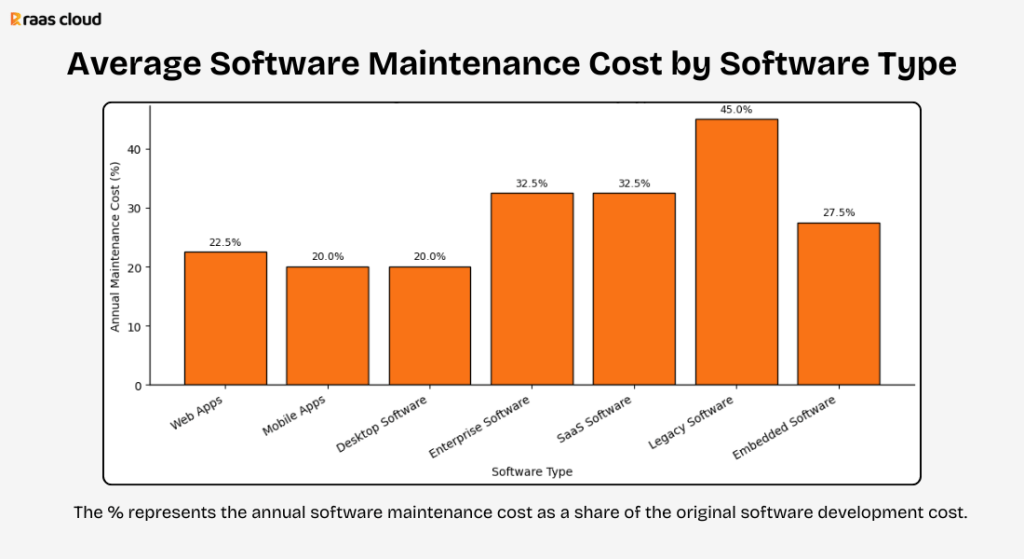
Here are the factors that shape how much time, effort, and budget businesses must spend after launch 👇
1. Web Applications
Web applications need constant care because they depend on browsers, servers, APIs, and third party tools. Browsers update often, security threats evolve daily, and performance expectations keep rising.
Typically, software maintenance includes fixing bugs, updating frameworks, improving speed, managing hosting, and applying security patches. As traffic grows, scaling and monitoring also add to the cost. This makes web application maintenance a recurring and predictable monthly expense.
- Cost: Web application maintenance cost is usually 15% to 30% per year of the original development cost.
2. Mobile Applications
Mobile apps face higher maintenance costs due to frequent iOS and Android updates. Each OS change can break features or require redesigns.
Apps must work across many devices, screen sizes, and hardware versions. Maintenance covers bug fixes, store compliance updates, performance tuning, and user experience improvements. When apps support both platforms, costs increase because teams must maintain and test two separate codebases.
- Cost: Mobile application maintenance cost typically ranges from 15% to 25% per year due to OS and device updates.
3. Desktop Software
Desktop software usually has slower update cycles, which lowers short term maintenance cost. However, long term costs rise due to operating system upgrades and hardware changes.
In fact, older versions must still work for existing users, which increases testing effort. Security updates and compatibility fixes remain essential, even if releases are less frequent. Each update must be stable because users often delay installing new versions.
- Cost: Desktop software maintenance cost stays around 15% to 25% per year with lower update frequency.
4. Enterprise Software
Enterprise software supports large teams and core business processes. Maintenance costs are high because systems are complex and highly customized. Updates must follow strict testing, approval, and documentation processes. Security, compliance, system integrations, and performance optimization all add ongoing cost. As the organization grows, the software must scale with it, which further increases maintenance effort and budget.
- Cost: Enterprise software maintenance cost is higher at 25% to 40% per year because of complexity and compliance.
5. SaaS Software
SaaS platforms require continuous maintenance because customers expect high uptime and fast performance at all times. Teams must release updates without disrupting users. Saas software maintenance includes cloud infrastructure costs, monitoring, backups, security management, and customer support. Feature updates are frequent to stay competitive.
As the user base grows, maintenance cost rises to maintain reliability, speed, and data protection.
- Cost: SaaS software maintenance cost often reaches 25% to 40% or more per year due to cloud and uptime demands.
6. Legacy Software
Legacy software is costly to maintain because it relies on outdated technology. Skilled developers are harder to find, and changes take longer to implement safely.
Small updates can cause unexpected failures. Security risks increase over time, which adds pressure for frequent fixes. In many cases, maintenance costs grow so high that replacing the system becomes more cost-effective than maintaining it.
- Cost: Legacy software maintenance costs can rise to 30% to 60% per year as technology becomes outdated.
7. Embedded Software
Embedded software runs on physical devices like machines or IoT products. Maintenance costs depend on hardware limits and safety requirements.
Updates need deep testing because failures can cause device damage or safety risks. Certification and compliance checks increase effort and cost. Updates are less frequent, but each release is expensive and time-consuming due to strict validation needs.
- Cost: Embedded software maintenance costs usually fall between 20% to 35% per year due to heavy testing and validation needs.
💡 Further Resources:
- What is the True Cost of Hiring AI Developers?
- How to Choose The Right Engagement Model For Your Software Development Project
- MVP Development Timeline: What You Can Build in 30/60/90 Days
Final words
Software maintenance is not a hidden cost. It is a predictable and necessary investment. In 2026, businesses that plan for maintenance early avoid downtime, security risks, and sudden budget shocks. The real cost comes from ignoring it, not managing it.
At RAAS Cloud, we help businesses design, maintain, and scale software with long term cost control in mind. When maintenance is planned the right way, software stays reliable, secure, and valuable for years, not just at launch.
👉 Contact our team and get a free consultation →

Dhanalakshmi Kadirvelu is a Business Intelligence and Data Analytics expert with a strong focus on software development and data engineering. She creates efficient data models, builds interactive dashboards, and integrates analytics into software systems using Power BI, OBIEE, and SQL. Her work helps development teams use data effectively to create smarter software solutions and improve business performance.