
Blockchain app development is seeing strong demand in 2026 as more companies build Web3 apps, enterprise blockchain systems, and tokenized platforms. Most people still think blockchain is only about Bitcoin and crypto trading, but today it is used for real products like supply chain tracking, payments, identity, finance, and digital assets. The problem is that cost is unclear. Many founders and teams start without knowing what it actually takes to build and run a blockchain app.
This guide is for founders, CTOs, product managers, and business owners who want clear and practical answers. We will break down how much blockchain app development costs in 2026, what drives the cost, what you pay for each feature, and how to budget for security, compliance, and long term maintenance. This will help you plan better and avoid surprises during development.
Who we are?
We are RAAS Cloud, a leading software development and IT outsourcing company. We offer expert blockchain development services for startups and enterprises. Our team has helped 80 plus businesses design, build, and scale blockchain apps across different industries.
Quick Answer: How Much Does Blockchain App Development Cost in 2026?
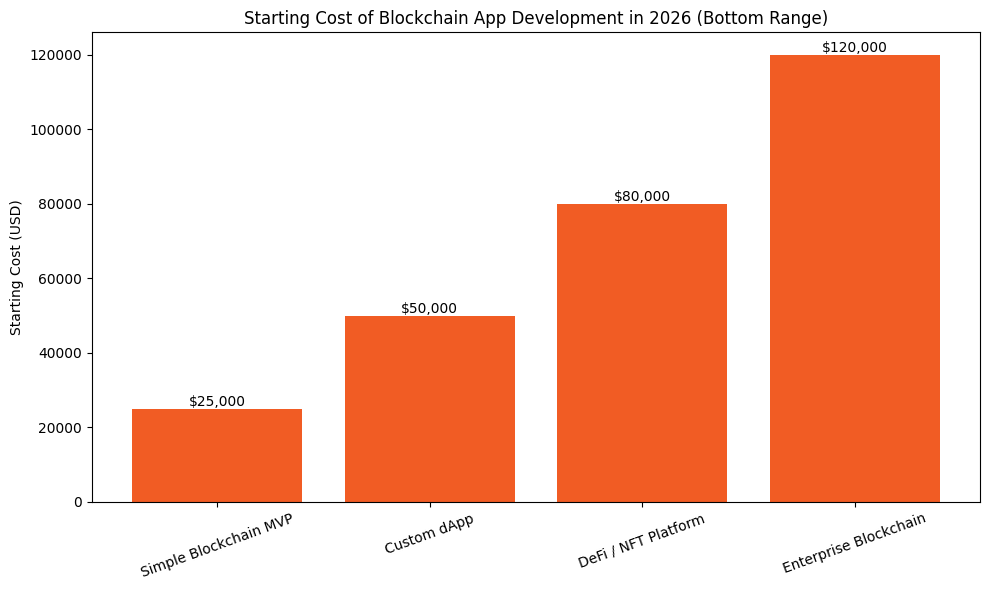
Blockchain app development in 2026 typically costs between $25,000 and $350,000 or more, depending on what you are building. This is a wide range, and that is expected. The final price changes a lot based on your app type, feature depth, security needs, blockchain network, compliance requirements, and the team model you choose. A simple MVP will cost far less than a secure, production ready platform built for real users and transactions.
Here are some practical cost ranges based on common project types in 2026. These are typical market ranges for building a working product, not just prototypes.
Simple blockchain MVP: $25,000 to $50,000
This is suitable for startups testing an idea or validating a use case. It usually includes basic smart contracts, a simple Web3 frontend, wallet integration, and limited user flows. Security is basic, and the scope is intentionally small to keep costs under control.
Custom dApp with smart contracts: $50,000 to $120,000
This covers production ready decentralized apps with custom smart contract logic, better UI and UX, admin panels, wallet integrations, and testing. It is a good fit for startups and growing businesses launching a real product for users.
DeFi platform or NFT marketplace: $80,000 to $200,000
These products involve complex smart contracts, token logic, marketplace features, transaction handling, gas optimization, and security audits. Costs go up because of higher risk, more testing, and the need for strong security and performance.
Enterprise blockchain solution: $120,000 to $350,000+
This includes private or hybrid blockchain systems for supply chain, finance, identity, or data tracking. Costs are higher due to system architecture, integrations with ERP and CRM tools, compliance requirements, access control, reporting, and long term support needs.
Blockchain Development Cost by Region in 2026
While the core components of blockchain development remain the same everywhere, where you build your app has a major impact on cost. Rates vary widely because of differences in developer salaries, operational costs, and market demand. Below are typical cost ranges for blockchain development in key regions in 2026:
USA: $100,000 to $350,000+
Development rates in the United States are among the highest in the world. High expertise and strong compliance standards drive costs up, especially for enterprise-grade blockchain solutions.
UK: $90,000 to $300,000+
The UK market is similar to the US, with high professional rates and a strong focus on secure, scalable development. Costs are high but quality and delivery standards are strong.
Eastern Europe: $60,000 to $180,000
Countries in Eastern Europe offer a strong balance between cost and technical skill. You can find experienced blockchain developers at more competitive rates than in the US or UK.
India: $40,000 to $120,000
India remains one of the most cost-effective regions for blockchain development. Skilled developers and teams are widely available, and costs are significantly lower than in Western markets.
Southeast Asia: $50,000 to $140,000
This region is quickly growing as a blockchain development hub. Cost ranges vary by country, but overall it remains more affordable than Western Europe and the US.
Region itself is just one factor in the total cost. What matters more is the combination of developer competition, talent availability, communication efficiency, quality standards, and local market demand. Lower regional rates do not guarantee better outcomes unless you also consider expertise, process maturity, and long-term support.
What Actually Drives Blockchain App Development Cost (Beyond Location)
There are multiple factors that decide how much your blockchain app will finally cost. Location is just one part of the picture. At RAAS Cloud, we offer custom proposals because every product has different technical needs, risk levels, compliance requirements, and long term goals. Two apps built on blockchain can have very different costs based on the choices you make during planning and architecture.
Below are the main factors that drive blockchain app development cost in 2026.
Blockchain network (Ethereum vs Polygon vs Solana vs private chains)
The blockchain you choose directly affects development time, tooling, performance, and transaction costs. Ethereum is widely adopted and secure, but gas fees and performance tuning add complexity and cost. Polygon reduces transaction costs but still requires Ethereum compatibility and security planning. Solana offers high speed but has a different development stack and fewer experienced developers, which can increase cost. Private or permissioned blockchains add cost due to custom infrastructure setup, node management, access control, and enterprise security requirements.
Smart contract complexity
Simple smart contracts that handle basic transactions or token logic are quicker and cheaper to build. As soon as you add features like multi role permissions, staking, rewards, escrow, governance, or cross chain logic, development time increases. Complex smart contracts also require more testing and review cycles. More logic on chain means more risk, which increases both development and audit costs.
Security and audit requirements
Security is not optional in blockchain apps. Even small bugs can lead to financial loss and legal issues. Costs go up when you include code audits, penetration testing, vulnerability assessments, and secure key management. Production grade apps often require third party audits in addition to internal reviews. The more value your app handles, the more security investment is needed, which increases overall cost.
Gas optimization strategies
Apps with high transaction volume need gas optimized smart contracts to keep running costs reasonable for users. Writing gas efficient code takes more planning, more testing, and experienced blockchain engineers. Optimizing storage usage, reducing unnecessary calls, and choosing the right contract patterns all add development time. This upfront cost saves money long term, but it does increase the initial build budget.
Regulatory and compliance requirements
If your app handles payments, financial data, user identity, or operates in regulated industries, compliance adds cost. This includes KYC, AML, data protection, audit trails, and region specific legal requirements. Compliance often impacts both backend architecture and frontend user flows. Planning for regulation early prevents rework later, but it does increase the initial scope and cost of development.
Frontend UX for Web3 users
Web3 UX is harder than regular app UX. You need to handle wallet connections, transaction signing, network switching, error handling, and user education. Building a smooth experience that does not confuse non technical users takes more design work, frontend engineering, and testing. Good UX reduces drop offs and support issues, but it increases development effort compared to basic interfaces.
Integration with Web2 systems (CRM, payment gateways, ERP)
Most real products need to connect blockchain logic with existing business systems. This includes CRMs, payment gateways, ERP tools, analytics platforms, and internal dashboards. These integrations add backend complexity, data syncing logic, security layers, and monitoring. The more systems you connect, the more time and cost are involved, but this is what makes blockchain apps usable in real business operations.
Real-World Cost Scenarios (Practical Examples)
While working with startups and enterprises across different industries, we see that blockchain app costs vary a lot based on the use case and scale of the product. To make this more practical, here are three real world scenarios that show how scope, timeline, and team setup affect the total cost in 2026.
Scenario 1: Blockchain MVP for Startup
Scope
A simple MVP to validate a business idea. Includes basic smart contracts, wallet login, a simple Web3 frontend, one core user flow, and a basic admin panel. No advanced analytics or heavy integrations.
Timeline: 6 to 8 weeks for design, development, and testing.
Team size
- 1 blockchain developer
- 1 frontend developer
- 1 part time product or QA resource
Estimated cost: $25,000 to $50,000
This is ideal for early stage startups that want to test demand before investing in a full scale product.
Scenario 2: NFT Marketplace for a Consumer Brand
Scope
A branded NFT marketplace with minting, buying and selling, royalty setup, wallet integration, user profiles, admin dashboard, and basic analytics. Includes security testing and gas optimization for smoother user experience.
Timeline: 10 to 14 weeks for design, development, testing, and launch support.
Cost range: $80,000 to $160,000
Costs increase if you add advanced features like auctions, multi chain support, or fiat on ramp integrations.
Scenario 3: Enterprise Blockchain Platform for Logistics
Scope
A private or hybrid blockchain platform to track goods across the supply chain. Includes role based access, data logging on chain, integration with ERP systems, reporting dashboards, compliance checks, and audit trails. Built for internal teams and partners.
Timeline: 16 to 24 weeks depending on integrations and compliance needs.
Cost range: $150,000 to $350,000+
Enterprise projects cost more due to custom architecture, integrations, security reviews, and long term support requirements.
Freelancer vs In-House vs Blockchain Development Company (RAAS Cloud Comparison)
When CTOs and product leaders make hiring decisions for blockchain projects, they need to balance cost, speed, risk, and long term ownership. Each option has pros and cons depending on your product stage, security needs, and timeline. Below is a practical comparison to help you choose the right model for your blockchain app in 2026.
| Factor | Freelancer | In-House Team | Blockchain Development Company |
| Cost | Lower hourly rates, but unpredictable total cost | High fixed cost including salaries, hiring, and overhead | Predictable pricing based on scope or team model |
| Speed to start | Fast to hire one person | Slow due to hiring and onboarding | Fast onboarding with ready teams |
| Skill coverage | Limited to one or two skills | Strong control but hard to hire full Web3 stack | Full stack team including blockchain, backend, frontend, QA |
| Security and audits | Usually limited or missing | Depends on internal expertise | Built in security practices and audit support |
| Risk management | High risk if freelancer drops off | Medium risk if key members leave | Lower risk with team continuity and backup |
| Scalability | Hard to scale fast | Slow and expensive to scale | Easy to scale team up or down |
| Project management | You manage everything | You manage delivery and processes | Managed delivery with defined process |
| Long term support | Unreliable for maintenance | Strong if team is retained | Ongoing support and maintenance options |
| Compliance readiness | Limited exposure | Depends on internal experience | Experience with regulated and enterprise use cases |
At RAAS Cloud, we offer multiple engagement models so you get the most value based on your product stage, budget, and delivery goals.
Whether you need a few blockchain developers to extend your in house team or you want a full team to design, build, and support your blockchain app end to end, we can structure the right setup for you. This helps you move fast without compromising on security, quality, or long term maintainability.
How RAAS Cloud Prices Blockchain App Development (Transparent Model)
RAAS Cloud offers flexible and transparent pricing for blockchain app development. We do not believe in one size fits all pricing because every product has different goals, risks, and technical needs. Our pricing models are designed to give you clarity on cost, control over scope, and confidence in delivery.
Hourly vs dedicated team vs fixed price
We offer three engagement models based on how defined your scope is and how fast you want to move. Hourly pricing works well for small tasks, experiments, audits, and ongoing improvements where scope changes often. A dedicated team model is best for startups and growing products that need continuous development and quick iterations.
You get blockchain, backend, frontend, and QA resources working as an extension of your team. Fixed price works when the scope is clear and locked. This is ideal for MVPs or well defined modules where timelines and deliverables are known upfront.
What is included in the cost?
Our pricing includes solution architecture, blockchain network selection guidance, smart contract development, frontend and backend development, testing, basic security reviews, and project management. We also include deployment support and initial handover documentation. Optional add ons like third party audits, compliance consulting, advanced security testing, and long term maintenance are scoped clearly so you know exactly what is included and what is not.
Free technical consultation
Before any commitment, we offer a free technical consultation. In this session, our blockchain architects review your idea, suggest the right blockchain stack, highlight security and compliance risks, and help you shape a realistic MVP or roadmap. This helps you avoid over building and wasting budget on features you do not need in the first phase.
Cost estimation process
Our cost estimation process is structured and practical. We start with your use case and business goals, then break the product into features and technical components. We define scope, timelines, team size, and risk areas. Based on this, we share a clear cost range with line items so you understand what you are paying for. This makes budgeting easier and reduces surprises during development.
Further Resources:
Get a Custom Blockchain App Cost Estimate From RAAS Cloud
With RAAS Cloud, you work with expert blockchain developers who have built real products for real businesses. Our team has helped 80 plus clients across 15 plus industries design, build, and scale blockchain apps that are secure, practical, and ready for production. We focus on building what your business actually needs, not just what looks good on paper.
If you are planning a blockchain product and want clear cost visibility, connect with our team. We will understand your use case, technical needs, timeline, and budget goals, then share a custom proposal with a realistic cost range and delivery plan.
The next step for you is simple. Fill in the form on our contact page and our team will get in touch to start your free technical consultation.

Dhanalakshmi Kadirvelu is a Business Intelligence and Data Analytics expert with a strong focus on software development and data engineering. She creates efficient data models, builds interactive dashboards, and integrates analytics into software systems using Power BI, OBIEE, and SQL. Her work helps development teams use data effectively to create smarter software solutions and improve business performance.