AI development cost in 2026 explained with real budgets, use cases, and cost drivers. Learn how to estimate AI project cost with RAAS Cloud.
AI is no longer an experiment for businesses in 2026. Companies across industries are using AI in live products, internal systems, customer support, analytics, fraud detection, and automation. AI is already powering billion dollar companies and is becoming a core part of how modern products and operations are built.
Many people have ideas to use AI in their business. Some want to add AI features to existing products. Others want to build new AI driven platforms from scratch. But the biggest question founders, CTOs, and product teams ask is simple.
How much does it actually cost to build an AI solution?
The answer is not a simple number. AI development costs vary widely based on the type of AI you build, the data you have, the level of customization needed, and how you deploy and maintain the system.
In this guide, we break down real AI development costs in 2026 using practical examples. You will learn what drives costs, what different AI solutions typically cost, what ongoing expenses to expect, and how to budget your AI project properly. We also share how RAAS Cloud structures AI development pricing and how to avoid overspending on your first AI build.
AI Development Cost In 2026 At a Glance
AI development cost in 2026 typically ranges between $15,000 to $1,000,000+. The final cost depends on the actual use case, the kind of data you work with, the level of customization needed, the scale at which the AI will run, and how critical the system is for your business.
As AI is used across very different business problems, there is no single fixed price. The same AI idea can cost very little for a small internal tool and much more when built as a secure, scalable product used by customers. Hundreds of technical and business factors drive the final cost.
To make this easier to understand, we divide AI development cost into three main buckets. Let us take a closer look at each one.
1) AI MVP or Prototype (Validation Stage)
Typical cost range: $15,000 to $50,000
This bucket is for businesses that want to test an AI idea before investing heavily. It is best suited for startups, new product ideas, and internal experiments.
What this usually includes:
- A simple AI use case such as a chatbot, document analysis tool, basic recommendation system, or internal automation
- Use of existing AI APIs or pre trained models
- Limited data processing and basic logic
- Simple user interface or internal dashboard
- Basic deployment for testing
- Limited security and performance optimization
What drives cost in this stage:
- Whether you already have clean and usable data
- How many features are included in the MVP
- Number of user flows and integrations
- Whether the AI output needs basic accuracy or production level quality
What this bucket is good for:
- Validating product ideas
- Proving technical feasibility
- Getting early user feedback
- Showing demos to investors or internal teams
This stage is not meant for large user traffic or business critical workflows. It helps you learn fast without overspending.
2) Production AI Application (Customer-Facing or Internal Tool)
Typical cost range: $50,000 to $350,000
This bucket is for AI systems that are used by real users in daily operations. These can be customer facing features or internal tools used by teams like sales, support, HR, or operations.
What this usually includes:
- AI models configured or fine tuned for your use case
- Integration with your website, app, CRM, ERP, or internal tools
- Secure APIs and authentication
- Performance tuning for real usage
- Logging, monitoring, and basic alerting
- Production deployment on cloud infrastructure
- Quality testing and edge case handling
What drives cost in this stage:
- Volume and quality of your data
- Number of integrations with existing systems
- Performance and response time requirements
- Security and access control needs
- Volume of expected users and requests
- Need for limited fine tuning or custom logic
What this bucket is good for:
- Launching AI features to customers
- Automating internal business workflows
- Improving product experience with AI
- Replacing manual processes with AI driven systems
This is the most common category for growing businesses and SaaS products. It balances speed, quality, and cost.
3) Enterprise AI Systems (Large-Scale or Core Product)
Typical cost range: $350,000 to $1,000,000+
This bucket is for large scale AI systems where AI is a core part of the product or a mission critical business system. These systems usually handle large volumes of data, high user traffic, and strict reliability and security requirements.
What this usually includes:
- Custom AI models or heavy fine tuning on proprietary data
- Large data pipelines for ingestion, cleaning, and processing
- High availability infrastructure and scalable deployment
- Advanced monitoring, logging, and incident handling
- Security, access control, and audit trails
- Compliance requirements based on industry or region
- Continuous model improvement and performance tracking
- Dedicated MLOps pipelines for model updates and rollbacks
What drives cost in this stage:
- Size and complexity of your data
- Custom model training or advanced fine tuning needs
- Number of AI workflows and services
- Uptime and reliability requirements
- Compliance and security standards
- Ongoing optimization and maintenance needs
- Scale of users and usage volume
What this bucket is good for:
- AI driven platforms and products
- Enterprise automation systems
- AI as a core revenue driver
- Systems that cannot afford downtime or errors
This category requires long term planning and budget ownership. It is best suited for enterprises and products where AI is central to business value.
👉 Start Your AI Journey with our AI Consulting Services
Why Costs Vary: The 6 Primary Drivers
As you might have already noticed, the cost of building AI solutions varies a lot from one project to another. This happens because AI systems do not scale in a linear way. As the use case grows, the data volume increases, the number of users goes up, and the system becomes more business critical. At that stage, the same processes that worked for a small AI MVP might not work anymore. You need stronger infrastructure, better data pipelines, more testing, tighter security, and ongoing monitoring.
This is why two AI projects that look similar on the surface can have very different budgets. Below are the 6 primary drivers that decide how much your AI development project will cost in 2026.
| Primary Cost Driver | How It Impacts AI Development Cost |
| Type of AI Solution | Simple AI features and rule based automation cost less than machine learning and LLM based systems that need tuning and continuous improvement. |
| Data Readiness and Quality | Clean and structured data reduces development time and cost. Poor quality data increases effort for cleaning, labeling, and preparation. |
| Model Choice and Customization | Using existing AI APIs is cheaper than training or heavily fine tuning custom models. More customization increases engineering and compute cost. |
| Infrastructure and Compute | Training and running AI at scale needs cloud resources. Higher usage and performance needs increase hosting and compute cost. |
| Team and Expertise Needed | Complex AI systems need experienced ML engineers, data engineers, and MLOps specialists which increases overall project cost. |
| Ongoing Maintenance and Operations | Monitoring, retraining, performance tuning, and cost control add ongoing expenses after the AI system goes live. |
Real Cost Components (Detailed Breakdown)
AI development is not cheap and it should not be treated like a regular software feature. It takes deep technical skills, real data work, infrastructure planning, and long term ownership. Many AI projects fail or go over budget because teams only plan for the build and ignore the real cost components that come before and after launch.
Let us get into a detailed breakdown of where AI development money actually goes.
People (largest single line item for many projects)
For most AI projects, people’s cost is the biggest expense. AI work needs specialized roles and senior experience. In 2026, senior ML engineer market rates have risen substantially.
Expect $80 to $200+ per hour for senior US based contractors. Local India rates are lower, but strong senior talent still commands premium pay because experienced ML engineers are in short supply.
Typical roles involved in an AI project:
- Product Manager to define use cases and scope
- ML Engineers to design and tune models
- Data Engineers to build data pipelines
- MLOps Engineer to manage deployment and monitoring
- Backend Engineer for APIs and integrations
- Frontend Engineer for user facing features
- QA Engineer for testing AI behavior and edge cases
Expected hourly ranges by geography (2026 market reality):
- US senior ML engineer: $80 to $200+ per hour
- US mid level backend or data engineer: $60 to $120 per hour
- India senior ML engineer: $30 to $80 per hour
- India backend or data engineer: $25 to $60 per hour
Example staffing for a mid size production AI project (monthly view):
- Product Manager 0.5 FTE
- 2 ML Engineers full time
- 1 Data Engineer full time
- 1 MLOps Engineer 0.5 FTE
This setup alone can run into tens of thousands of dollars per month, depending on where the team is based and how senior the talent is. This is why choosing the right scope early is critical. Over staffing at the MVP stage is one of the fastest ways to burn budget.
Data (collection, labeling, storage, ETL)
Data is an important cost driver and is often underestimated. If your project requires new data collection, data cleaning, labeling, or continuous data updates, the cost adds up quickly.
Where data cost shows up:
- Collecting raw data from internal systems or external sources
- Cleaning and structuring messy data
- Labeling data for training and evaluation
- Building ETL pipelines to move data between systems
- Storing large datasets securely
If your data is already clean and structured, you save a lot of money. If your data lives in different systems, has missing fields, or is inconsistent, you will spend more time and money preparing it than building the AI itself.
Real cost impact:
- Labeling work becomes expensive at scale
- Data engineers spend weeks building pipelines
- Storage and data transfer costs grow as datasets grow
- Ongoing data refresh is needed for model performance
Being a leading AI development company, we often audits data readiness before finalizing AI project scope. Poor data quality is one of the top reasons AI projects go over budget.
Models and Licensing
You might save money by using existing AI APIs instead of training your own models. This is often the right decision for early stage and even mid stage AI products.
Cost differences by approach:
- Using APIs from providers like OpenAI or Anthropic has predictable usage based pricing
- Fine tuning models increases both training cost and maintenance cost
- Training custom models from scratch is the most expensive option
Licensing and model usage costs are not one time costs. They grow with usage. As your user base grows, your token usage or inference volume grows, and your monthly AI bill grows with it.
Key cost drivers here:
- Volume of API calls
- Length of inputs and outputs
- Need for fine tuning or custom models
- Caching and optimization strategy
Many teams underestimate how fast model usage costs can grow once real users start using AI features daily.
Compute and Hosting
Computing and hosting is another big cost area. Even companies like OpenAI and cloud providers charge based on usage, not intent. As your AI solution scales, your compute bill grows with every user request and every training run.
Where compute costs come from:
- Model training and fine tuning
- Inference when users interact with AI
- Hosting APIs and backend services
- Databases, vector stores, and logs
- Scaling for peak traffic
Early stage projects might have low compute costs. Production AI systems often see compute become one of the top monthly expenses. This is why infrastructure planning matters from day one. Poor architecture choices can lock you into high costs later.
RAAS Cloud designs AI systems with cost control in mind by choosing the right model size, caching outputs where possible, and scaling infrastructure only when usage grows.
Integrations, UX, and QA
AI does not live in isolation. It needs to work inside your product, tools, and workflows. This adds real development and testing cost.
Cost drivers in this area:
- Integrating AI with CRM, ERP, apps, or internal tools
- Building clean user interfaces that guide users on how to use AI
- Handling edge cases and incorrect AI outputs
- Testing AI responses across real world scenarios
- Adding guardrails to prevent misuse or errors
AI UX is not the same as normal UX. Users need clarity on what the AI can and cannot do. Poor UX leads to low adoption even if the AI model works well. This part of the budget is often overlooked and then added late, increasing total cost.
Ongoing and Ops (monthly)
AI systems are not built once and forget. They need ongoing care. This is where many businesses get surprised by long term cost.
Ongoing costs include:
- Monitoring model performance
- Handling model drift
- Retraining or updating models
- Managing API usage and cloud spend
- Fixing issues as usage grows
- Security updates and access control
- Support and incident handling
For most production AI systems, ongoing and ops costs can be 10 to 25 percent of the initial build cost per year. If you do not plan for this early, AI becomes a growing cost center instead of a business advantage.
This is why RAAS Cloud focuses not just on building AI solutions, but on designing them for long term cost control, maintainability, and predictable scaling.
AI Development Cost by Solution Type (With Real Budget Ranges)
It is important to understand cost drivers and pricing ranges. But when it comes to real world planning, teams need concrete examples to relate to. Let us take a few common AI use cases and break down what they actually do, how much they typically cost to build in 2026, and what goes into that cost.
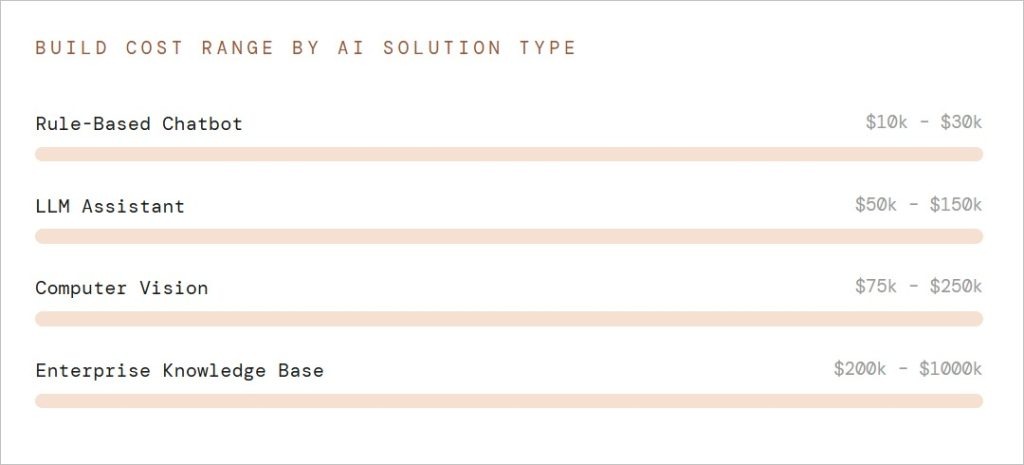
Rule Based Chatbot for FAQ (Low Complexity)
This is a basic chatbot used for answering frequently asked questions on websites or internal portals. It follows predefined rules and decision trees. There is no real learning involved. The bot responds based on keywords, menu options, or simple logic flows. It is commonly used for support pages, HR FAQs, and onboarding queries.
Typical build cost (2026): $10,000 to $30,000
Ongoing monthly cost: $200 to $800
Key components included
- Predefined conversation flows and rules
- Intent mapping and response templates
- Basic UI for web or internal use
- Simple analytics to track usage
- Hosting and basic monitoring
- Basic integration with website or internal system
Small LLM Powered Assistant (API + Prompt Engineering + Fine Tune)
This type of assistant uses large language model APIs to answer questions, summarize content, draft responses, or help users complete tasks. It is used inside SaaS products, internal tools, or customer support workflows. The assistant can be trained on your documents and workflows to provide context aware responses.
Typical build cost (2026): $50,000 to $150,000
Ongoing monthly cost: $1,000 to $5,000
Key components included
- Integration with LLM APIs
- Prompt design and optimization
- Optional fine tuning on your data
- Context handling and response filtering
- Backend APIs and basic UI
- Logging and usage tracking
- Basic cost controls for token usage
Computer Vision Pipeline (Retail or Quality Inspection)
This system uses AI to analyze images or video to detect defects, count items, recognize objects, or verify quality. It is used in retail, manufacturing, warehousing, and logistics. Examples include detecting damaged products, checking shelf stock, or verifying packaging quality.
Typical build cost (2026): $75,000 to $250,000
Ongoing monthly cost: $2,000 to $10,000
Key components included
- Dataset collection and labeling
- Image preprocessing and augmentation
- Model training and validation
- Inference service for real time or batch processing
- API integration with existing systems
- Basic monitoring and performance tracking
Custom LLM + Proprietary Data (Enterprise Knowledge Base With Search and QA)
This is an enterprise grade AI system that allows employees or customers to search internal documents and ask questions in natural language. The system retrieves relevant data from company sources and generates accurate answers. It is used for internal knowledge management, customer support, legal, HR, and operations.
Typical build cost (2026): $200,000 to $1,000,000+
Ongoing monthly cost: $5,000 to $25,000+
Key components included
- Data ingestion pipelines for documents and structured data
- Vector database and search infrastructure
- Retrieval and response generation logic
- Model fine tuning or customization
- Access control and user permissions
- Audit logs and monitoring
- Security and compliance setup
- Scalable hosting and performance tuning
These were some of the most common AI solution types and their typical cost ranges in 2026. One thing to keep in mind is that these numbers are only meant to give you a rough reference. They are not fixed prices and they are not RAAS Cloud’s offerings or packages.
Every AI project is different. The final cost depends on your use case, data readiness, integrations, security needs, scale, and long term goals. At RAAS Cloud, we share custom proposals based on your exact requirements after understanding your product, workflows, and business priorities.
Further Resources:
- What to Include in Your Software Development RFP (With Template)
- What is the True Cost of Hiring AI Developers in 2026?
Get a Clear AI Cost Estimate for Your Use Case
This was a practical breakdown of how much AI development costs in 2026 and what actually drives those numbers. As you saw, there is no single price for building AI. The cost depends on what you are building, the data you have, how critical the system is for your business, and how you plan to scale it.
At RAAS Cloud, we have built 20+ enterprise AI solutions across different industries and use cases. Whether you are validating an idea, adding AI features to an existing product, or building a large scale AI system, you can always start with a practical and realistic plan.
We offer different engagement models based on your needs and budget. You can hire AI developers, outsource the full AI development project, or build a dedicated team with us. If you only need a simple API based AI tool, that can be done at a much lower cost compared to large custom AI systems. If you need a core AI product or enterprise platform, we help you plan the right scope and budget from day one.
Take the next step. Get in touch with the RAAS Cloud team, share your use case, and we will help you estimate cost, scope, and timelines clearly before you invest in building AI.

Dhanalakshmi Kadirvelu is a Business Intelligence and Data Analytics expert with a strong focus on software development and data engineering. She creates efficient data models, builds interactive dashboards, and integrates analytics into software systems using Power BI, OBIEE, and SQL. Her work helps development teams use data effectively to create smarter software solutions and improve business performance.