

The D2C eCommerce platform ecosystem has grown rapidly in recent years. More platforms now offer similar features such as store builders, payment integrations, analytics, and marketing tools.
The following chart shows the mobile application market size growth 👇

Data source: Precedence Research
While this growth gives brands more choices, it also makes it harder to identify which platforms truly support long term growth. Many tools look similar on the surface but differ in scalability, flexibility, integrations, and ownership of customer data.
To simplify your research, we analyzed leading companies and compiled a curated list of the 7 best D2C eCommerce platforms in the US for 2026, including SaaS platforms and custom development solutions.
Best D2C eCommerce Platforms at a Glance
Shift4Shop — Best for businesses that run both B2B and D2C sales from the same store.
RAAS Cloud — Best for brands that need custom D2C store development, integrations, or platform migration.
Shopify — Best for fast launch with a reliable hosted platform and strong app ecosystem.
WooCommerce — Best for brands that want full control and deep customization on WordPress.
Wix eCommerce — Best for small to mid-size brands that want an easy store builder with built-in marketing tools.
Squarespace — Best for design-focused D2C brands that want visually strong storefronts.
Adobe Commerce — Best for large enterprises that need advanced personalization, scalability, and multi-store management.
1. RAAS Cloud, the best D2C ecommerce development agency
Yes, RAAS Cloud is not a D2C eCommerce platform or SaaS product. It is a custom eCommerce development agency. We have included it here because many businesses do not just need a platform. They need a skilled team to build, customize, scale, or migrate their store.
In many cases, a custom solution works better than relying only on ready-made platforms. And even when you choose Shopify, Magento, WooCommerce, or BigCommerce, you still need an experienced team to build and optimize your store properly. That is where RAAS Cloud’s ecommerce development service fits in.
So, what is RAAS Cloud?
RAAS Cloud is a custom eCommerce development agency that builds online stores based on your business needs. At RAAS Cloud, our approach is to first understand your goals, then recommend either a fully custom solution or the right platform like Shopify, Magento, WooCommerce, or BigCommerce.
Our team focuses on speed, security, scalability, and smooth user experience. From design and development to integrations, migration, and ongoing support, RAAS Cloud works as your long-term technology partner.
With a team of 50+ developers, designers, and eCommerce experts, we handle UI and UX design, backend development, API integrations, headless commerce setups, migrations, performance optimization, and ongoing maintenance.
Get a custom quote for your D2C store →
2. Shopify

Shopify is built for D2C brands that want to sell directly to customers across online and offline channels. It lets you create a branded storefront, own your domain, and manage products, payments, inventory, and fulfillment from one admin panel. Brands can sell on their website, social media, retail stores with POS, and the Shop app while keeping customer data centralized.
Also, Shopify supports international selling with localized stores, currencies, and markets. Its checkout with Shop Pay improves conversions and repeat purchases. It’s built-in marketing, analytics, B2B features, APIs, and a large app ecosystem that help D2C brands scale without relying on marketplaces.
Key Features of Shopify for D2C Brands
- Create a fully owned D2C storefront using the online store editor, customizable themes, and your own domain with secure hosting included.
- Sell on your website, social media platforms, AI discovery platforms, the Shop app, and physical retail using Shopify POS while keeping all sales synced.
- Expand into international markets with localized stores, multi-currency pricing, region-specific experiences, and centralized management through Shopify Markets.
- Use Shopify Checkout with Shop Pay to speed up payments, increase conversions, and drive more repeat purchases.
- Offer custom pricing, bulk discounts, and flexible payment terms while running D2C and wholesale from one platform.
- Run email campaigns, recover abandoned carts, use Shopify Messaging, and track customer insights to improve retention.
- Monitor sales, customer behavior, orders, and performance from a single dashboard.
- Manage stock levels, fulfillment, and returns across online and offline channels in real time.
- Access thousands of apps and developer tools to extend functionality, build custom storefronts, and integrate with third-party systems.
- You can also use the Shopify mobile app to manage products, orders, payments, and performance from anywhere.
3. WooCommerce
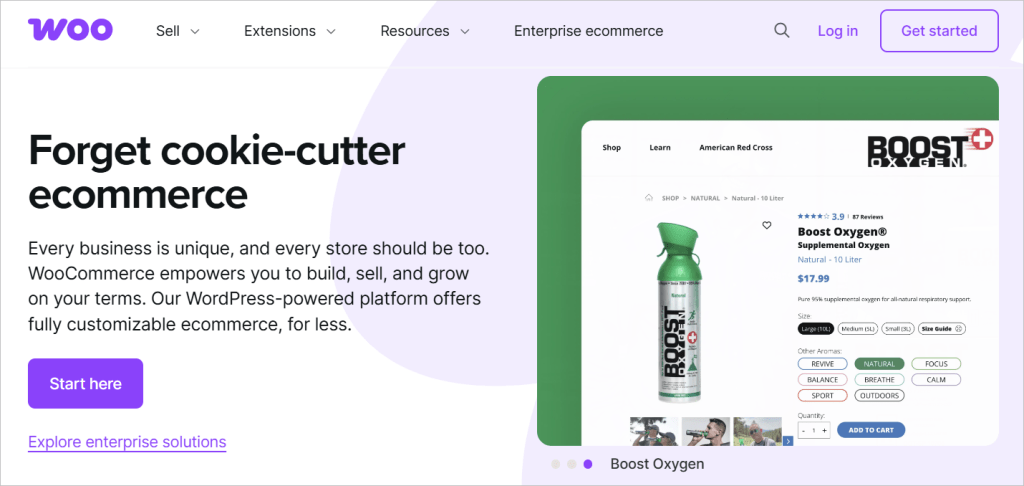
WooCommerce is a D2C ecommerce platform built on WordPress that gives brands full control over their online store. It is open source, which means you can customize every part of the shopping experience, from product pages to cart and checkout.
D2C brands can sell directly from their own website, manage payments, control shipping, and handle inventory without relying on third-party marketplaces.
WooCommerce supports multichannel selling, integrations with major carriers like USPS, UPS, and DHL, and advanced fulfillment workflows. With hundreds of extensions, block themes, APIs, and developer tools, brands can build a fully customized store that matches their operations, pricing, and growth strategy.
Key features of WooCommerce for D2C brands
- Build a fully customizable D2C store on WordPress with complete control over design, content, and functionality.
- Edit your entire site visually using Block Themes and modular blocks without coding.
- Customize cart and checkout pages to improve conversions and match your brand experience.
- Manage products, variations, pricing, and inventory directly from your WordPress dashboard.
- Accept secure online payments with WooPayments and integrations like Apple Pay and major gateways.
- Sync sales across your website, marketplaces, and social platforms using extensions.
- Access live shipping rates from carriers like USPS, UPS, and DHL and print labels from your dashboard.
- Automate fulfillment with order routing, split shipments, custom statuses, and branded packing slips.
- Extend functionality with hundreds of themes and extensions from the Woo Marketplace.
- Use APIs and developer tools to build advanced workflows, integrations, and enterprise-level customizations.
4. Wix eCommerce

Wix eCommerce is a D2C website builder that helps US brands create and manage their own online store without coding. It offers customizable templates, AI-powered design tools, and full control over product pages, cart, and checkout. D2C brands can sell physical products, digital goods, subscriptions, dropshipping items, and print-on-demand products from one dashboard.
Wix supports multichannel selling across your website, retail POS, and marketplaces like Amazon, eBay, Facebook, and TikTok. It also includes built-in SEO tools, email marketing, paid ads, social media features, and blogging to drive traffic and retention.
With secure hosting, PCI-compliant payments, real-time analytics, and scalable infrastructure, Wix helps D2C brands launch fast and grow without technical complexity.
Key Features of Wix eCommerce for D2C Brands
- Build a fully customized online store using drag and drop tools, AI design features, and mobile optimized templates.
- Sell on your website, social media platforms like Facebook and Instagram, and marketplaces such as Amazon and eBay from one dashboard.
- Accept global payments through Wix Payments or 80+ gateways with support for credit cards, PayPal, bank transfers, and buy now pay later options.
- Display prices in local currencies and translate your store into 180+ languages using Wix Multilingual.
- Automate international tax calculations with Avalara integration or set custom tax rules.
- Offer flexible shipping options, including region-based rates, weight-based pricing, free shipping, and live carrier rates via apps like Shippo and ShipStation.
- Sync online and offline sales using Wix POS with real-time inventory and order tracking.
5. Squarespace

Squarespace eCommerce is a D2C ecommerce platform built for brands that want strong design control and direct customer relationships. It offers professionally designed templates and an AI website builder so you can launch a store that reflects your brand identity. You can customize product pages, highlight related products, add upsells at checkout, and use AI to generate product descriptions faster.
The platform includes built-in shipping, tax management, order tracking, and inventory tools without relying on extra add-ons. You can accept online payments, use POS for in-person sales, and even create pay links or instant payouts to improve cash flow.
Key Features of Squarespace Online Stores for D2C Brands
- Customizable templates and AI powered site builder to create unique product pages and brand focused online stores.
- Mobile-optimized shopping layouts that ensure a smooth experience on phones and tablets.
- Built in product reviews to build trust and increase conversions.
- Unlimited products and easy inventory management directly from the dashboard.
- Flexible shipping options such as local delivery, pickup, and label printing.
- Central order management with customer profiles and branded notifications.
- Multiple payment options, in-person POS support, and customizable checkout experiences.
- Automatic tax calculation tools that work for your sales locations.
- Extensions and third-party integrations like Printful, Easyship, and LiveChat to expand store capabilities.
- Gift cards, subscriptions, and digital products to create repeat revenue streams.
- Pay links and Instant Payouts to help control cash flow.
6. Adobe Commerce

Adobe Commerce is an enterprise D2C ecommerce platform built for global brands that need full control, scalability, and deep personalization. It is a cloud native, composable solution that supports both B2C and B2B from one system. Brands can manage multiple storefronts, regions, languages, currencies, and business models from a single platform.
Adobe’s D2C commerce platform offers high-performance storefronts, AI-powered search and product recommendations, advanced catalog management, and deep integrations with ERP, CRM, PIM, and marketing systems. With headless commerce support, API first architecture, and event-driven extensibility, Adobe Commerce gives developers flexibility while enabling marketers to run personalized campaigns at scale.
Key Features of Adobe Commerce for D2C Brands
- Supports multi brand, multi site, and multi region operations from one centralized cloud platform.
- Manages large scale catalogs with millions of products, flexible pricing, and centralized merchandising.
- Uses AI powered search, personalized recommendations, and dynamic category merchandising to increase conversions and average order value.
- Delivers real time personalization using customer data integrations with Adobe Experience Cloud tools.
- Build headless storefronts using GraphQL APIs, REST APIs, and developer tools for complete front end flexibility.
- Integrates with ERP, CRM, OMS, PIM, SAP, Salesforce, Microsoft Dynamics, and other enterprise systems.
- Scale automatically during peak traffic with cloud native infrastructure and auto scaling services.
- Offers global payment support with PCI compliant processing, digital wallets, BNPL, and fraud protection.
- Monitor performance with advanced analytics dashboards, A/B testing, and commerce intelligence tools.
- Extend capabilities through event driven architecture, webhooks, and a large marketplace of integrations and extensions.
7. Shift4Shop
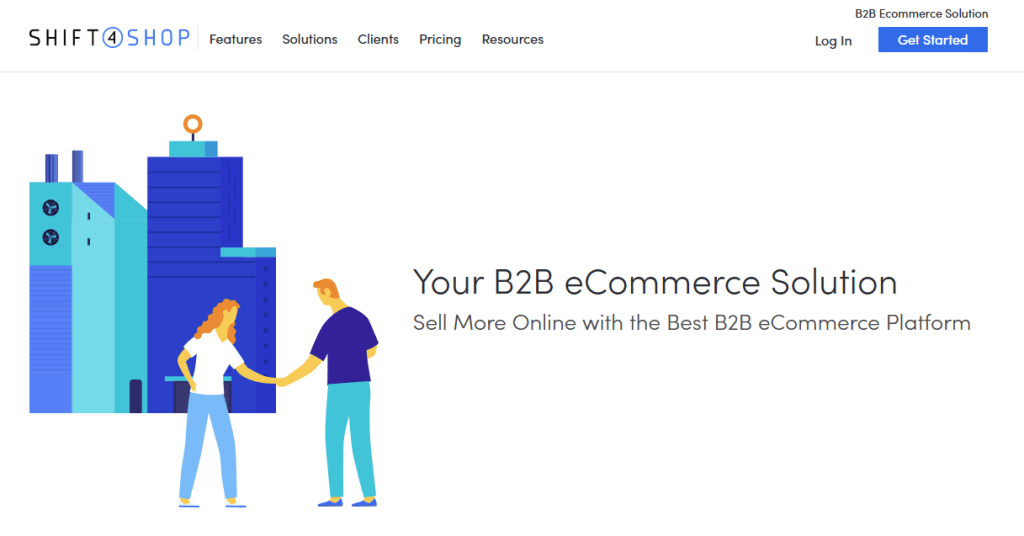
Shift4Shop is a B2B focused ecommerce platform built for wholesalers, manufacturers, and distributors that sell to other businesses online. It allows companies to run a dedicated B2B storefront or combine B2B and B2C sales from the same website. The platform supports custom pricing, bulk discounts, fast reordering, and flexible payment terms that match real-world B2B buying behavior.
It is designed to help suppliers give business buyers a smooth, self-service experience while maintaining control over pricing rules, tax settings, shipping logic, and customer access.
Key Features of Shift4Shop Shopping Cart Software
- Turn any website into a full online store without rebuilding from scratch.
- Choose a hosted platform that includes secure web hosting, automatic updates, and a browser-based admin dashboard.
- Sell unlimited products with no limits on categories, storage, or bandwidth.
- Avoid extra transaction fees beyond your payment processor charges.
- Access built in marketing tools including email newsletters, coupons, daily deals, wish lists, and abandoned cart recovery.
- Sell across channels by connecting to Facebook, Amazon, eBay, Google Shopping, and more from one dashboard.
- Accept payments instantly with credit cards, PayPal, Google Pay, Amazon Pay, and other gateways.
- Calculate real-time shipping rates and global tax rules at checkout.
- Integrate with hundreds of third-party tools for CRM, shipping, accounting, marketing, and automation.
- Automate workflows with rules that segment customers, update order status, and trigger campaigns.
- Use SmartCategories and SmartLists to dynamically group products and customers.
- Schedule automatic CSV exports for orders, customers, and inventory data.
- Send automated emails for welcome messages, review requests, back in stock alerts, reward points reminders, and abandoned carts.
- Connect with automation apps like Zapier and IFTTT to build custom workflows across tools.
Why choose RAAS Cloud for D2C eCommerce Platforms
Many D2C brands realize that choosing a platform is only the first step. The real challenge is building a store that loads fast, integrates with business systems, and scales as sales grow. That is where RAAS Cloud helps.
RAAS Cloud builds custom eCommerce solutions customised to your business model. The team works across Shopify, Magento, WooCommerce, BigCommerce, and custom stacks to design stores that are fast, secure, and easy to scale. They handle the entire development lifecycle, from UI UX design and integrations to platform migration and long-term support.
With a team of 50+ experts and dozens of successful projects, RAAS Cloud helps brands turn their stores into reliable growth engines.
Planning a new D2C store or scaling an existing one? Talk to RAAS Cloud to build the right eCommerce foundation.

Dhanalakshmi Kadirvelu is a Business Intelligence and Data Analytics expert with a strong focus on software development and data engineering. She creates efficient data models, builds interactive dashboards, and integrates analytics into software systems using Power BI, OBIEE, and SQL. Her work helps development teams use data effectively to create smarter software solutions and improve business performance.