AI customer service chatbots are helping businesses handle support faster while reducing operational costs. These systems can answer common questions, guide customers through tasks, and provide assistance around the clock.
However, the cost of building an AI chatbot can vary widely depending on its capabilities. A simple FAQ chatbot may cost only a few thousand dollars, while advanced AI chatbots powered by large language models can require much larger investments.
In this comprehensive guide, we break down the factors that influence chatbot development costs.
What Is the Average Cost to Build an AI Customer Service Chatbot in 2026?
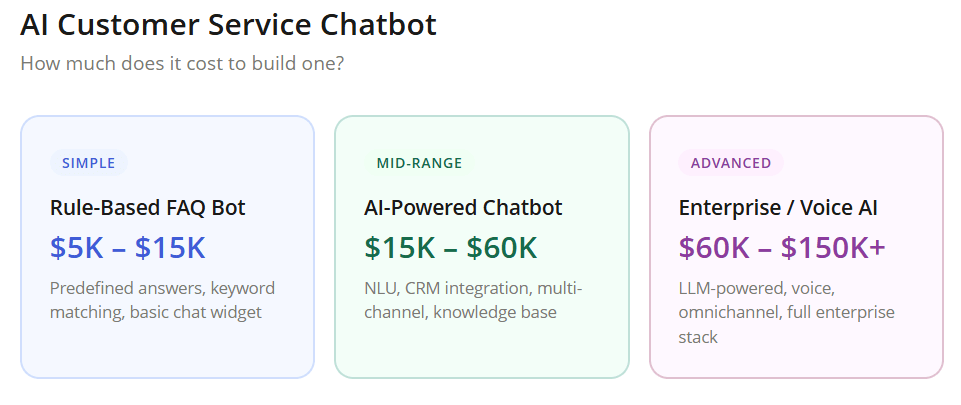
The average cost to build an AI customer service chatbot in 2026 ranges from $5,000 to $150,000 or more, depending on complexity.
Simple rule-based chatbots that answer predefined questions usually cost $5,000 to $15,000, while advanced AI chatbots powered by large language models can exceed $60,000 to $150,000+ due to training, integrations, and infrastructure.
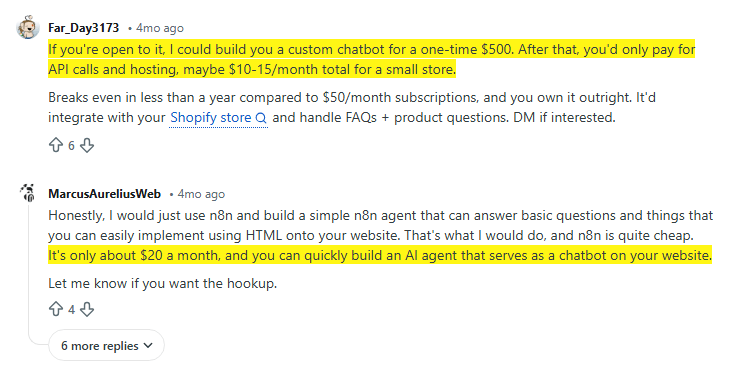
In some small-business cases, very basic FAQ bots can be built for a few hundred dollars, but these solutions offer limited functionality. The final cost largely depends on AI capability, system integrations, deployment channels, and customization requirements.
Here’s what experts on reddit suggests to small businesses at their initial stages:
Core Features That Influence AI Chatbot Development Cost
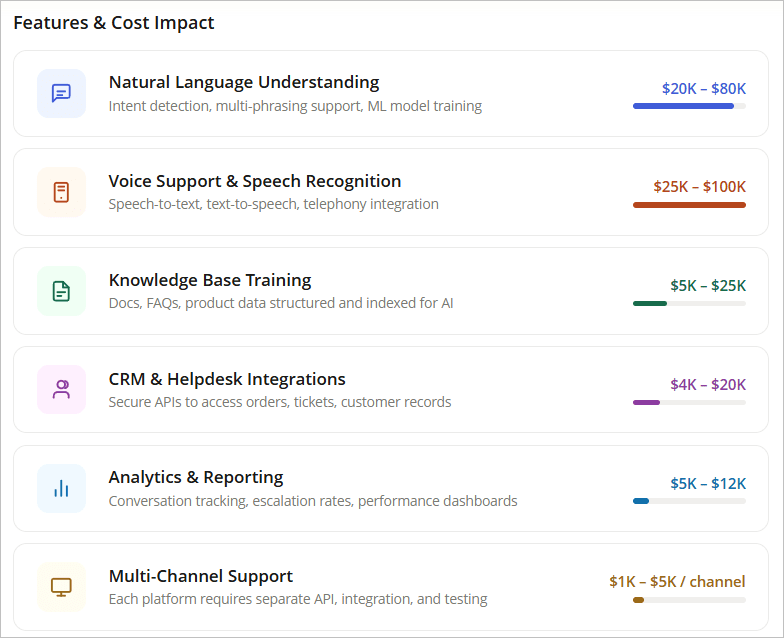
The cost of an AI customer service chatbot largely depends on the features it includes. A basic chatbot that answers simple FAQs can be built quickly and at a lower cost. However, when businesses want the chatbot to understand natural language, access customer data, or support multiple communication channels, the development effort increases.
Each added feature requires additional development, integration work, testing, and sometimes AI model training. Below are the core features that typically influence the cost of building an AI customer service chatbot.
Natural Language Understanding
Natural Language Understanding allows a chatbot to understand what a user actually means when they type a question. Instead of matching exact keywords, the chatbot identifies the intent behind the message.
For example, customers might ask the same question in different ways, such as “Where is my order?”, “Track my delivery”, or “Has my package shipped yet?”. A chatbot with strong language understanding can recognize that all these queries relate to order tracking and respond correctly.
This capability relies on machine learning models and language processing systems that analyze user inputs and classify intent. The chatbot must also be trained on example conversations to learn how customers typically phrase their questions.
Cost impact: Implementing advanced NLP or NLU capabilities can add $20,000 to $80,000 to development costs, depending on the level of customization.
Multi Channel Support (Website, WhatsApp, Messenger)
Modern customer service does not happen on a single platform. Customers may start a conversation on a website chat widget and later continue it through messaging platforms like WhatsApp or Facebook Messenger.
Businesses often want their chatbot to be available across several communication channels so customers can reach support wherever they prefer. This requires the chatbot to connect with different messaging APIs and manage conversations across platforms.
Each platform has its own technical requirements, message formats, authentication systems, and limitations. Developers must integrate the chatbot with each platform, ensure that conversations remain synchronized, and test the experience across every channel.
Cost impact: Each additional channel increases integration complexity and can significantly raise development costs.
CRM and Helpdesk Integrations
A chatbot becomes much more powerful when it connects with internal business systems such as CRM software or helpdesk platforms.
Without integration, a chatbot can only answer general questions. When connected to internal systems, it can perform real customer service actions.
For example, the chatbot can:
- Look up customer account details
- Check order status or delivery updates
- Create support tickets automatically
- Update customer records in the CRM
These integrations allow the chatbot to resolve real customer issues instead of only providing general information.
However, connecting multiple systems requires secure APIs, data mapping, and authentication layers. Developers must ensure that customer data is accessed safely and that the chatbot can retrieve information quickly during conversations.
Cost impact: Backend system integrations can add $4,000 to $20,000 or more, depending on the complexity of the systems involved.
Knowledge Base Training
AI chatbots rely heavily on knowledge bases to answer customer questions accurately. This knowledge base typically includes company documentation, support articles, FAQs, product descriptions, and policies.
Before the chatbot can provide useful responses, this information must be organized and prepared for AI training. Developers often structure the content, convert documents into searchable data, and connect it with the chatbot’s AI model.
The chatbot also needs testing to ensure it retrieves the correct information when users ask questions. If responses are inaccurate, the knowledge base may need further refinement.
For businesses with large product catalogs or extensive documentation, preparing and optimizing this knowledge base can take significant time.
Cost impact: Knowledge base preparation and AI training can add $5,000 to $25,000, depending on content volume and domain complexity.
Voice Support and Speech Recognition
Some companies extend their chatbot into voice-based systems, especially for call centers or voice-enabled applications. Voice support allows customers to speak instead of typing messages.
In these systems, speech recognition converts spoken words into text that the AI can understand. The chatbot then processes the request and generates a spoken response using text-to-speech technology.
Voice-enabled chatbots are commonly used in automated phone systems where customers call a support line and interact with an AI assistant.
Developing this functionality requires speech recognition services, voice synthesis tools, and telephony integrations. It also requires additional testing to ensure the system understands different accents and speaking styles.
Cost impact: Adding voice capabilities can increase development costs by $25,000 to $100,000, depending on the sophistication of the voice AI system.
Analytics and Reporting
Businesses need to understand how well their chatbot performs after deployment. Analytics and reporting tools provide insights into chatbot usage and customer behavior.
For example, analytics dashboards can show:
- How many conversations does the chatbot handles
- The most common customer questions
- How often do conversations escalate to human agents
- The chatbot’s success rate in resolving issues
These insights help businesses improve the chatbot over time. If analytics show that certain questions frequently confuse, the company can update the knowledge base or adjust the chatbot’s responses.
Developing analytics systems requires tracking conversation data, building reporting dashboards, and storing performance metrics.
Cost impact: Implementing advanced analytics and reporting systems increases development complexity and infrastructure requirements.
Key Features That Impact AI Chatbot Development Cost
| Feature | Why It Increases Cost | Typical Cost Impact |
| Natural language understanding | Requires AI models, training data, and intent detection systems to interpret different customer queries. | $20,000 – $80,000 |
| Multi-channel support | Each channel, such as a website, WhatsApp, or Messenger, requires separate APIs, integration, and testing. | $1,000 – $5,000 per channel |
| CRM and helpdesk integrations | Secure API connections and data mapping are needed to access customer records, orders, and support tickets. | $4,000 – $20,000+ |
| Knowledge base training | Company documents, FAQs, and product data must be structured, indexed, and optimized for AI responses. | $5,000 – $25,000 |
| Voice support and speech recognition | Requires speech recognition systems, voice generation tools, and telephony integrations. | $25,000 – $100,000 |
| Analytics and reporting | Needs conversation tracking, performance monitoring, and custom reporting dashboards. | $5,000 – $12,000 |
Chatbot Deployment Channels and Their Cost Impact
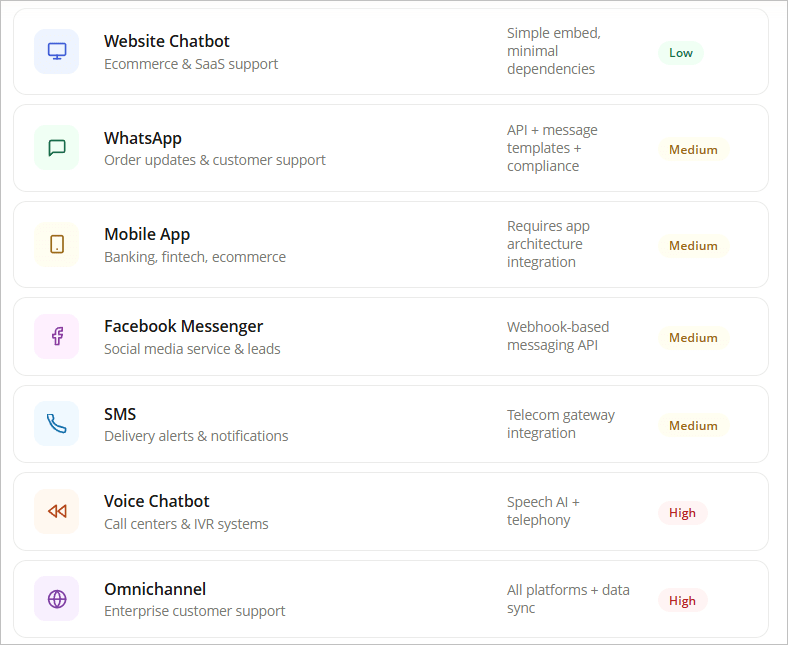
Here are the deployment channels at a glance:
Website Chatbot
A website chatbot is embedded directly into a company’s website using a chat widget. Visitors can ask questions, track orders, or get support without leaving the page. Most businesses start with this channel because it is easy to deploy and works well for FAQs, product questions, and basic support automation.
Cost impact: Usually the lowest cost because integration is simple and requires minimal platform dependencies.
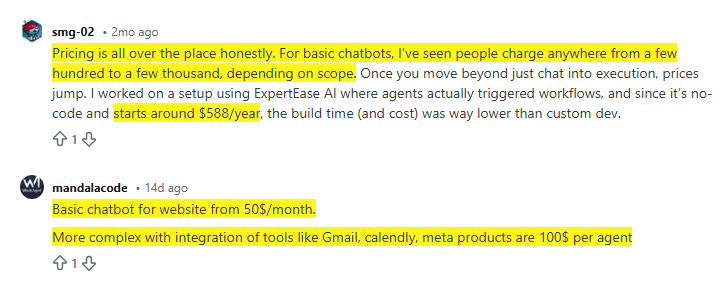
Here’s what experts on Reddit say about the pricing of developing chatbots:
WhatsApp Chatbot
A WhatsApp chatbot allows businesses to communicate with customers through the WhatsApp Business API. It can answer questions, send order updates, and handle customer inquiries directly within the messaging app. Since WhatsApp is widely used for customer communication, many ecommerce and service businesses prioritize this channel.
Cost impact: Medium cost due to API integration, message templates, and platform compliance requirements.
Mobile App Chatbot
A mobile app chatbot is built directly inside a company’s Android or iOS application. It allows users to get support without leaving the app. Businesses often use these chatbots for banking apps, ecommerce apps, and service platforms where customers frequently interact with the mobile interface.
Cost impact: Medium cost because it requires integration with the mobile app architecture and ongoing updates with app releases.
Facebook Messenger Chatbot
Messenger chatbots connect to a company’s Facebook page and automate conversations with users who contact the business through social media. These chatbots are often used for customer inquiries, lead generation, and quick product support.
Cost impact: Medium cost because developers must integrate with Messenger APIs and manage webhook-based messaging systems.
SMS Chatbot
SMS chatbots communicate with users through standard text messages using telecom gateways or messaging APIs. Businesses often use them for notifications, appointment reminders, and service updates because SMS works on almost all mobile devices.
Cost impact: Medium cost due to telecom integrations and ongoing messaging infrastructure costs.
Voice Chatbot
Voice chatbots allow users to interact with AI using spoken commands instead of typing messages. They rely on speech recognition and voice synthesis technologies. These chatbots are commonly used in automated phone systems, call centers, and voice assistants.
Cost impact: High, as voice processing, telephony integration, and speech recognition systems add significant complexity.
Omnichannel Chatbot
An omnichannel chatbot operates across multiple platforms, including websites, messaging apps, mobile apps, and voice systems. It maintains consistent conversations across channels and often integrates with enterprise systems like CRM and support platforms.
Cost impact: High cost due to multiple platform integrations, data synchronization, and more complex infrastructure.
| Channel | What It Means | Typical Use Case | Cost Impact |
| Website chatbot | Embedded support chat on a website | Ecommerce and SaaS support | Low to Medium |
| WhatsApp chatbot | Messaging-based chatbot through WhatsApp | Order updates and customer support | Medium |
| Mobile app chatbot | Chatbot built directly inside mobile apps | Banking, fintech, and ecommerce apps | Medium |
| Facebook Messenger chatbot | Chatbot connected to Facebook Messenger | Social media customer service | Medium |
| SMS chatbot | Automated chatbot through text messaging | Delivery alerts and service notifications | Medium |
| Voice chatbot | Voice-based AI assistant using speech recognition | Call centers and IVR systems | High |
| Omnichannel chatbot | Chatbot that works across multiple platforms | Enterprise customer support | High |
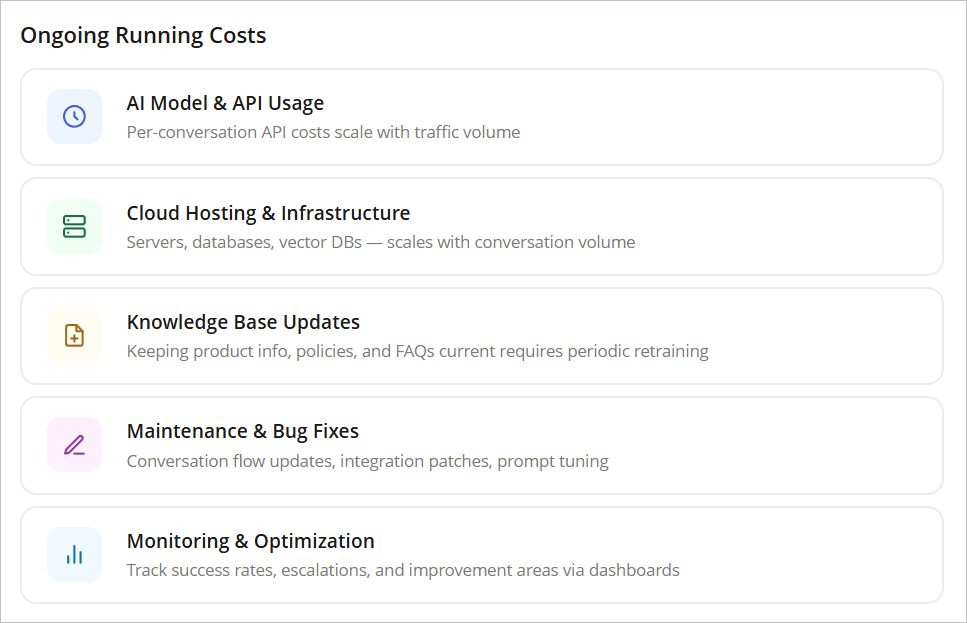
Ongoing Costs of Running an AI Customer Service Chatbot
AI Model and API Usage
Many modern chatbots rely on AI models through APIs to understand queries and generate responses. Each interaction consumes processing resources, which creates usage-based costs. Businesses with high customer traffic may see higher AI processing expenses as conversation volume grows.
Cloud Hosting and Infrastructure
Chatbots require cloud servers to store data, run applications, and manage conversations. Infrastructure may include application servers, databases, and sometimes vector databases used for AI search and knowledge retrieval. As chatbot traffic increases, businesses may need to scale their infrastructure to maintain fast response times.
Maintenance and System Updates
AI chatbots require continuous maintenance to ensure reliable performance. Developers regularly update conversation flows, fix bugs, improve prompts, and update integrations with other systems. Without regular maintenance, chatbot accuracy and performance can decline over time.
Knowledge Base Updates
Businesses often update product information, policies, and support documentation. These changes must be reflected in the chatbot’s knowledge base to keep responses accurate. Maintaining and expanding this content requires periodic review and retraining of the AI system.
Monitoring and Performance Optimization
Companies typically monitor chatbot performance to understand how customers interact with the system. Monitoring tools track conversation success rates, common queries, and areas where the chatbot fails to resolve issues. These insights help teams improve the chatbot and maintain a good customer experience.
How RAAS Cloud helped a healthcare company build a AI chatbot for customer support
A healthcare provider approached RAAS Cloud because their existing chatbot could only answer basic FAQ questions. Most patient conversations still needed human agents, which slowed response times and increased support costs.
The organization wanted a smarter chatbot that could understand real patient queries and automatically handle common requests.
RAAS Cloud designed and deployed an AI-powered chatbot trained on healthcare-related conversations. The system can answer patient questions, help schedule or reschedule appointments, and guide users through billing or prescription inquiries. The chatbot was integrated with the client’s CRM and appointment systems and deployed across the website, mobile app, and WhatsApp.
Today, the chatbot resolves most routine patient queries instantly, allowing support teams to focus on more complex cases.If you are planning to build an AI chatbot for your business, contact RAAS Cloud. We work with experienced developers who can help you design a solution that truly improves customer support.

Dhanalakshmi Kadirvelu is a Business Intelligence and Data Analytics expert with a strong focus on software development and data engineering. She creates efficient data models, builds interactive dashboards, and integrates analytics into software systems using Power BI, OBIEE, and SQL. Her work helps development teams use data effectively to create smarter software solutions and improve business performance.