

React continues to dominate the frontend ecosystem in 2025 and early 2026. According to the Stack Overflow Developer Survey 2025, React remains the most widely used web framework, with usage levels reported around 44–45% among developers, holding its position as the industry default for modern web applications.
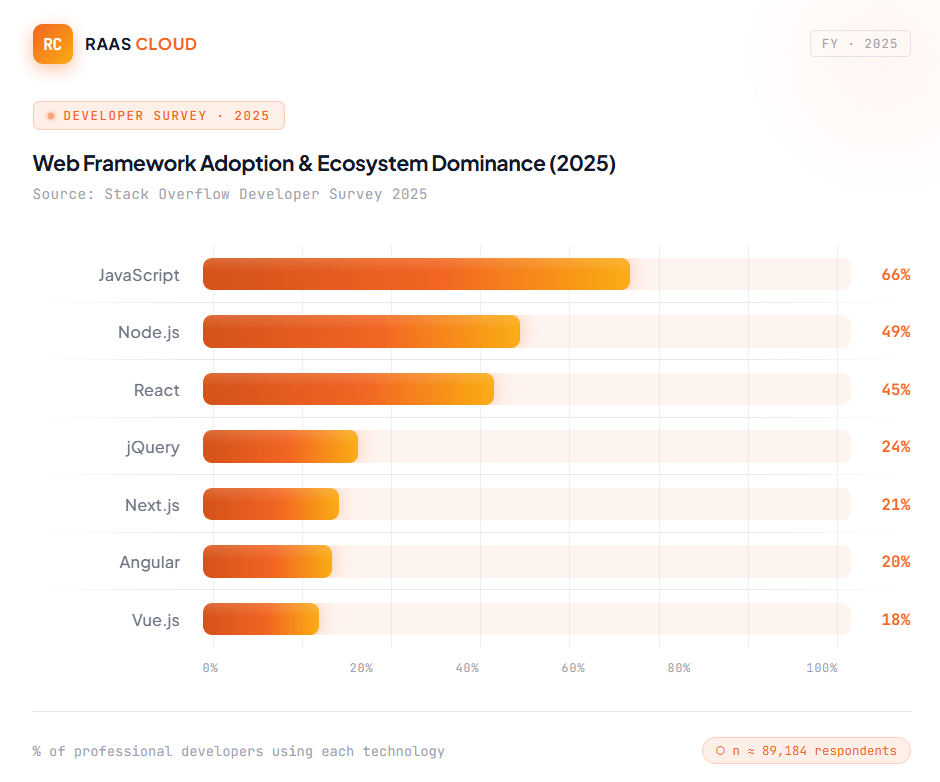
At the same time, JavaScript itself is used by nearly 66% of developers globally, reinforcing the overall dominance of the React-led ecosystem in frontend development.
This widespread adoption has made React the go-to choice for many founders starting new products.
However, popularity does not always mean suitability.
Recent industry analysis and startup reports continue to highlight a recurring pattern: early-stage teams often adopt complex technologies too soon. Studies referenced in startup research (including insights from CB Insights) show that over-engineering and premature scaling remain key contributors to delays, higher costs, and failed product iterations.
React is a powerful tool, but like any tool, its effectiveness depends entirely on context.
Understanding when not to use React is just as important as knowing when it is the right choice.
When You Should NOT Use React
React is a powerful library, but it is not always the most efficient choice for every type of project. In certain scenarios, using React can introduce unnecessary complexity, increase development time, and add overhead that does not contribute to the actual goals of the product. Understanding these situations helps founders make more practical and cost-effective decisions.
1. When Your Product is a Simple or Static Website
If you are building a basic website such as a landing page, portfolio, or informational site, React is often more than what is actually required. These types of projects typically do not involve complex user interactions, dynamic state management, or real-time updates areas where React truly excels.
Introducing React in such scenarios can add layers of complexity that do not provide proportional value. It increases the need for build tools, dependency management, and ongoing maintenance, all of which can slow down development and increase costs. In contrast, simpler approaches such as static site generators or lightweight frameworks can deliver the same outcome more efficiently.
For founders, this often comes down to a simple trade-off: if the product does not behave like an application, it does not need to be built like one.
2. When Speed of Launch is Your Top Priority
In the early stages of a startup, speed is often more important than perfect architecture. The goal is to validate the idea, gather feedback, and iterate quickly. In such cases, introducing React can sometimes slow things down, particularly if the team needs to set up the project structure, manage components, and handle state management from the beginning.
This does not mean React is inherently slow, but it does require a certain level of setup and planning to be used effectively. For teams working under tight timelines, simpler solutions can help achieve faster initial releases without compromising the ability to pivot.
React becomes more valuable once the product has validated demand and begins to scale. At that point, its structure and flexibility start to provide long-term benefits that justify the initial investment.
3. When Your Team Lacks React Expertise
Technology decisions should always take into account the strengths and experience of the team building the product. While React is widely used, it still requires a solid understanding of concepts such as component architecture, state management, and performance optimization.
When teams adopt React without sufficient experience, they often end up creating codebases that are difficult to maintain. Components may become overly complex, state may be handled inefficiently, and performance issues can arise as the application grows.
These challenges are not immediately visible, but they accumulate over time and lead to higher maintenance costs and slower development cycles. In such situations, choosing a simpler technology that aligns with the team’s existing expertise can lead to better outcomes.
Working with experienced React developers can help avoid these issues and ensure a cleaner, scalable codebase from the start.
4. When the Application is Small and Unlikely to Scale
Not every product is designed to grow into a large, complex application. Some internal tools, small business applications, or limited-scope products are built to serve a specific purpose without significant expansion.
Using React in these cases can introduce unnecessary overhead. The benefits of component-based architecture and scalability may never be fully realized, while the complexity remains.
For smaller applications, simplicity often leads to better maintainability. A lightweight approach allows teams to focus on functionality without managing the additional layers that come with a larger framework.
5. When SEO is Critical but Not Properly Planned
React applications can perform well for SEO, but this requires the right implementation strategy. Without server-side rendering or proper optimization, React-based websites may face challenges with indexing and initial load performance.
For content-heavy platforms where search visibility is a primary driver of traffic, these issues can have a direct impact on growth. If SEO is a critical requirement, it is important to either implement React with the right tools or consider alternatives that are inherently optimized for search engines.
This is not a limitation of React itself, but rather a reminder that the technology needs to be implemented correctly to achieve the desired results.
6. When Your Product Does Not Require High Interactivity
React is designed for applications that involve frequent updates, dynamic user interfaces, and complex interactions. Dashboards, real-time platforms, and highly interactive applications benefit greatly from its capabilities.
However, if your product does not require this level of interactivity, you may not be leveraging React’s strengths. In such cases, simpler technologies can achieve the same outcome with less effort and fewer resources.
Choosing React for a low-interactivity product can result in a mismatch between the tool and the problem, leading to inefficiencies in both development and maintenance.
The Real Problem: Choosing Based on Trends
One of the most common reasons founders choose React is not because of specific product requirements, but because it is widely used and recommended. It has become a default choice in many development discussions, which can create the impression that it is always the right option.
However, technology decisions should never be driven by trends alone.
When decisions are made without a clear understanding of the product’s needs, the consequences often appear later in the form of increased complexity, higher costs, and scalability challenges. These issues are not always immediate, but they can significantly impact the product as it grows.
The better approach is to evaluate the problem first and then choose the technology that aligns with it. This ensures that the product is built efficiently from the start and can evolve without unnecessary rework.
When React Actually Makes Sense
While there are clear scenarios where React may not be the best choice, there are many cases where it provides significant advantages.
React is particularly effective for products that require scalability, dynamic user interfaces, and continuous interaction. Applications such as SaaS platforms, dashboards, and real-time systems benefit from its component-based architecture and flexibility.
In these situations, React enables teams to build structured, maintainable, and scalable applications that can grow with the business. Its ecosystem and community support also make it easier to extend functionality and adopt best practices.
The key is to use React where its strengths are truly needed, rather than applying it universally.
Making the Right Technology Decision
Choosing the right technology is less about selecting the most popular option and more about understanding what your product actually requires. This involves evaluating factors such as complexity, scalability, timeline, and team expertise.
A well-informed decision at the beginning can save significant time and cost in the long run. It allows teams to focus on building the product rather than managing unnecessary complexity.
For founders, this often means taking a step back and asking whether the chosen technology aligns with the current stage of the product, rather than its potential future state.
How RAAS Cloud Helps You Build the Right Way
Making the right technology decision is not always straightforward, especially when balancing speed, cost, and long-term scalability. This is where having the right technical guidance becomes valuable.
Being a leading ReactJS development company, RAAS Cloud works with startups and enterprises to ensure that frontend architecture decisions are aligned with business goals. Whether it involves evaluating if React is the right fit, building scalable applications, or providing dedicated ReactJS developers, the focus is always on creating solutions that support growth without unnecessary complexity.
Instead of defaulting to a specific technology, the approach is centered around choosing what works best for the product. When React is the right choice, it can unlock performance and scalability. When it is not, a simpler approach can deliver faster and more efficient results.

Not Sure If React Is Right for Your Product?
We help founders pick the right tech stack from day one — so you don’t waste months rebuilding. Get expert advice before you commit.
Free consultation · No commitment
Further Resources:
- Top 7 ReactJS Development Companies in Florida
- Top Platforms to Hire Pre-Vetted Remote React Developers in the US
What This Means for Founders
React is not a one-size-fits-all solution. It is a powerful framework that delivers significant value when used in the right context, but it can also introduce challenges when applied without clear reasoning.
The difference lies in how the decision is made.
Founders who focus on aligning technology with product needs are more likely to build systems that are efficient, scalable, and easier to maintain. Those who follow trends without context often face unnecessary complexity later.
In the end, it is not about choosing React or not choosing it. It is about choosing what makes the most sense for the product you are building.

Dhanalakshmi Kadirvelu is a Business Intelligence and Data Analytics expert with a strong focus on software development and data engineering. She creates efficient data models, builds interactive dashboards, and integrates analytics into software systems using Power BI, OBIEE, and SQL. Her work helps development teams use data effectively to create smarter software solutions and improve business performance.