
For the last few years, logistics companies have been under constant pressure. Rising fuel costs because of the West Asia situation, increasing delivery expectations, driver shortages, supply chain disruptions, and growing operational expenses have made logistics operations much harder to manage.
At the same time, customer preferences have also changed. Businesses and consumers now expect faster deliveries, accurate tracking, real-time updates, and fewer delays. Even a small operational issue can affect customer satisfaction and overall profitability.
One thing that can help logistics companies handle many of these challenges is artificial intelligence. While AI cannot completely replace operations teams, drivers, warehouse staff, or supply chain managers, it can help companies in different ways.
The problem is that there is too much noise around AI right now. Many companies talk about AI without explaining how it actually helps logistics businesses in real operations.
To help logistics companies understand what truly works, our team spoke with AI experts, studied current logistics trends, and analyzed practical use cases already being adopted across the industry. Based on these insights, we prepared this guide to help you focus on AI use cases that can deliver measurable business outcomes and help you get started with the right priorities in 2026.
What Makes AI Valuable For Logistics Companies
AI is helping almost every industry improve efficiency and decision-making, but its impact is especially significant in logistics. Logistics companies deal with massive amounts of operational data every day, from shipments and delivery routes to warehouse operations, fleet tracking, inventory movement, and customer communication.
There are also many repetitive and time-consuming processes in logistics that can now be automated or improved using AI. This helps companies reduce manual work, improve operational visibility, and make faster decisions.
Here are some of the biggest advantages AI offers logistics companies:
- Faster route planning
- Reduced fuel costs
- Better delivery accuracy
- Real-time shipment tracking
- Predictive maintenance
- Improved warehouse efficiency
- Smarter demand forecasting
- Reduced operational delays
- Faster customer support
- Improved supply chain visibility
- Better fraud detection
- Improved driver safety
- Data-driven decision making
Now let us look at the key AI use cases helping logistics companies improve operations and reduce costs.
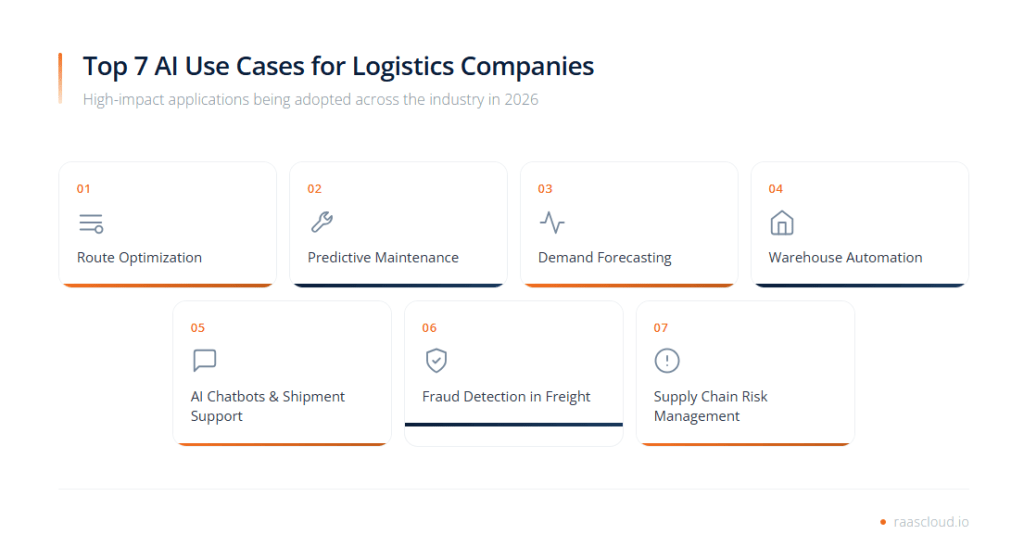
Top AI Use Cases For Logistics Companies In 2026
Below are some of the most practical and high-impact AI use cases helping logistics businesses improve efficiency, reduce costs, and make faster operational decisions in 2026.
1. AI-Powered Route Optimization
For logistics companies that operate large fleets, transportation is usually the most significant operational cost. In many cases, it contributes nearly 58% of the total logistics cost. Traffic unpredictability, delivery delays, fuel price fluctuations, poor route planning, idle time, and inefficient dispatching make transportation management even more challenging.
This is where AI-powered route optimization is helping logistics companies improve efficiency and reduce operational costs. Instead of relying only on manual planning or static maps, AI can analyze real-time conditions and suggest better delivery routes automatically.
How AI Can Help In Route Optimization
- Real-time traffic analysis
- Dynamic route adjustments
- Fuel-efficient route planning
- Multi-stop delivery optimization
- Weather-aware route suggestions
Key KPIs To Track
- Fuel consumption
- On-time delivery rate
- Average delivery time
- Fleet idle time
- Cost per delivery
Tools To Start With
Onfleet, OptimoRoute, Routific, FarEye
2. Predictive Maintenance For Fleet Management
Fleet management is one of the most critical parts of logistics operations. Reactive maintenance is always expensive because unexpected vehicle breakdowns can lead to delivery disruptions, higher repair costs, delayed shipments, and reduced fleet availability. Even a single vehicle issue can affect multiple deliveries and overall operational efficiency.
AI helps logistics companies move from reactive maintenance to predictive maintenance. Instead of waiting for a vehicle to fail, AI systems can analyze vehicle data and identify early warning signs before major issues happen.
How AI Predicts Vehicle Failures
- Engine performance monitoring
- Tire wear analysis
- Battery health tracking
- Driver behavior monitoring
- Sensor-based fault detection
Key KPIs To Track
- Fleet downtime
- Maintenance costs
- Vehicle utilization rate
- Breakdown frequency
- Average repair time
Tools To Start With
Samsara, Geotab, Fleetio, Verizon Connect
3. AI Demand Forecasting For Inventory & Supply Chain Planning
AI demand forecasting is one of the classic AI use cases in logistics and supply chain management. Many logistics companies struggle with sudden demand fluctuations, inaccurate inventory planning, and supply chain inefficiencies.
During peak seasons, fuel surcharges, labor costs, and expedited shipping fees usually increase significantly. Truck availability becomes limited and shipping lanes get congested, leading to inflated operational costs across the supply chain.
Because of this, it is always suggested for logistics companies to improve demand forecasting and inventory planning before peak demand periods instead of reacting after disruptions happen. This is where AI can help by analyzing historical trends, seasonal patterns, operational data, and external factors to predict future demand more accurately.
How AI Forecasting Works
- Historical sales and shipment analysis
- Seasonal demand prediction
- Regional demand pattern analysis
- External market trend monitoring
- Real-time inventory forecasting
Key KPIs To Track
- Forecast accuracy
- Inventory holding costs
- Stockout rate
- Warehouse utilization
- Order fulfillment rate
Tools To Start With
Blue Yonder, SAP IBP, Oracle Demand Management, Kinaxis RapidResponse
4. AI In Warehouse Automation
Warehouse automation is already a multi-billion-dollar industry, and AI has made it even more efficient and scalable. Modern warehouses handle thousands of inventory movements, picking operations, packaging tasks, and shipment processes every day. Managing all of this manually often leads to delays, inventory errors, and operational inefficiencies.
AI is helping warehouses improve speed, accuracy, inventory visibility, and workforce productivity. Instead of relying only on manual processes, warehouses can now use AI systems to optimize operations in real time.
AI Use Cases Inside Warehouses
- Smart inventory placement
- AI-powered picking optimization
- Automated inventory tracking
- Warehouse robotics coordination
- Demand-based stock allocation
Key KPIs To Track
- Order picking accuracy
- Inventory accuracy
- Warehouse throughput
- Average fulfillment time
- Labor productivity
Tools To Start With
Locus Robotics, Zebra Technologies, GreyOrange, Manhattan Associates
5. AI Chatbots & Virtual Assistants For Shipment Support
For direct customer-facing operations, AI chatbots and virtual assistants are becoming highly valuable for logistics companies. Customers today expect quick shipment updates, accurate delivery timelines, and faster support responses. Managing thousands of shipment-related queries manually can increase operational workload and support costs.
AI-powered support systems help logistics companies automate customer communication, improve response time, and provide real-time shipment assistance without depending completely on manual support teams.
How Logistics Companies Use AI Support Systems
- Automated shipment tracking support
- Real-time delivery status updates
- AI-powered customer query handling
- Internal operations assistance
- Smart delivery ETA communication
Key KPIs To Track
- Average response time
- Customer satisfaction score
- Ticket resolution time
- Support cost reduction
- Query automation rate
Tools To Start With
Intercom AI, Zendesk AI, Freshdesk Freddy AI, Salesforce Einstein
We at RAAS Cloud are experts at building AI chatbots and virtual AI agents for logistics companies. We recently completed AI agent implementation for a global logistics company and helped them improve operational efficiency by nearly 3X while achieving around 93% response accuracy across shipment support workflows.
Further Resources on this:
- How Much Does It Cost To Build An AI Customer Service Chatbot?
- How to Build an AI Agent for Customer Support For Your Small Business
6. AI-Based Fraud Detection In Logistics & Freight
According to the Homeland Security Investigations agency, broker fraud, shipment interception, and other forms of cargo theft cost global supply chains up to $35 billion annually. As logistics operations become more digital and interconnected, fraud risks are also increasing across freight management, transportation, warehousing, and cross-border shipping.
AI is helping logistics companies identify suspicious activities faster and reduce operational risks before major losses happen. Instead of relying only on manual audits and reactive investigations, AI systems can continuously monitor operational patterns and detect anomalies in real time.
How AI Detects Anomalies
- Suspicious shipment activity detection
- Route deviation monitoring
- Invoice and billing anomaly detection
- Unusual driver behavior analysis
- Real-time cargo risk alerts
Industries Where This Is Becoming Critical
- Pharmaceutical logistics
- High-value electronics shipping
- Retail supply chains
- Cross-border freight operations
- Cold chain logistics
Key KPIs To Track
- Fraud incident rate
- Cargo theft losses
- False alert percentage
- Investigation response time
- Risk detection accuracy
Tools To Start With
Overhaul, project44, FourKites, Samsara
7. AI-Powered Supply Chain Risk Management
Supply chain risks have increased significantly over the last few years because of geopolitical instability, port congestion, supplier disruptions, weather events, labor shortages, and global transportation delays. Many logistics companies still struggle with limited visibility across their supply chain operations, making it difficult to identify risks before they impact deliveries and operational costs.
Even most companies that we have worked with in the last 5 years faced challenges related to delayed shipments, inventory uncertainty, and unpredictable supplier issues. By implementing AI-driven monitoring and forecasting systems, we helped them improve operational planning, identify risks earlier, and make faster supply chain decisions.
How AI Predicts Risks
- Supplier risk analysis
- Shipment delay prediction
- Port congestion monitoring
- Weather disruption forecasting
- Real-time supply chain alerts
Key KPIs To Track
- Supply chain disruption rate
- Delay prediction accuracy
- Supplier performance score
- Shipment visibility rate
- Risk response time
Tools To Start With
Resilinc, Everstream Analytics, project44, FourKites

AI Agents That Support Your Customers 24/7
We build intelligent AI solutions for small businesses — from customer support bots to fully automated workflows that save you time and money.
Free consultation · No commitment
Real-World AI Case Studies In Logistics
Let us look at how logistics companies across the globe are using AI to improve operations, reduce costs, and solve real supply chain challenges.
1. UPS Uses AI-Powered ORION System For Route Optimization
One of the most well-known examples of AI implementation in logistics is UPS’s ORION system. ORION, which stands for On-Road Integrated Optimization and Navigation, uses AI, machine learning, GPS data, traffic conditions, and delivery information to optimize delivery routes for drivers in real time.
According to UPS, the ORION system helps the company cut nearly 100 million miles from delivery routes every year. It also saves around 10 million gallons of fuel annually and reduces CO2 emissions by nearly 100,000 metric tons per year. Beyond sustainability benefits, the system also helps UPS improve delivery efficiency and reduce operational costs at a massive scale.
2. Walmart Uses AI For Demand Forecasting & Supply Chain Optimization
Walmart has heavily invested in AI-driven demand forecasting and supply chain optimization to improve inventory planning across its massive retail network. By using AI to analyze purchasing behavior, seasonal trends, regional demand patterns, and real-time supply chain data, Walmart reportedly achieved nearly 90% inventory forecasting accuracy.
3. DHL Improves Warehouse Efficiency Using AI
DHL is another major example of AI adoption in logistics operations. The company uses AI across warehouse automation, demand forecasting, shipment visibility, and operational planning.
By implementing AI-powered forecasting and warehouse intelligence systems, DHL reduced forecast errors by nearly 40% while improving warehouse productivity by around 35%. The company also achieved approximately 99.7% order accuracy in several warehouse operations through AI-assisted inventory management and automation systems.
How Logistics Companies Can Successfully Implement AI
Based on our experience of helping 30+ logistics companies implement AI solutions from scratch, one thing is very clear. Companies that approach AI with a practical operational strategy usually achieve better results compared to businesses that try to automate everything at once.
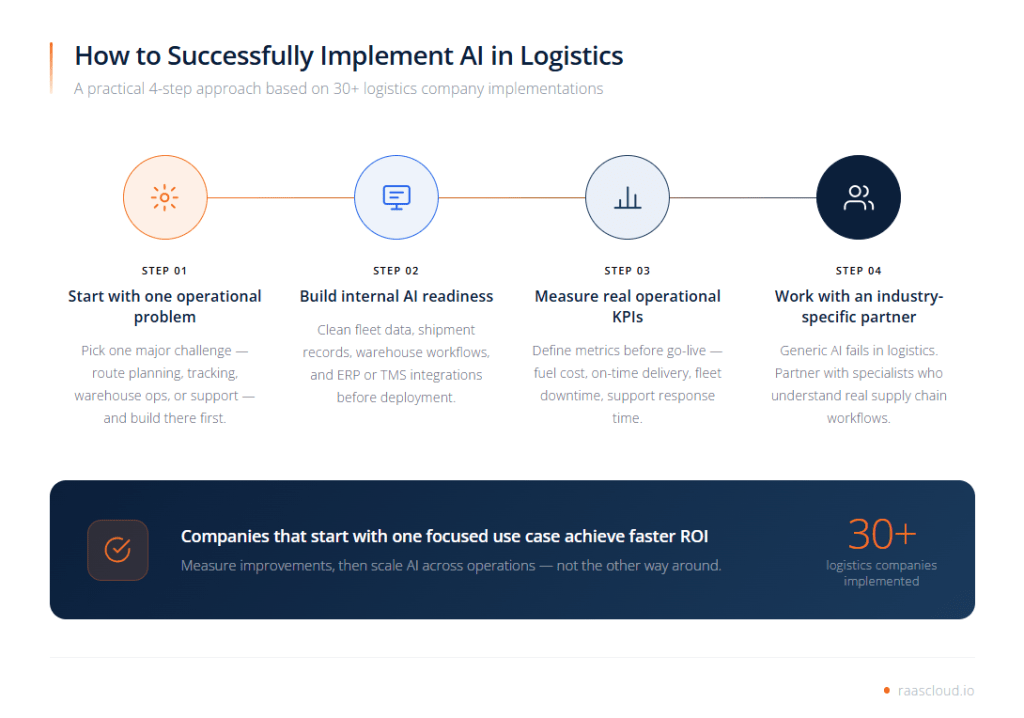
Here are some practical ways logistics companies can successfully implement AI in 2026.
Start With One Operational Problem
Many logistics companies make the mistake of starting AI implementation without a clear operational goal. Instead of trying to apply AI across the entire business, it is always better to begin with one major operational challenge.
This could be route optimization, shipment tracking, warehouse inefficiencies, support automation, or fleet maintenance. Starting with one focused use case helps teams measure ROI faster, reduce implementation risks, and build confidence internally before scaling AI across operations.
Build Internal AI Readiness
AI systems are only as effective as the operational data and processes behind them. Before implementing AI, logistics companies should focus on improving data quality, integrating operational systems, and organizing workflows properly.
This includes preparing fleet data, shipment records, warehouse operations data, customer support workflows, and ERP or TMS integrations. Internal team readiness is also important because operations teams need to understand how AI systems support their work instead of replacing them.
Measure Real Operational KPIs
One of the biggest mistakes companies make is implementing AI without tracking measurable business outcomes. Logistics companies should always define operational KPIs before deployment and continuously monitor improvements after implementation.
Important KPIs may include fuel cost reduction, on-time delivery rates, warehouse productivity, shipment visibility, support response time, fleet downtime, and operational cost savings. This helps companies understand the actual business impact of AI adoption.
Work With Industry-Specific AI Partners Like RAAS Cloud
Logistics operations are highly complex and require industry-specific workflows, integrations, and operational understanding. Generic AI implementations often fail because they do not align with real logistics processes.Working with experienced AI partners like RAAS Cloud can help logistics companies identify the right use cases, build scalable AI systems, integrate with existing platforms, and achieve faster implementation outcomes. Our AI engineers team has worked with logistics companies on AI chatbots, operational automation, shipment intelligence systems, and AI-driven workflow optimization solutions.

Dhanalakshmi Kadirvelu is a Business Intelligence and Data Analytics expert with a strong focus on software development and data engineering. She creates efficient data models, builds interactive dashboards, and integrates analytics into software systems using Power BI, OBIEE, and SQL. Her work helps development teams use data effectively to create smarter software solutions and improve business performance.