AI has moved far beyond simple chatbots. Today, businesses are building AI agents that can answer customer queries, qualify leads, update CRM records, analyze documents, interact with business tools, and complete tasks with minimal human involvement. Unlike chatbots that mainly respond to questions, AI agents can take actions and handle multi-step workflows.
As more companies look to build AI agents and take advantage of the AI wave, one question comes up in almost every conversation: how much does it cost to build an AI agent? The answer depends on the use case, complexity, integrations, AI models, and whether you build using existing AI tools or a custom solution.
Based on our experience helping startups and enterprises build 50+ AI agents, we have seen costs vary widely across support, sales, HR, and other business functions. In this guide, we break down AI agent development costs by use case, compare no-code and custom development approaches, and share practical benchmarks to help you plan your budget.
AI Agent Development Cost At A Glance (2026)
The cost of building an AI agent is usually divided into two parts: the initial development cost and the ongoing monthly operating cost. The development cost covers planning, workflow design, integrations, testing, and deployment. The monthly cost includes AI model usage, automation platforms, cloud infrastructure, monitoring, and maintenance.
In most cases, businesses spend significantly more on building and integrating an AI agent than they do on running it every month. The table below provides a quick overview of typical AI agent development and operating costs across different use cases:
| AI Agent Type | Build Cost | Monthly Cost | Time To Build |
| Support Agent | $2k-$10k | $50-$2,000 | 2-6 weeks |
| Sales Agent | $5k-$20k | $100-$5,000 | 4-8 weeks |
| HR Agent | $3k-$20k | $50-$3,000 | 3-8 weeks |
| Enterprise Multi-Agent System | $30k-$150k+ | $1k-$20k+ | 2-6 months |
What Actually Drives AI Agent Development Costs?
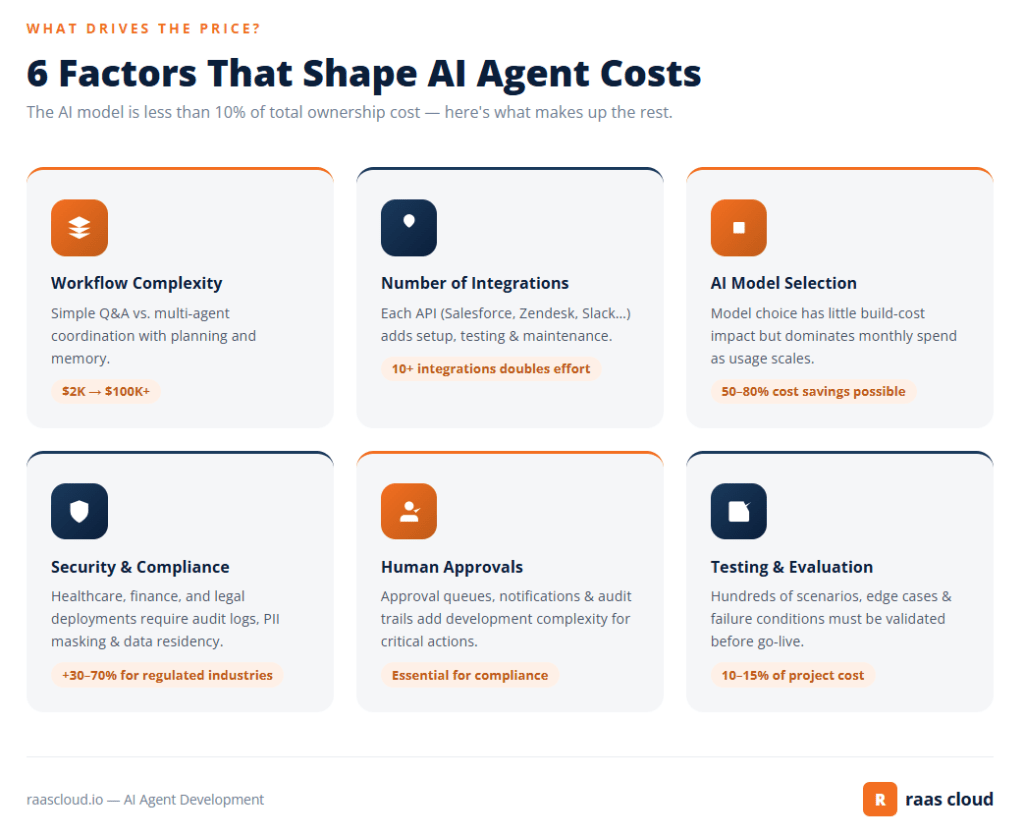
The cost of an AI agent depends on much more than the AI model powering it. Based on our experience, the AI model itself is usually less than 10% of total ownership cost. But there are several other factors that influence the overall development budget, implementation timeline, and long-term operating costs.
Workflow Complexity
The complexity of the workflow has a direct impact on AI agent development costs. A simple AI agent that answers questions and retrieves information from a knowledge base can be built quickly and at a relatively low cost. However, costs increase as the agent needs to perform actions, make decisions, coordinate multiple systems, and handle more advanced business processes.
For example,
- A Level 1 agent may only answer questions, search internal documents, and escalate requests to a human agent.
- A Level 2 agent can search CRM records, create tickets, update customer data, and trigger automated workflows.
- A Level 3 agent is much more sophisticated and may involve multiple AI agents working together, tool calling, planning, human approvals, and long-term memory.
| Complexity | Typical Cost |
| Simple | $2,000 – $5,000 |
| Medium | $5,000 – $20,000 |
| Advanced | $20,000 – $100,000+ |
Number Of Integrations
Most AI agents need to connect with existing business systems such as Salesforce, HubSpot, Zendesk, Slack, SAP, Workday, and Microsoft Dynamics. Each integration requires API setup, testing, data mapping, and workflow configuration, which adds to the overall development cost.
Agent with:
- 2 integrations → Baseline development cost
- 10+ integrations → Development effort often doubles due to increased complexity, testing, and maintenance requirements.
Many businesses overlook ongoing API maintenance costs. Vendors regularly update APIs, change authentication methods, and retire older endpoints, which can require additional development work after deployment.
AI Model Selection
While the AI model does not have a major impact on the initial development cost, it can significantly affect the monthly operating cost of your AI agent. Different models have different pricing, performance levels, reasoning capabilities, and context windows. Choosing the right model is important because it directly impacts how much you will spend as usage grows.
For most support, HR, and internal productivity agents, smaller and mid-tier models are often sufficient. More expensive models are typically reserved for complex reasoning, multi-step workflows, coding tasks, and advanced enterprise use cases.
| Model | Input Cost (Per 1M Tokens) | Output Cost (Per 1M Tokens) | Cost Impact |
| GPT-5.4 Mini | $0.75 | $4.50 | Low |
| GPT-5.4 | $2.50 | $15.00 | Medium |
| GPT-5.5 | $5.00 | $30.00 | High |
| Claude Haiku 4.5 | $1.00 | $5.00 | Low |
| Claude Sonnet 4.6 | $3.00 | $15.00 | Medium |
| Claude Opus 4.8 | $5.00 | $25.00 | High |
Open source models do not charge per token, but they require hosting infrastructure, GPUs, monitoring, and maintenance. This can make them more cost-effective at scale, especially for high-volume AI agents.
| Model | Typical Monthly Infrastructure Cost |
| Llama 4 Scout | $100 – $500+ |
| Llama 4 Maverick | $300 – $2,000+ |
| DeepSeek V3 | $300 – $3,000+ |
| Qwen 3 | $100 – $1,500+ |
A common mistake is choosing the most powerful model available from day one. In our experience, many businesses can reduce AI operating costs by 50% to 80% simply by using smaller models for routine tasks and reserving premium models only for complex workflows.
Security & Compliance
If you are building an AI agent for industries such as healthcare, insurance, finance, or legal services, security and compliance requirements can significantly increase development costs. Features such as audit logs, role-based access controls, data encryption, PII masking, compliance reviews, and data residency requirements often require additional development and testing effort.
We have worked with healthcare and insurance companies in the past, and in some cases, compliance-related requirements alone increased project costs by 30% to 70% compared to a similar AI agent built for a non-regulated industry. For enterprise deployments, compliance can become one of the largest cost drivers after development itself.
Human Approvals
AI agents are becoming increasingly capable, but they are still not reliable enough to make every business decision on their own. For critical actions such as approving insurance claims, processing refunds, modifying employee records, or handling financial transactions, businesses often require human approval before the action is executed.
Adding human-in-the-loop workflows increases development complexity because approval systems, notifications, audit trails, and fallback mechanisms need to be built into the agent. While this adds to the overall cost, it is often essential for reducing risk and maintaining compliance.
Testing & Evaluation
Testing and evaluation is one of the most overlooked aspects of AI agent development. Unlike traditional software, AI agents can produce different outputs for the same input and are still prone to mistakes, hallucinations, and unexpected behavior.
As a result, teams need to test hundreds of scenarios, edge cases, workflows, and failure conditions before deployment. In our experience, testing, evaluation, and optimization can account for 10% to 15% of the total project cost. Skipping this step may reduce initial costs, but it often leads to poor performance, incorrect responses, and expensive fixes later.
Customer Support AI Agent Development Cost
Customer support is one of the first AI agent use cases that companies typically invest in. Support teams handle thousands of repetitive customer queries every month, making it an ideal area for automation. A well-built support AI agent can reduce response times, improve customer experience, and help support teams focus on more complex issues.
Common Customer Support AI Agent Use Cases
- Answer FAQs
- Search knowledge bases
- Retrieve product information
- Create support tickets
- Route conversations to the right team
- Check order status
- Process simple requests
- Escalate complex issues to human agents
Typical Tech Stack
| Tool-Based AI Agent | Custom AI Agent |
| n8n | OpenAI Agents SDK |
| Make | LangGraph |
| Zapier | CrewAI |
| Intercom | FastAPI / Node.js Backend |
| Zendesk | Pinecone / Weaviate |
| Slack | PostgreSQL |
| OpenAI API | OpenAI or Anthropic APIs |
Cost Breakdown
Basic Support Agent → $2,000 – $4,000
- FAQ answering
- Knowledge base integration
- Email or chat support
- Human escalation
Intermediate Support Agent → $4,000 – $8,000
- CRM integration
- Ticket creation
- Order status lookup
- Multi-channel support
Advanced Support Agent → $8,000 – $15,000+
- Multiple integrations
- Automated ticket resolution
- Multi-agent workflows
- Advanced reporting and analytics
Monthly Operating Cost
| Monthly Conversations | Estimated AI Cost |
| 1,000 | $5 – $20 |
| 10,000 | $20 – $100 |
| 50,000 | $100 – $500 |
In many cases, companies can automate 30% to 60% of incoming support requests with a relatively small investment compared to hiring additional support staff.
AI Sales Agent Development Cost
Sales is one of the fastest-growing areas for AI agent adoption. Companies are using AI sales agents to qualify leads, engage prospects, update CRM records, and automate repetitive sales tasks that would otherwise consume a significant amount of SDR and sales team time. Unlike support agents, sales agents often require deeper integrations and more personalized workflows, which can increase development costs.
Common AI Sales Agent Use Cases
- Lead qualification
- Prospect research
- Personalized outreach
- Email response generation
- Meeting scheduling
- CRM updates
- Lead scoring
- Follow-up automation
- Call summaries
- Pipeline management
Typical Tech Stack
| Tool-Based AI Agent | Custom AI Agent |
| n8n | OpenAI Agents SDK |
| Make | LangGraph |
| Zapier | CrewAI |
| HubSpot | FastAPI / Node.js Backend |
| Salesforce | Pinecone / Weaviate |
| Apollo | PostgreSQL |
| Calendly | OpenAI or Anthropic APIs |
Cost Breakdown
Basic Sales Agent → $3,000 – $6,000
- Lead qualification
- Meeting scheduling
- CRM updates
- Email response generation
Intermediate Sales Agent → $6,000 – $12,000
- HubSpot or Salesforce integration
- Lead scoring
- Prospect research
- Automated follow-ups
Advanced Sales Agent → $12,000 – $20,000+
- Multiple sales tool integrations
- Multi-step outreach workflows
- Pipeline management
- Multi-agent coordination
Sales agents typically cost more than support agents because they interact with multiple systems such as CRMs, prospecting tools, email platforms, and scheduling software. However, they can also deliver a faster return on investment.
HR AI Agent Development Cost
HR AI agents are not as common as support or sales agents today, but adoption is growing rapidly. We recently delivered an HR AI agent for a tour and travel company to help employees access company policies, leave information, onboarding documents, and HR-related information without needing to contact the HR team.
Common HR AI Agent Use Cases
- Employee onboarding
- HR policy assistance
- Leave and attendance queries
- Benefits information
- Internal helpdesk support
- Employee document retrieval
- HR ticket creation
- Training and learning assistance
- Employee FAQs
- Recruitment support
Typical Tech Stack
| Tool-Based AI Agent | Custom AI Agent |
| n8n | OpenAI Agents SDK |
| Make | LangGraph |
| Zapier | CrewAI |
| Slack | FastAPI / Node.js Backend |
| Microsoft Teams | Pinecone / Weaviate |
| Google Workspace | PostgreSQL |
| BambooHR / Workday | OpenAI or Anthropic APIs |
Cost Breakdown
Basic HR Agent → $2,500 – $5,000
- Employee FAQs
- Policy assistance
- Onboarding guidance
- Internal knowledge base search
Intermediate HR Agent → $5,000 – $10,000
- Leave and attendance queries
- HR ticket creation
- Employee document access
- Slack or Teams integration
Advanced HR Agent → $10,000 – $18,000+
- Workday or BambooHR integration
- Recruitment workflows
- Employee lifecycle automation
- Multiple HR system integrations
Monthly Operating Cost for HR AI Agent
| Employees Served | Estimated AI Cost |
| 100 Employees | $10 – $30 |
| 1,000 Employees | $30 – $150 |
| 5,000 Employees | $150 – $750 |
One of the biggest advantages of HR AI agents is that they handle repetitive internal queries that consume a large portion of HR teams’ time. However, unlike support agents, HR agents often require stricter permissions, employee data controls, and compliance measures, which can increase development complexity and overall project costs.
Best AI Agent Development Platforms And Pricing
While we generally recommend building custom AI agents for businesses that need scalability, flexibility, and deeper integrations, we also help clients build AI agents using no-code and low-code platforms. These platforms can significantly reduce development costs and are often a great starting point for MVPs and internal automation projects.
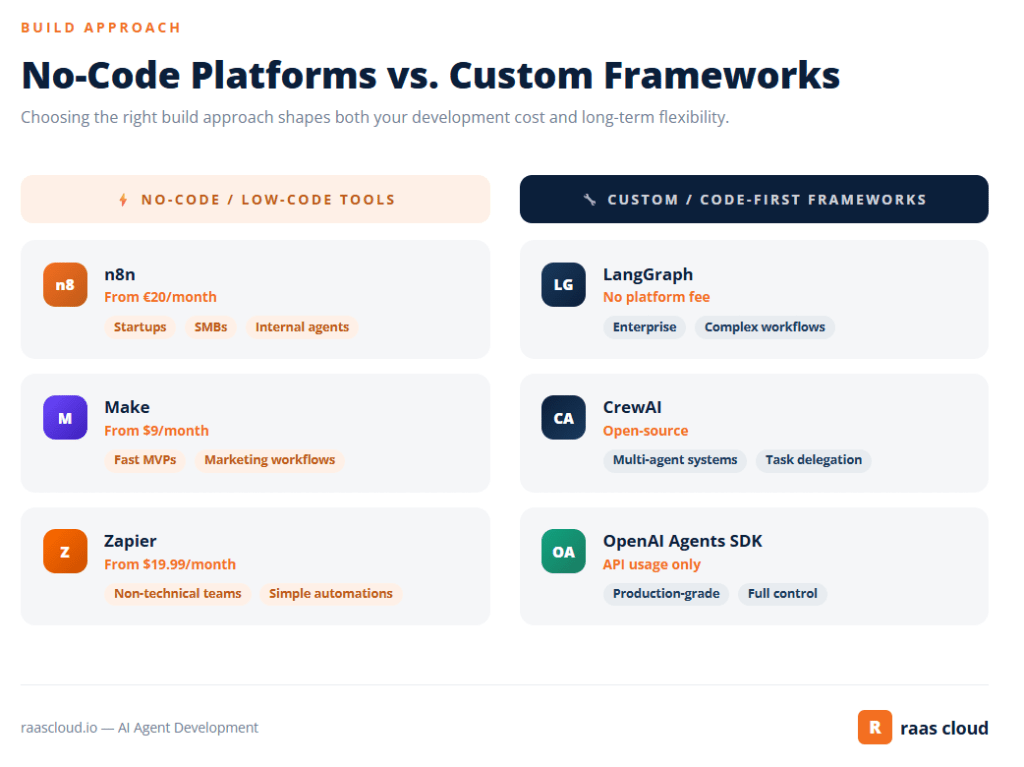
Here are some of the AI agent development platforms we commonly use.
n8n
Pricing
- Starter: €20/month
- Pro: €50/month
Pros
- Unlimited workflows
- Unlimited integrations
- Predictable pricing
- Self-hosting option available
Best For
- Startups
- Internal AI agents
- SMBs
- Workflow automation
Cost Example
- 10,000 workflow executions/month ≈ €50/month
Our Take: n8n is currently one of the most cost-effective platforms for building AI agents. Since pricing is based on executions rather than individual actions, costs remain predictable even as workflows become more complex.
Make
Pricing
- Free: 1,000 credits/month
- Core: $9/month
- Pro: $16/month
- Teams: $29/month
Best For
- Fast MVPs
- Marketing workflows
- Lead generation automation
- Simple AI agents
Hidden Cost
Every action inside a workflow consumes credits. As AI agents become more advanced and require multiple steps, credit consumption can increase quickly.
Our Take: Make is excellent for rapid prototyping and lightweight AI workflows. However, complex agents can become expensive as workflow activity grows.
Zapier
Pricing
- Free: 100 tasks/month
- Professional: Starts at $19.99/month
Best For
- Non-technical teams
- Business users
- Simple automations
Hidden Cost
AI actions can consume multiple tasks, which means costs can increase rapidly for high-volume workflows.
Our Take: Zapier offers one of the easiest learning curves but is often not the most cost-effective option for advanced AI agents running at scale.
LangGraph
Pricing
- No platform fee
- Development and infrastructure costs only
Best For
- Enterprise AI agents
- Multi-agent systems
- Complex workflows
- Custom business logic
Our Take: LangGraph has become one of the most popular frameworks for building advanced AI agents. It offers significantly more flexibility than no-code tools but requires engineering expertise.
CrewAI
Pricing
- Open-source
- Infrastructure costs only
Best For
- Multi-agent workflows
- Task delegation
- Collaborative AI systems
Our Take: CrewAI is commonly used when multiple AI agents need to work together. For example, one agent researches information, another analyzes it, and a third generates the final output.
OpenAI Agents SDK
Pricing
- No platform fee
- Pay only for API usage
Best For
- Fully custom AI agents
- Production-grade deployments
- Enterprise applications
Our Take: The OpenAI Agents SDK is ideal for businesses that want complete control over workflows, tools, memory, approvals, and integrations. While development costs are higher, it provides the flexibility required for complex and business-critical AI applications.
Explore our solutions:
- AI Agent Development Company In Atlanta
- AI Agent Development Company in Florida
- AI Chatbot Development Services
Ready To Build Your AI Agent?
The costs shared in this guide are intended to provide a high-level overview. In reality, every AI agent project is different. Factors such as workflows, integrations, security requirements, business goals, and user volume can significantly influence the final cost and implementation approach.
We have been helping startups, SMBs, and enterprises design, build, and deploy AI agents for the last three years across customer support, sales, HR, operations, and industry-specific use cases. Whether you run a restaurant, hotel, educational institution, retail business, healthcare organization, finance company, or SaaS startup, our team can help you identify the right AI opportunities and build an agent that delivers measurable business value.
If you’re planning to build an AI agent, get in touch with our AI experts for a free consultation. We’ll help you evaluate the right architecture, estimate costs, and create a roadmap for implementation. In most cases, once the project starts, we can get your AI agent live in less than four weeks.

Dhanalakshmi Kadirvelu is a Business Intelligence and Data Analytics expert with a strong focus on software development and data engineering. She creates efficient data models, builds interactive dashboards, and integrates analytics into software systems using Power BI, OBIEE, and SQL. Her work helps development teams use data effectively to create smarter software solutions and improve business performance.