

For years, manufacturers managed inventory using historical sales data, fixed reorder points, and rule-based ERP systems. These methods worked when customer demand was relatively stable and inventory plans could remain unchanged for months. Today, demand changes much faster, supply chains are less predictable, and static ERP rules can no longer keep up.
Artificial intelligence is changing how manufacturers manage inventory. AI can forecast demand, predict when stock will run low, recommend replenishment, identify slow-moving inventory, and continuously optimize stock levels using real-time business data. Instead of relying on fixed rules, it learns from sales trends, production schedules, supplier performance, and warehouse data to make smarter inventory decisions.
Rather than purchasing separate tools for forecasting, procurement, and inventory planning, many manufacturers are building custom AI solutions that bring everything together on a single platform.
In this guide, we’ll explore how AI is transforming inventory optimization, the most valuable use cases for manufacturers, and how custom AI applications, AI agents, and AI consulting can help businesses improve efficiency and reduce inventory costs.
What is AI Inventory Optimization?
| Factor | Traditional Inventory Management | AI Inventory Optimization |
| Planning Approach | Based on fixed rules and manual planning | Continuously adapts using real-time data |
| Demand Forecasting | Uses historical sales and estimates | Predicts future demand using machine learning and multiple data sources |
| Reorder Decisions | Fixed reorder points and schedules | Dynamic recommendations based on demand, stock levels, and lead times |
| Inventory Visibility | Limited to periodic reports | Real-time visibility across warehouses and locations |
| Stock Level Management | Often results in overstocking or stockouts | Maintains optimal inventory levels with continuous monitoring |
| Supplier Planning | Based on predefined lead times | Considers supplier performance, delays, and changing lead times |
| Response to Market Changes | Slow and mostly manual | Quickly adjusts to demand shifts, disruptions, and seasonal trends |
| Slow-Moving Inventory | Identified after inventory reports are generated | Detects slow-moving and excess inventory early and suggests corrective actions |
| Decision Making | Manual and experience-based | Data-driven recommendations supported by predictive analytics |
| Automation | Limited automation through ERP rules | Automates forecasting, replenishment, alerts, and inventory recommendations |
| Accuracy | Depends heavily on manual inputs | Improves over time as AI learns from new data |
| Scalability | Difficult to manage across multiple warehouses | Easily manages inventory across multiple plants, warehouses, and regions |
Note: Unlike traditional systems that follow predefined rules, AI continuously learns from sales data, production schedules, supplier performance, warehouse movements, seasonal demand, and other operational data.
How AI Improves Inventory Optimization
AI improves inventory optimization by turning business data into intelligent decisions. Instead of reacting to stock shortages or excess inventory, manufacturers can predict demand, optimize stock levels, and automate routine inventory tasks before they become costly problems. The entire process follows a simple pipeline.
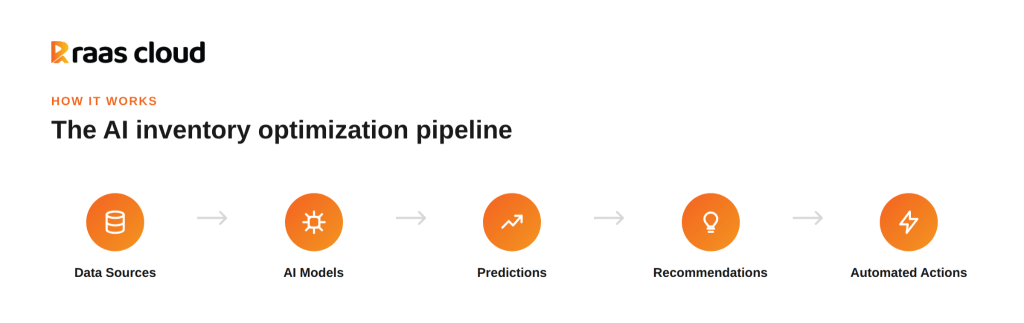
Data Sources
Everything starts with data. AI collects information from different business systems to understand how inventory moves across the entire manufacturing process. Rather than relying on a single report, it combines data from multiple sources to build a complete picture.
Some of the most common data sources include:
- ERP and Warehouse Management Systems (WMS)
- Sales orders and purchase orders
- Production schedules
- Current inventory levels
- Supplier lead times and delivery history
- Barcode, RFID, and IoT devices
↓
AI Models
Once the data is collected, AI models analyze it to identify patterns that are difficult to detect manually. They study historical sales, production capacity, supplier performance, seasonal demand, and inventory movements to understand what influences stock levels. As new data is added every day, the models continue learning, making future predictions more accurate and relevant.
↓
Predictions
Using these insights, AI predicts what is likely to happen before inventory issues occur. It can estimate future demand, identify products that may run out of stock, detect excess inventory, forecast supplier delays, and highlight items that are likely to become slow-moving. This gives manufacturers enough time to take corrective action instead of responding after the problem has already affected production.
↓
Recommendations
After generating predictions, AI recommends the best course of action based on current business conditions. Instead of following fixed reorder rules, it suggests inventory decisions that help reduce costs while maintaining product availability. These recommendations continuously change as demand, supplier performance, and production schedules evolve.
↓
Automated Actions
In advanced AI systems, many of these recommendations can be executed automatically after approval. This reduces manual work, speeds up decision-making, and ensures inventory stays optimized even as conditions change.
Common automated actions include:
- Creating purchase requests
- Updating reorder quantities
- Triggering low-stock alerts
- Initiating inventory transfers between warehouses
- Notifying procurement teams about supplier risks
This continuous cycle allows AI to keep learning from new business data, helping manufacturers make smarter inventory decisions with every planning cycle.
Also Read: AI App Development Companies In USA
5 Practical Ways Manufacturers Can Use AI for Inventory Optimization
Now let’s look at some practical ways manufacturers can use AI to optimize inventory. Based on our experience building custom AI solutions for manufacturers across the USA, we’ve seen AI deliver measurable improvements across demand forecasting, procurement, warehouse operations, and inventory planning.
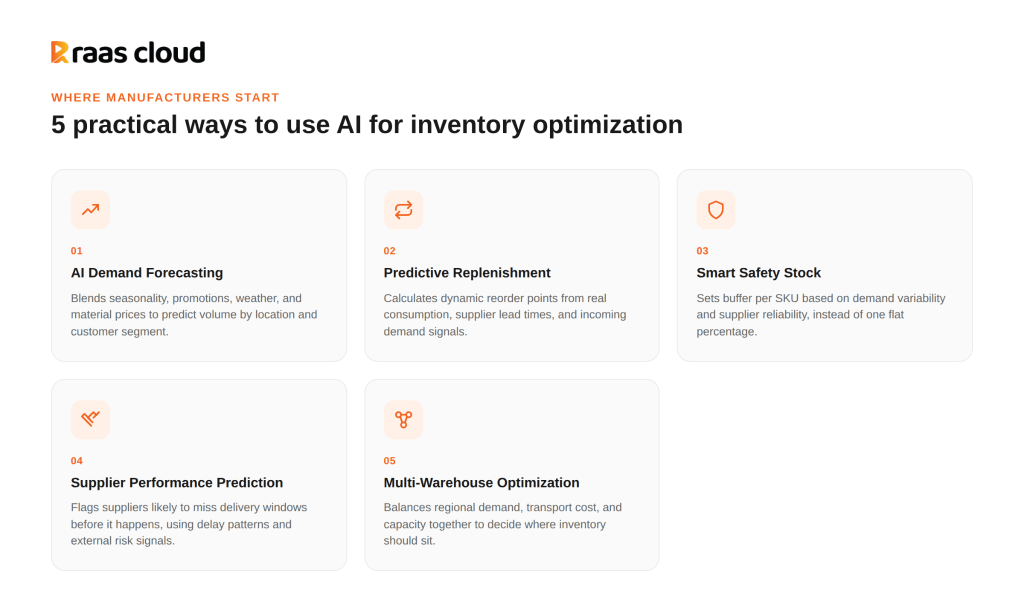
Here are some of the most valuable use cases.
AI Demand Forecasting
Most manufacturers still forecast demand using last year’s numbers plus a gut-feel adjustment. AI models change this by pulling in seasonality, promotions, weather patterns, and even macroeconomic signals like raw material price shifts.
We’ve seen forecasting accuracy jump from around 60-65% (typical for spreadsheet-based methods) to 85%+ when manufacturers switch to ML models trained on SKU-level historical data. The real value shows up during demand spikes or sudden drops, situations where traditional forecasting breaks down completely. A good model doesn’t just predict volume, it predicts volume by location, by customer segment, and by lead time window.
Predictive Replenishment Planning
Replenishment used to mean someone checking stock levels every Monday and placing orders based on a fixed reorder point. AI replenishment systems instead calculate dynamic reorder points that shift with actual consumption patterns, supplier lead times, and incoming demand signals. For manufacturers running hundreds of SKUs across multiple production lines, this removes the guesswork entirely.
One mid-sized auto parts manufacturer we worked with cut excess inventory by 22% within two quarters simply by letting the system trigger reorders based on real consumption velocity instead of static thresholds set years earlier and never revisited.
Smart Safety Stock Optimization
We built a safety stock system for a US-based industrial equipment manufacturer that was holding nearly 40% more buffer stock than needed across three warehouses. Their old formula used a flat percentage buffer regardless of SKU volatility. We replaced it with a model that calculated safety stock per SKU based on demand variability, supplier reliability scores, and lead time variance.
High-volatility, unreliable-supplier SKUs got higher buffers. Stable, reliable-supplier SKUs got trimmed down. Result: a 31% reduction in tied-up working capital within five months, with zero increase in stockout incidents. The formula isn’t complex, it just needed real variability data behind it.
Supplier Performance Prediction
Supplier scorecards are usually backward-looking, showing what already went wrong last quarter. AI models flip this by predicting which suppliers are likely to miss delivery windows or quality specs before it happens, based on patterns like order size fluctuations, historical delay frequency, and even external factors like port congestion or raw material shortages in the supplier’s region.
Manufacturers using this approach can shift orders to backup suppliers proactively instead of scrambling after a missed shipment. It also gives procurement teams real leverage in supplier negotiations since they’re working from predictive risk data, not just gut instinct.
Multi-Warehouse Inventory Optimization
Manufacturers running multiple warehouses often end up with stock imbalances, one location overstocked while another stocks out on the same SKU. AI-driven inventory balancing looks at regional demand patterns, transportation costs, and warehouse capacity together to decide where inventory should actually sit.
This matters most for manufacturers with regional customer bases where shipping distance affects delivery commitments. We’ve seen this approach reduce inter-warehouse emergency transfers by more than half, since the system positions stock correctly upfront instead of reacting after a shortage. It also surfaces which warehouse locations are consistently mismatched with demand.
Also Read: How Much Does It Cost To Build An AI Customer Service Chatbot?
How Manufacturers Can Build AI Beyond Inventory Optimization
Inventory optimization is just one of the many ways manufacturers can use AI to improve their operations. At RAAS Cloud, we provide end-to-end AI solutions for manufacturing companies as well as businesses across 15+ other industries. While AI-powered inventory management is a common starting point, many manufacturers go on to implement AI across production, procurement, quality control, customer support, sales, and internal operations.
Over the last four years, we have worked with 12 manufacturing companies and delivered 20+ custom AI solutions designed to solve real business challenges. Every solution is built around the client’s existing workflows, data, and business goals rather than using a one-size-fits-all approach.
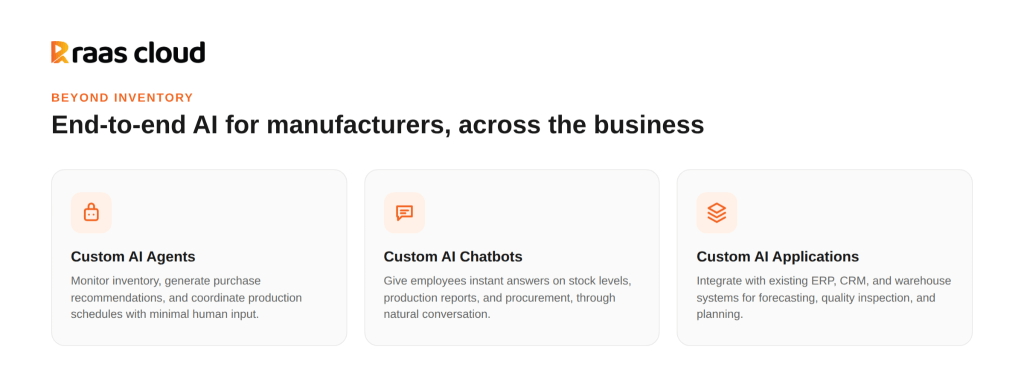
Custom AI Agents
We build AI agents that automate repetitive business processes and support faster decision-making. These agents can monitor inventory, generate purchase recommendations, track supplier performance, coordinate production schedules, analyze operational data, and perform many other tasks with minimal human intervention.
Custom AI Chatbots
Our AI chatbots help employees access information instantly through natural conversations. Whether it’s checking inventory levels, retrieving production reports, answering HR questions, assisting procurement teams, or supporting customers, AI chatbots reduce manual effort and improve response times across the organization.
Custom AI Applications
We develop custom AI applications that integrate with your existing ERP, CRM, warehouse management, and manufacturing systems. From demand forecasting and predictive maintenance to quality inspection, production planning, and workflow automation, these applications are built around your specific operational requirements instead of forcing you to adapt to generic software.
If you’re planning to adopt AI in your manufacturing business, our team can help you identify the highest-impact opportunities before you invest. We offer a free AI consultation where we assess your current processes, identify practical AI use cases, estimate the expected business impact, and recommend the right implementation roadmap for your organization.

Dhanalakshmi Kadirvelu is a Business Intelligence and Data Analytics expert with a strong focus on software development and data engineering. She creates efficient data models, builds interactive dashboards, and integrates analytics into software systems using Power BI, OBIEE, and SQL. Her work helps development teams use data effectively to create smarter software solutions and improve business performance.