
The rise of AI has completely changed how software is built. Developers are now shipping features faster than ever with AI coding assistants, automated testing, and intelligent development tools. But faster development also puts more pressure on infrastructure. Applications need reliable deployment pipelines, scalable cloud environments, stronger security, and systems that can keep up with rapid release cycles. This is where DevOps becomes critical.
For a growing startup or even a large enterprise, hiring a DevOps engineer sounds straightforward. The first question is usually, “How much does it cost?” In reality, the answer depends on much more than salary.
Experience level, cloud platform expertise, Kubernetes knowledge, automation skills, security requirements, and whether you hire in-house or outsource all have a significant impact on the total cost.
At RAAS Cloud, we provide pre-vetted DevOps engineers who have helped businesses across the United States build cloud infrastructure, implement CI/CD pipelines, automate deployments, optimize cloud costs, and modernize software delivery.
Based on our experience working with startups, SaaS companies, and enterprise teams, this guide explains what it really costs to hire a DevOps engineer in 2026, what factors influence pricing, and how to choose the hiring model that delivers the best value for your business.
How Much Does It Cost to Hire a DevOps Engineer in 2026?
The cost to hire a DevOps engineer in 2026 can range from $30 per hour for an offshore dedicated engineer to over $220,000 per year for an experienced DevOps architect in the United States. The actual cost depends on several factors, including the engineer’s experience, technical expertise, industry, project complexity, and hiring model.
Among these, the hiring model has the biggest impact on your overall investment. Hiring a full-time employee comes with salaries, benefits, recruitment costs, and onboarding time.
On the other hand, outsourcing or working with a DevOps consulting partner gives you access to experienced engineers without the long-term hiring commitment. In the following sections, we’ll break down each of these factors in detail so you can choose the most cost-effective option for your business.
| Hiring Model | Typical Cost |
|---|---|
| Full-time Junior | $85,000–$105,000/year |
| Mid-level | $110,000–$135,000/year |
| Senior | $140,000–$170,000/year |
| Principal / Architect | $170,000–$220,000+/year |
| Freelancer | $60–$110/hour |
| US DevOps Consultant | $100–$180/hour |
| Offshore Dedicated DevOps Engineer | $30–$55/hour |
| Dedicated DevOps Team | Starts around $6,000–$12,000/month |
Hiring an In-House vs. Dedicated Remote DevOps Talent
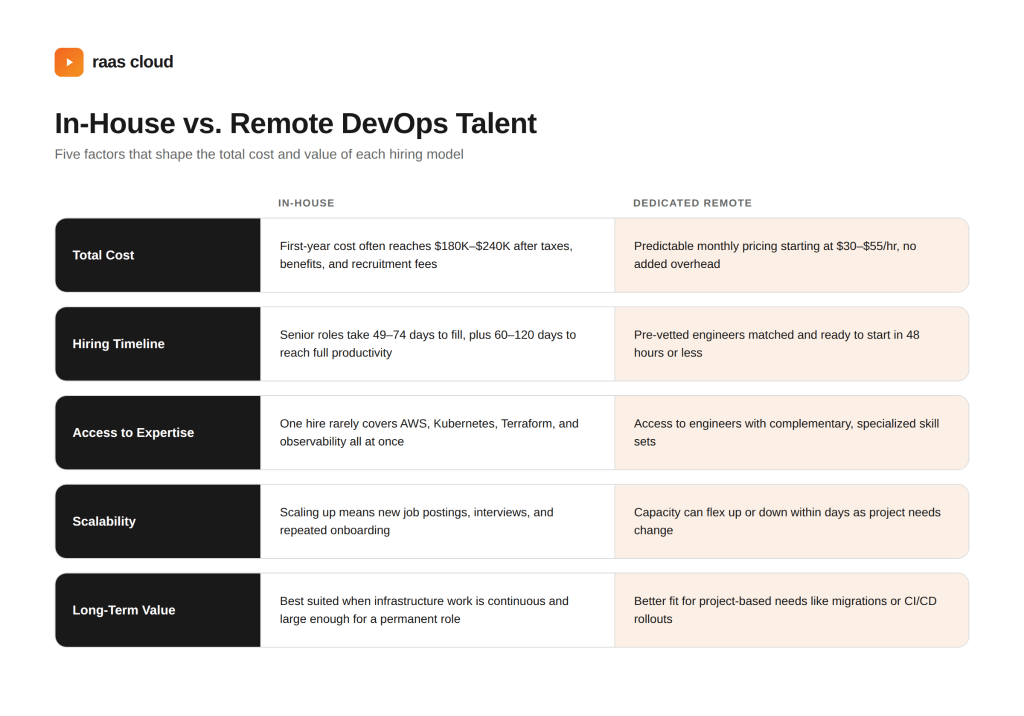
When hiring DevOps talent, businesses typically choose between building an in-house team or working with dedicated remote engineers. Both approaches have their advantages, but they differ significantly in terms of hiring costs, time to onboard, access to expertise, and scalability. Here’s how they compare across the factors that matter most.
1. Total Cost of Hiring
A full-time DevOps engineer earning $140,000 per year rarely costs just $140,000. Once you factor in employer taxes, health insurance, retirement contributions, recruitment fees, equipment, software licenses, paid leave, and onboarding, the first-year investment typically reaches $180,000 to $240,000 for a mid-level engineer, and even higher when external recruiters are involved.
With a dedicated remote DevOps engineer, these costs are already built into a predictable monthly engagement. At RAAS Cloud, businesses can hire experienced remote DevOps engineers starting at $30–$55/hour, with talent available from both the United States and leading engineering hubs such as India, Poland, and Eastern Europe. This allows companies to avoid recruitment expenses, employee benefits, HR overhead, and long-term employment liabilities while gaining access to experienced cloud engineers.
2. Hiring Timeline and Time to Productivity
Finding experienced DevOps engineers is becoming increasingly difficult. Across the US market, senior DevOps roles typically take 49 to 74 days to fill, depending on seniority. Even after joining, most engineers require 60 to 120 days to understand infrastructure, deployment workflows, security policies, and production environments before operating independently.
At RAAS Cloud, we help businesses hire pre-vetted remote DevOps engineers in 48 hours or less. Every engineer is technically screened before being matched with your project, eliminating lengthy recruitment cycles and multiple interview rounds.
Since hiring, technical evaluation, and onboarding are already taken care of, your team can start working on cloud migrations, CI/CD implementation, infrastructure automation, or platform modernization almost immediately. For businesses working against tight product launch timelines, this can save weeks or even months compared to a traditional hiring process.
3. Access to Specialized Expertise
Modern DevOps rarely revolves around one technology. A typical enterprise project may require expertise in AWS or Azure, Kubernetes, Terraform, Docker, GitHub Actions, ArgoCD, Prometheus, Grafana, Cloudflare, IAM, FinOps, and disaster recovery planning.
Hiring one employee with deep expertise across all these areas is both expensive and difficult. A dedicated remote engineering partner like RAAS Cloud gives businesses access to engineers with complementary skill sets, allowing them to solve infrastructure, automation, observability, and cloud optimization challenges without recruiting multiple specialists.
4. Scalability and Business Flexibility
Infrastructure requirements rarely stay constant. A SaaS company may need two DevOps engineers during a cloud migration, four engineers during a major product launch, and only one engineer for ongoing platform management afterwards.
Scaling an in-house team means opening new positions, interviewing candidates, purchasing equipment, and repeating the onboarding process every time demand changes. With a dedicated remote team, businesses can increase or reduce engineering capacity within days, making it easier to manage costs while responding to changing workloads.
5. Long-Term Business Value
An in-house DevOps engineer makes sense when infrastructure work is continuous and large enough to justify a permanent role. However, many startups and mid-sized businesses don’t need senior DevOps expertise every day. They often need it during cloud migrations, Kubernetes implementation, CI/CD automation, security hardening, or cloud cost optimization projects.
From our experience working with US businesses, this is where dedicated remote DevOps talent often delivers better value. Instead of spending well over $200,000 in first-year employment costs for a single senior hire, companies gain immediate access to experienced engineers, predictable monthly pricing, and the flexibility to scale resources as infrastructure requirements evolve.
Factors That Affect The Cost of Hiring DevOps Engineers
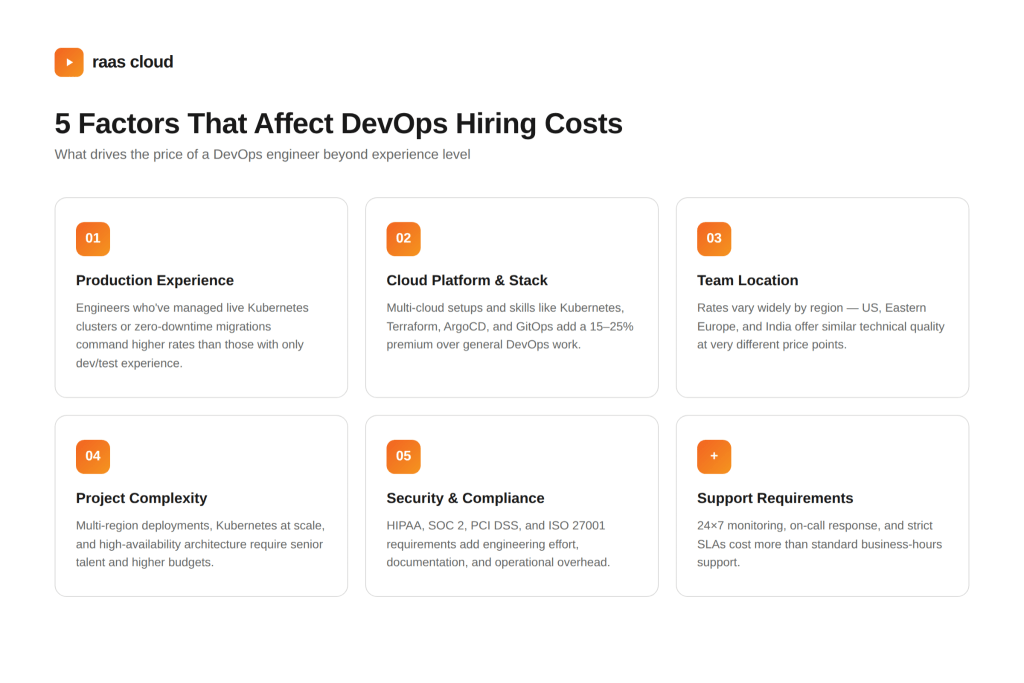
The hiring model is only one part of the overall cost. Whether you’re building an in-house team or hiring remote DevOps engineers, several other factors influence pricing, including experience, technical expertise, cloud platforms, project complexity, and industry requirements. Understanding these factors will help you estimate the right budget and choose the best talent for your needs.
1. Experience and Production Expertise
The biggest factor affecting remote DevOps pricing is not years of experience but production experience. An engineer who has managed live Kubernetes clusters, implemented CI/CD for hundreds of deployments, or handled zero-downtime cloud migrations will naturally command higher rates than someone with only development or testing experience.
As a benchmark, mid-level remote DevOps engineers typically charge $38–$60/hour, while senior engineers with Kubernetes, Terraform, GitOps, and cloud architecture expertise often range from $60–$90/hour. Engineers with platform engineering or SRE experience can command even higher rates.
2. Cloud Platform and Technology Stack
Not every DevOps project requires the same level of expertise. A startup running a single AWS environment with basic CI/CD pipelines costs significantly less than an enterprise managing multiple AWS, Azure, and GCP environments.
Projects involving technologies such as Kubernetes, Terraform, Helm, ArgoCD, Istio, GitOps, service meshes, observability platforms, and FinOps generally increase engineering costs because these skills remain among the most in-demand across the DevOps market. Specialists with Kubernetes and AWS or Azure architecture experience commonly earn a 15% to 25% premium over general DevOps engineers.
3. Team Location and Time Zone Coverage
One of the biggest advantages of hiring remote DevOps talent is access to global engineering markets. Experienced engineers from countries such as India, Poland, Romania, and other Eastern European countries often deliver the same technical capabilities at substantially lower costs because of regional operating expenses rather than differences in technical ability.
For example, senior DevOps engineers in the United States commonly bill $150–$210+ per hour, while similarly experienced engineers in Eastern Europe typically range from $85–$120/hour, and experienced engineers in India often range between $45–$90/hour depending on expertise. This cost difference allows businesses to build experienced cloud engineering teams without compromising technical quality.
4. Project Complexity and Infrastructure Scale
Supporting a SaaS application serving 10,000 users is very different from operating infrastructure that processes millions of API requests every day across multiple regions.
As infrastructure grows, DevOps engineers are expected to design highly available architectures, automate disaster recovery, optimize cloud spending, implement advanced monitoring, manage container orchestration, and maintain uptime during deployments. Projects involving multi-region deployments, Kubernetes at scale, platform engineering, or high-availability architectures require senior engineers and naturally fall into higher pricing brackets.
5. Security, Compliance, and Support Requirements
Industries such as healthcare, fintech, insurance, and government require much more than infrastructure automation. DevOps engineers must also implement secure CI/CD pipelines, manage secrets, enforce identity and access controls, support compliance frameworks, and prepare systems for security audits.
Similarly, businesses requiring 24×7 monitoring, on-call incident response, strict SLAs, or dedicated production support should expect higher engagement costs than companies needing standard business-hours support. Compliance requirements such as HIPAA, SOC 2, PCI DSS, and ISO 27001 add additional engineering effort, documentation, and operational controls throughout the project lifecycle.
Explore more:
- Top 10 DevOps Implementation Services Companies in USA
- DevOps Outsourcing: Pricing, Benefits, and When to Consider It
- Data Scientist Hourly Rates | Cost to Hire Data Scientist
DevOps Consulting: A Smarter Alternative for Specialized Projects
Hiring a full-time DevOps engineer or building a dedicated remote team isn’t always the right choice. Many businesses only need experienced DevOps expertise for a specific project, such as migrating to the cloud, implementing CI/CD pipelines, optimizing cloud infrastructure, improving application security, or modernizing legacy systems.
This is where DevOps consulting offers a more flexible and cost-effective approach. Instead of hiring permanent employees, you work with experienced DevOps consultants who assess your existing infrastructure, identify bottlenecks, recommend the right architecture, and implement best practices based on your business goals.
At RAAS Cloud, our DevOps consultants help businesses across the United States with cloud migrations, Infrastructure as Code (IaC), Kubernetes deployments, CI/CD automation, DevSecOps implementation, cloud cost optimization, monitoring, and platform modernization. Since you’re paying for specialized expertise rather than maintaining a full-time resource, consulting is often the most practical option for businesses that need senior-level guidance without a long-term hiring commitment.
If you’re looking for a DevOps consulting company in Orlando or need experienced DevOps engineers to support your cloud transformation initiatives, get in touch with the RAAS Cloud team. We’ll help you identify the right engagement model and build a scalable, secure, and cost-efficient DevOps strategy for your business.

Dhanalakshmi Kadirvelu is a Business Intelligence and Data Analytics expert with a strong focus on software development and data engineering. She creates efficient data models, builds interactive dashboards, and integrates analytics into software systems using Power BI, OBIEE, and SQL. Her work helps development teams use data effectively to create smarter software solutions and improve business performance.