
Developers now use AI tools daily. Companies invest billions in AI. Teams ship code faster than before. But at the same time, many developers do not trust AI output. Code quality issues are rising. Security risks are also increasing.
This creates a clear gap.
AI helps developers move faster, but it also creates new problems that teams must manage. Many teams now depend on AI for writing, testing, and debugging code. Still, they spend extra time fixing AI mistakes.
In this article, you will see how developers use AI tools, where AI helps, where it fails, and what this means for the future of coding. Each section groups real statistics from across adoption, productivity, trust, risks, tools, and market trends.
All data comes from our online research across industry reports, company data, and trusted publications. All the sources are listed below for reference.
AI Coding Reality Check: Stats That Matter Most
- 41% of all code is already generated by AI, moving fast toward half of total output.
- 84% of developers now use or plan to use AI tools in their workflow.
- Only 3% of developers fully trust AI-generated code without review.
- 66% say AI outputs are close but still not fully correct.
- AI-generated code creates 1.7x more issues than human-written code.
- AI code has 2.74x more security vulnerabilities, raising serious risk concerns.
- Only 4.4% of developers say AI handles complex coding tasks very well.
- AI can improve coding speed by up to 55%, showing strong productivity gains.
- 74% of companies see ROI from AI agents within the first year.
- Only 16% of companies have fully scaled AI across their organization.
👉 Quick insight: AI boosts speed, but it also increases chance of errors and risks, so teams must balance automation with strong review.
AI Coding Adoption and Usage
AI tools are now a core part of coding work. Developers use them across many tasks, from writing code to fixing errors. Companies also bring these tools into daily workflows to improve speed and output. Adoption keeps growing as AI becomes a normal part of development.
- 41% of all code is already generated by AI, and this share is moving closer to half of total code output.
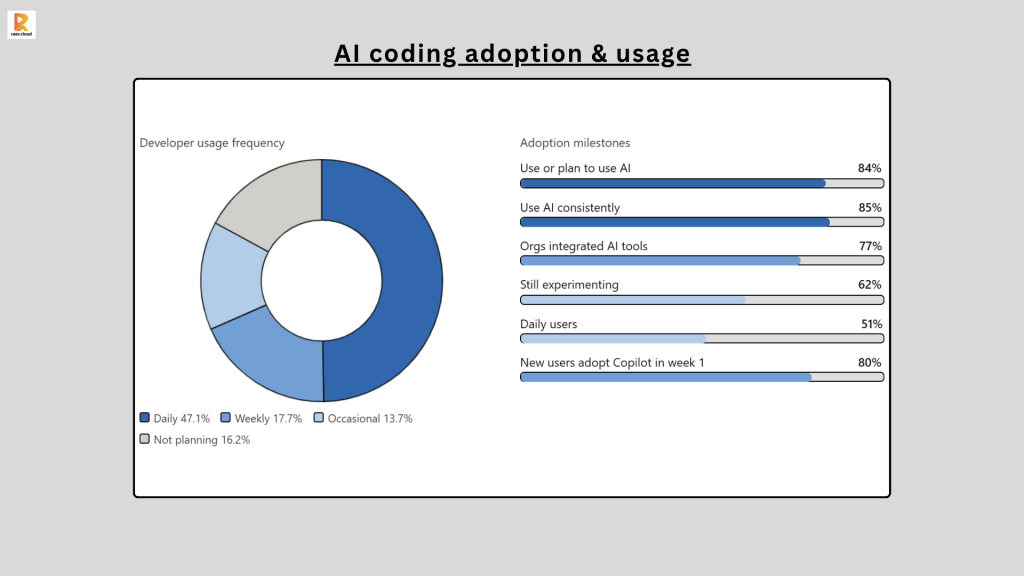
- A large majority is involved, as 84% of developers either use or plan to use AI tools in their work.
- Daily usage is now common, with 51% of developers relying on AI every day for coding tasks.
- Looking at usage patterns, developers report 47.1% daily use, 17.7% weekly use, and 13.7% occasional use.
- Not everyone has adopted AI yet, since 16.2% of developers say they do not plan to use these tools.
- AI has become a regular part of development, and 85% of developers now use it consistently for coding, debugging, or review.
- Among new users, adoption happens fast, with 80% starting to use Copilot within their first week on GitHub.
- At the company level, 77% of organizations have integrated coding assistants into their workflows.
- Many teams are still in the testing phase, as 62% of organizations continue to experiment with AI tools.
- For most developers, AI is no longer optional, and around 80% treat it as a standard part of their coding process.
Developer Sentiment and Trust in AI
Developers use AI tools often, but they do not fully trust them. Many review outputs before using them in real projects. Trust depends on accuracy, experience, and task type. Overall, confidence in AI has dropped even as usage grows.
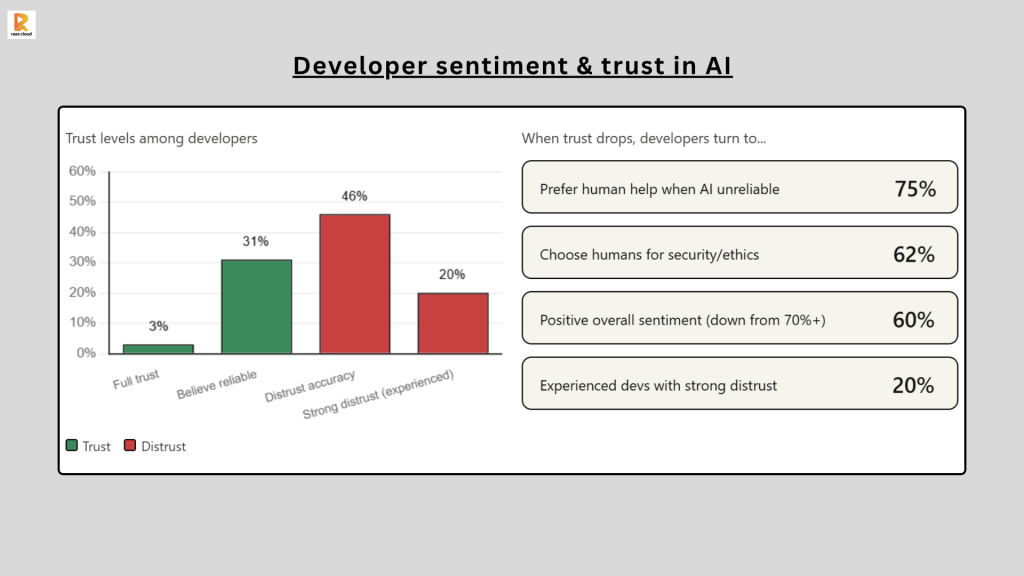
- Only about 60% of developers now feel positive about AI tools, which is lower than previous years.
- Earlier sentiment was higher, but it has dropped from over 70% in past years to around 60% now.
- Trust remains limited, as only 29% to 33% of developers believe AI output is reliable.
- Very few show strong confidence, with just 3% saying they fully trust AI-generated code.
- Distrust is also high, since 46% of developers say they do not trust AI accuracy.
- Among experienced developers, confidence is even lower, with only 2.6% showing high trust in AI output.
- At the same time, 20% of experienced developers show strong distrust, which highlights growing caution.
- When confidence drops, developers turn to people, as 75% prefer human help when they do not trust AI answers.
- For critical concerns like security or ethics, 61.7% choose human input over AI suggestions.
AI Capability and Task Confidence
AI tools help with simple tasks, but developers still question their ability in complex work. Confidence drops when tasks involve risk or deep logic. Many developers feel AI is useful but not fully reliable for advanced coding problems.
- Many see some value but not full reliability, with 25.2% saying AI performs well but still needs improvement.
- 4.4% of developers say AI handles complex tasks very well, which shows limited strong confidence.
- A neutral view exists among users, where AI performance is seen as neither good nor bad at 14.1%.
- Poor performance in complex scenarios is reported by developers, reaching 22%.
- 17.6% rate AI as very poor for handling advanced tasks, which highlights strong negative perception.
- Some developers avoid using AI for difficult work, with 16.8% choosing not to rely on it for complex tasks.
AI Use Cases in Development Workflow
Developers use AI tools more for support tasks than critical work. They rely on AI to speed up learning, writing, and small fixes. High-risk tasks still see lower adoption. Usage depends on how safe and reliable the task feels.
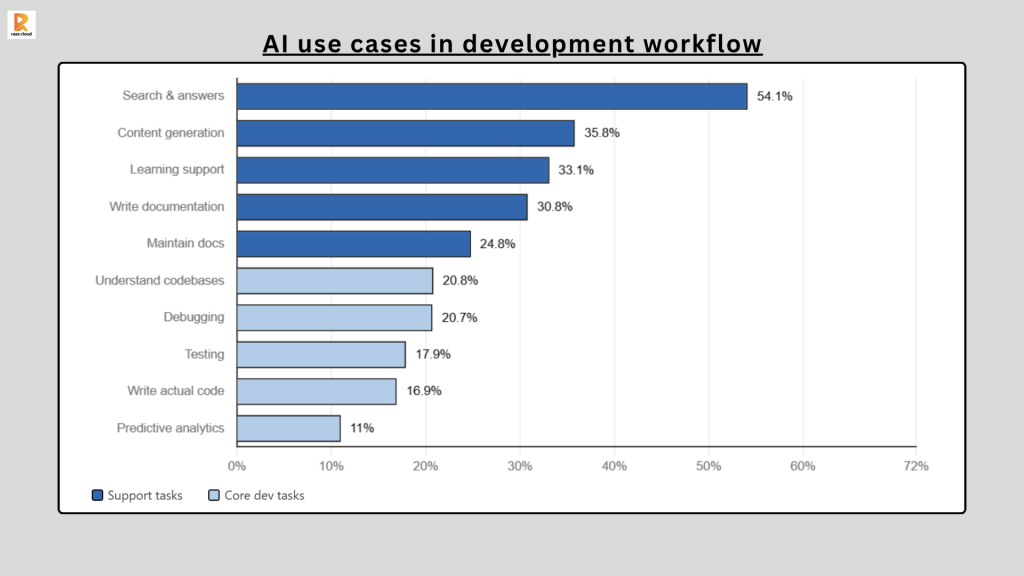
- Developers mostly depend on AI to find quick solutions, with 54.1% using it for search and answers.
- 35.8% of developers use AI for content generation, which includes code snippets and synthetic data.
- Learning support is also common, as developers rely on AI to understand new tools, reaching 33.1% usage.
- AI helps with documentation tasks, and 30.8% use it to write or improve code documentation.
- Some teams also use AI to maintain docs, where adoption stands at 24.8%.
- 20.8% of developers use AI to understand existing codebases, especially in large projects.
- Debugging support remains limited, with usage reported at 20.7% among developers.
- Testing is another smaller use case, where 17.9% rely on AI for test creation and validation.
- Core coding still sees caution, as only 16.9% use AI to write actual code.
- Predictive use cases are rare, with 11% using AI for analytics or forecasting tasks.
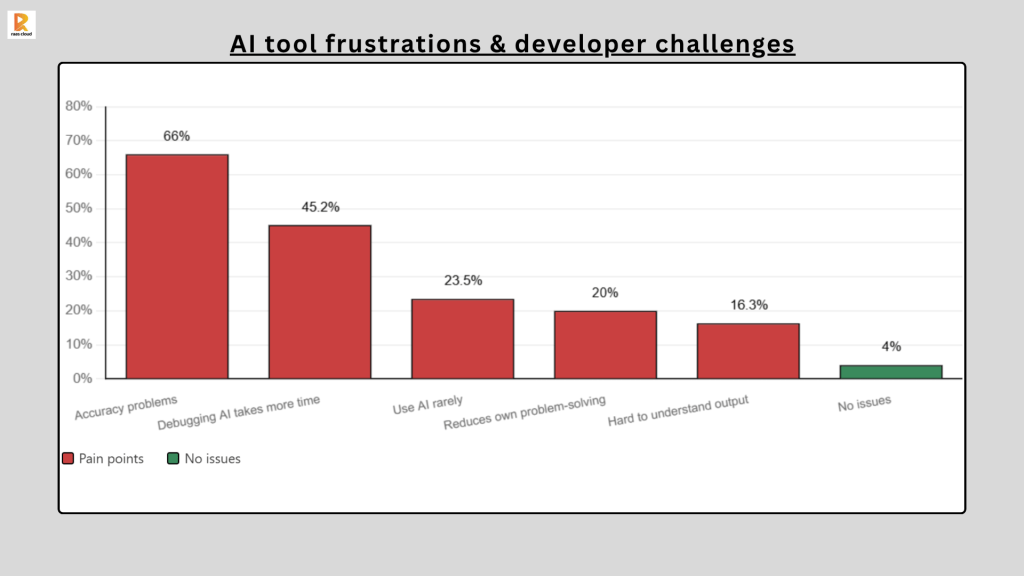
AI Tool Frustrations and Developer Challenges
AI tools help speed up work, but they also create new problems. Developers often deal with outputs that are close but not fully correct. This leads to more checking and fixing. Many users also struggle to understand how AI-generated code works.
- Accuracy is the biggest issue, as 66% of developers say AI outputs are almost correct but not fully right.
- 45.2% of developers say debugging AI-generated code takes more time, which slows down overall workflow.
- Some developers do not rely on AI often, and this group accounts for 23.5% of users.
- Confidence drops for some users, with 20% saying AI reduces their own problem-solving ability.
- Understanding AI output is still a challenge, reported by 16.3% of developers.
- 11.6% of users report other issues, which vary based on use case and experience.
- A small group faces no issues at all, which stands at 4%.
AI Agents Adoption and Use Cases
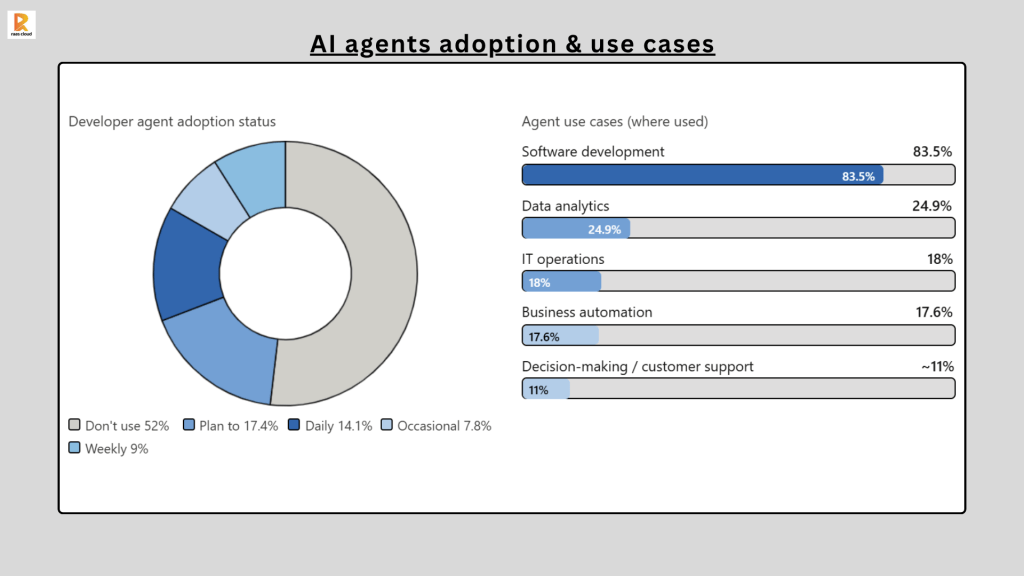
AI agents are still new for many developers. Some teams use them for advanced workflows, while others rely on basic AI tools. Adoption depends on skill level and use case. Many developers are still exploring how to use agents effectively.
- Many developers have not adopted agents yet, as 52% say they do not use AI agents in their work.
- 14.1% of developers use AI agents daily, showing early but limited regular usage.
- Weekly usage is lower, with 9% using agents on a weekly basis.
- Occasional usage exists too, where developers use agents less frequently, at 7.8%.
- Some developers plan to adopt soon, and this group stands at 17.4%.
- A segment still prefers simpler tools, with 13.8% using only Copilot-style autocomplete instead of agents.
- Many users avoid adoption completely, as 37.9% say they do not plan to use AI agents.
- In real work scenarios, agents are mainly used for coding tasks, reaching 83.5% usage in software development.
- Beyond coding, agents support other areas, including 24.9% in data analytics and 18% in IT operations.
- Business functions also use agents, with 17.6% for automation and around 11% each for decision-making and customer support tasks.
AI Agents Impact, ROI, and Challenges
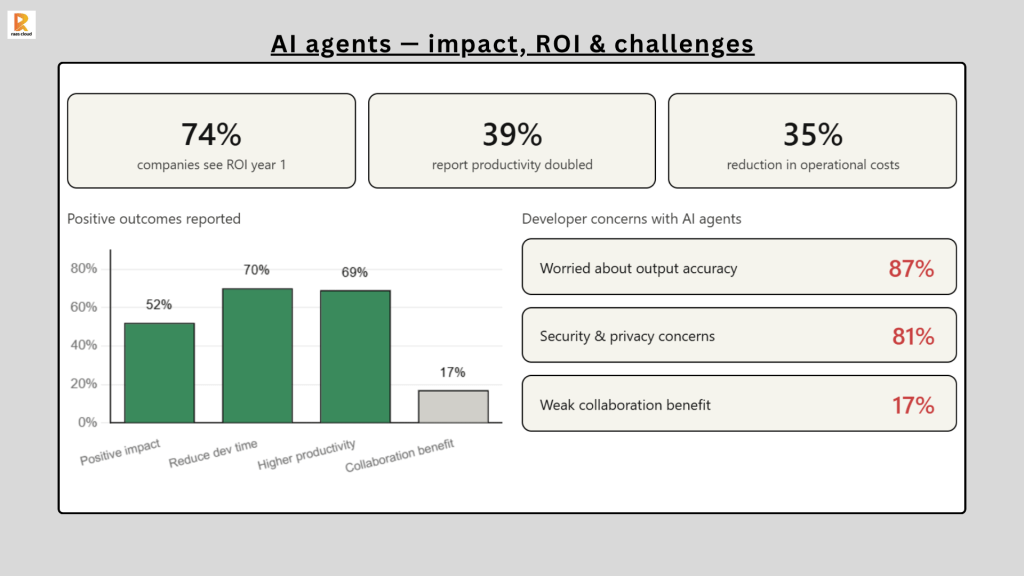
AI agents help improve speed and output, but their impact is not equal across all teams. Many companies see strong gains in efficiency and cost savings. At the same time, concerns around accuracy and collaboration still exist.
- Productivity improves with AI agents, as 52% of developers report a positive impact on their work.
- 70% of users say agents reduce the time spent on development tasks, which shows clear efficiency gains.
- Many also see output improvement, with 69% reporting higher productivity after using AI agents.
- Collaboration remains weak, and only a small share of teams benefit from it, at 17%.
- Strong business value is visible, as 74% of companies achieve ROI within the first year of using AI agents.
- 39% of organizations report that productivity has at least doubled after adoption.
- Companies gain efficiency, with 55% higher operational performance reported after using AI agents.
- Cost savings also play a role, as 35% reduction in operational costs is achieved in many cases.
- Accuracy remains a concern, with 87% of developers worried about the correctness of AI outputs.
- Data risks are also high, and 81% report concerns around security and privacy when using AI agents.
AI Tools and Ecosystem
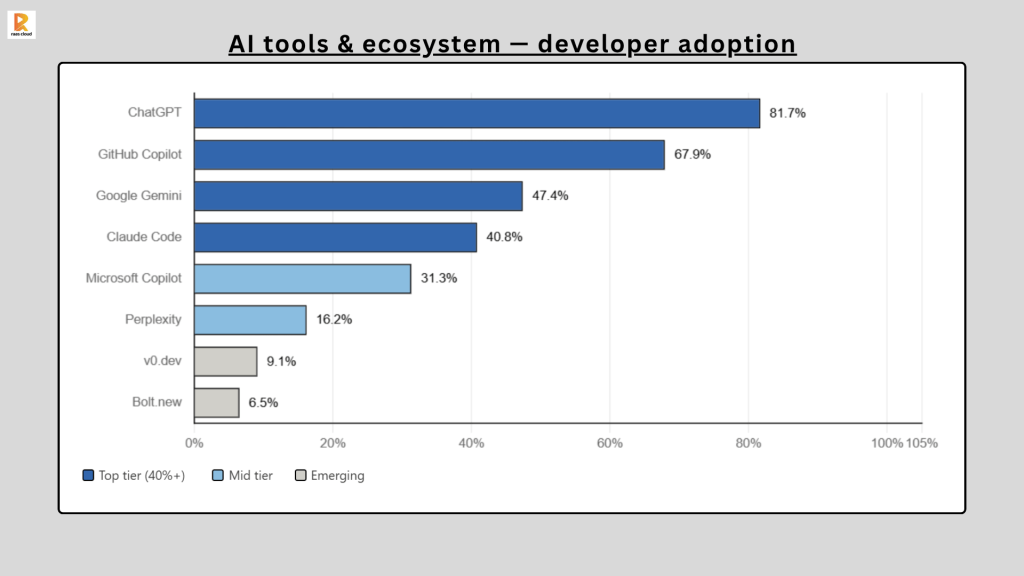
The AI coding space now includes many tools and platforms. Developers choose tools based on ease of use, output quality, and integration. Both open source and enterprise tools shape this ecosystem. New tools continue to enter and compete in this space.
- Developers widely use conversational AI tools, with ChatGPT leading adoption at 81.7%.
- 67.9% of developers use GitHub Copilot, making it one of the most common coding assistants today.
- Usage of other tools is growing, as 47.4% rely on Google Gemini for development support.
- 40.8% adoption of Claude Code shows rising interest in alternative AI coding tools.
- Platform integration is also visible, with 31.3% using Microsoft Copilot across systems.
- Some developers explore alternatives, where usage of Perplexity reaches 16.2%.
- 9.1% of developers use v0.dev, while Bolt.new follows with 6.5% adoption.
- Smaller tools still exist in the ecosystem, including 5.7% using Lovable.dev and around 5% using AgentGPT, Tabnine, and Replit.
- Framework usage is strong, as 51.1% use Ollama and 32.9% use LangChain to build AI workflows.
- Infrastructure tools support these systems, with 42.9% using Redis and 43% using Grafana with Prometheus for monitoring.
Enterprise Adoption and AI Maturity Gap
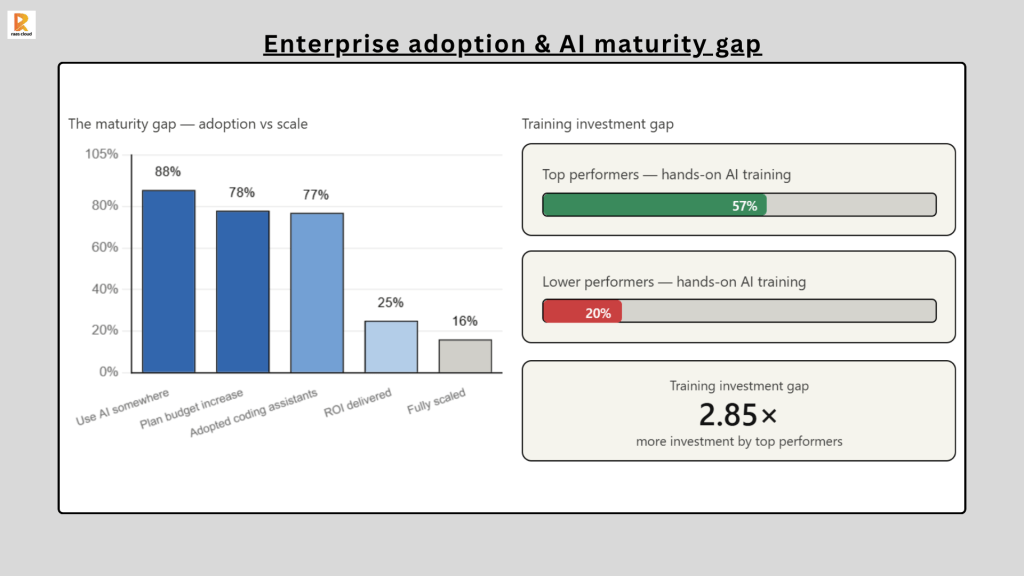
Companies are adopting AI tools at a fast pace. Many teams use AI in daily work, but only a few scale it across the whole organization. There is also a gap between companies that train teams well and those that do not. This creates differences in results and return.
- Many organizations already use AI tools in development, with coding assistants adopted by 77% of high-adoption companies.
- Content-related AI tools are also common, and 65% of organizations use them for generating or supporting work.
- Documentation support is growing, as 57% rely on AI tools to search and manage documentation.
- 88% of organizations use AI in at least one part of their business, which shows wide but shallow adoption.
- Spending is increasing across industries, with 78% of companies planning to increase their AI budgets.
- Full-scale implementation is still rare, since only 16% of organizations have successfully scaled AI across the enterprise.
- ROI remains a challenge, with just 25% of AI initiatives delivering expected results.
- Top-performing companies invest more in people, as 57% provide hands-on AI training and workshops.
- In comparison, only 20% of lower-performing organizations invest in similar training efforts.
Code Quality, Errors, and Security Risks
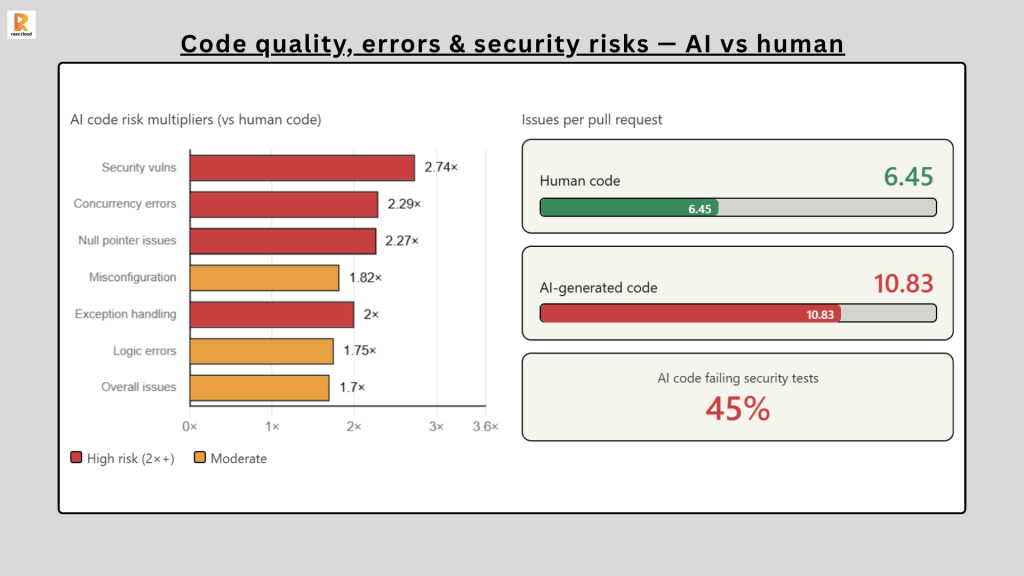
AI helps speed up coding, but it also increases errors and risks. Many issues come from logic gaps and weak validation. Small mistakes can create bigger problems in real systems. Teams now spend more time reviewing and fixing AI-generated code.
- AI-generated code creates more issues overall, with 1.7 times higher problem rates compared to human-written code.
- 10.83 issues per pull request appear in AI-generated code, compared to 6.45 in human code.
- Logic problems increase significantly, as 75% more logic errors are found in AI-generated code.
- Readability drops in many cases, with AI output showing over 3 times more readability issues.
- Error handling is weaker, where AI introduces nearly 2 times more gaps in exception handling.
- 1.82 times higher misconfiguration errors are seen in AI-generated code compared to human-written code.
- Concurrency issues rise sharply, with 2.29 times more errors in AI-generated code.
- 2.27 times more null pointer issues appear, which increases the risk of runtime failures.
- Security risks are higher overall, with 2.74 times more vulnerabilities found in AI-generated code.
- Many outputs fail validation, as 45% of AI-generated code does not pass security tests.
Productivity, Workflow Changes, and Future Trends
AI is changing how developers work every day. Teams now complete tasks faster but also handle more review work. Productivity gains are clear, but workflows are also becoming more complex. Future development will depend on how well teams balance speed with quality.
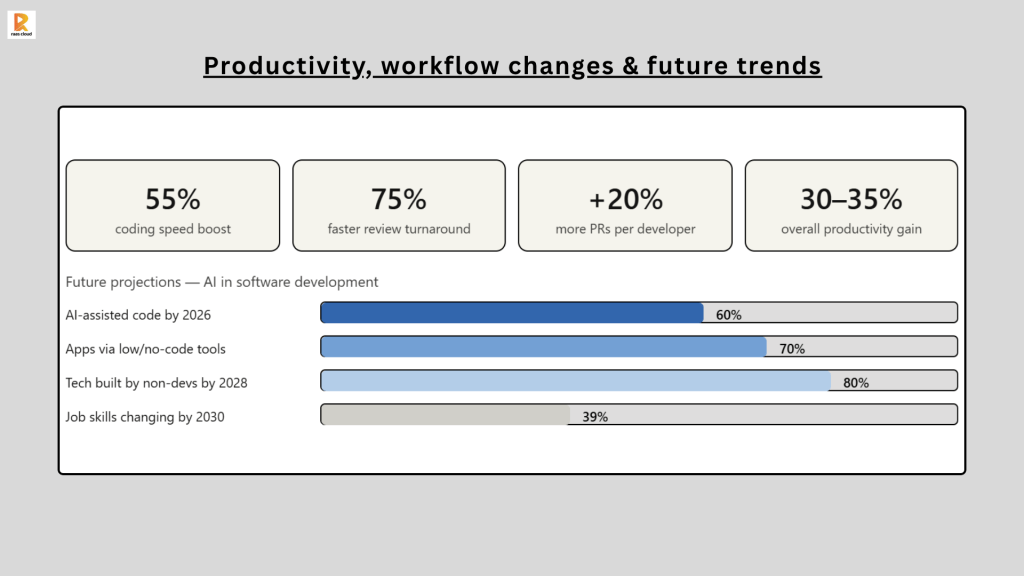
- Developers complete tasks faster with AI support, showing up to 55% improvement in coding speed.
- 20% more pull requests are created per developer when AI tools are used in daily workflows.
- Output growth also brings challenges, as 23.5% more incidents occur per pull request with AI usage.
- Review cycles are shorter, with turnaround time dropping by 75% when AI tools are used.
- Overall efficiency improves across teams, reaching 30% to 35% productivity gains in development processes.
- 280,000 developer hours have been saved in large organizations using internal AI tools.
- Future trends show growing dependence, as 60% of code is expected to be AI-assisted by 2026.
- Skill requirements are shifting, with 39% of job skills expected to change due to AI by 2030.
- Development is becoming more accessible, and 70% of applications may use low-code or no-code tools.
- 80% of tech products could be built by non-developers by 2028, which shows a major shift in how software is created.
Market Growth and Investment Trends
AI coding is growing fast across industries. Companies invest more money to build and use AI tools. Startups and large firms both see AI as a strong advantage. This growth shows that AI will play a bigger role in software development.
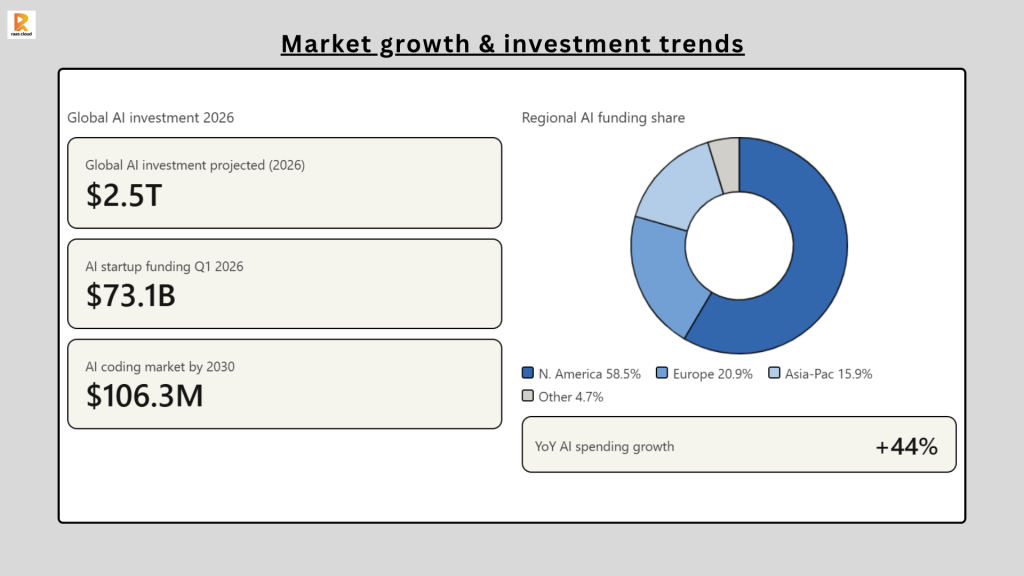
- Investment in AI coding is rising, with the market expected to reach $106.3 million by 2030.
- $73.1 billion was raised by AI startups in Q1 2026, which shows strong funding momentum.
- A large share of capital goes to AI, as 57.9% of total venture funding focused on AI in that quarter.
- Regional dominance is clear, with North America holding 58.5% of the total AI funding market.
- Europe and Asia-Pacific also contribute, accounting for 20.9% and 15.9% market share respectively.
- Overall spending is increasing fast, as global AI investment is projected to hit $2.5 trillion in 2026.
- Growth remains strong year over year, with 44% increase in AI spending across industries.
- 78% of organizations plan to increase their AI budgets, which signals continued expansion.
- AI is now a strategic focus, with 90% of businesses viewing it as a competitive advantage.
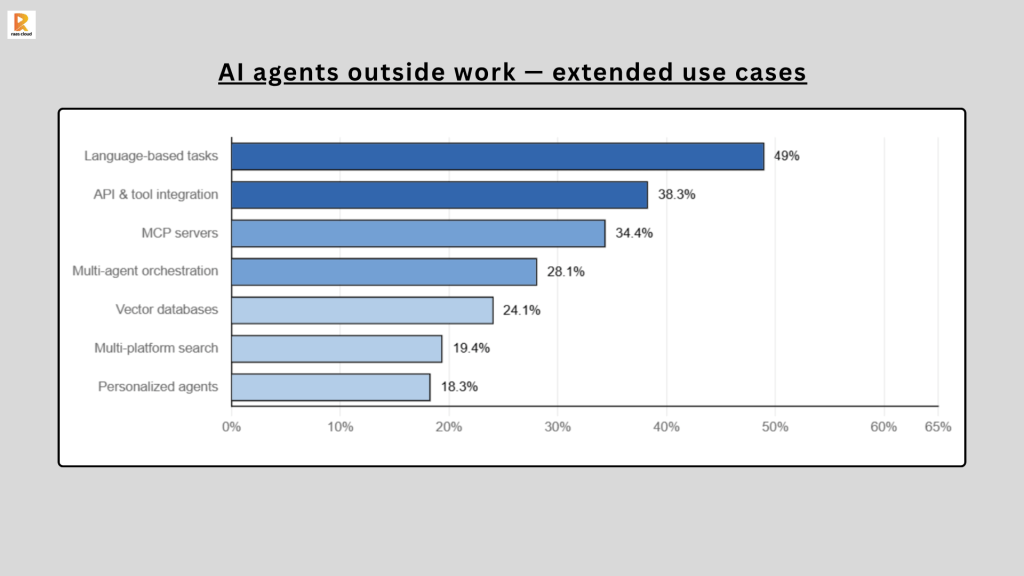
AI Agents Outside Work and Extended Use
AI agents are not only used in coding jobs. Many developers also use them for personal and experimental tasks. These use cases show how flexible AI agents are. Adoption outside work helps developers learn and test new workflows.
- Language-based tasks are the most common, with usage reaching 49% among developers.
- API and tool integration is another major use case, where 38.3% of users rely on agents to connect systems.
- Developers also explore advanced setups like MCP servers, used by 34.4% of users.
- 28.1% of developers use multi-agent orchestration, which helps manage complex workflows.
- Data-focused applications are growing, with 24.1% using vector databases in agent systems.
- Cross-platform tasks are supported as well, and 19.4% of users apply agents for multi-platform search.
- 18.3% of developers create personalized AI agents, which shows growing customization trends.
AI Agent Infrastructure and Observability Tools
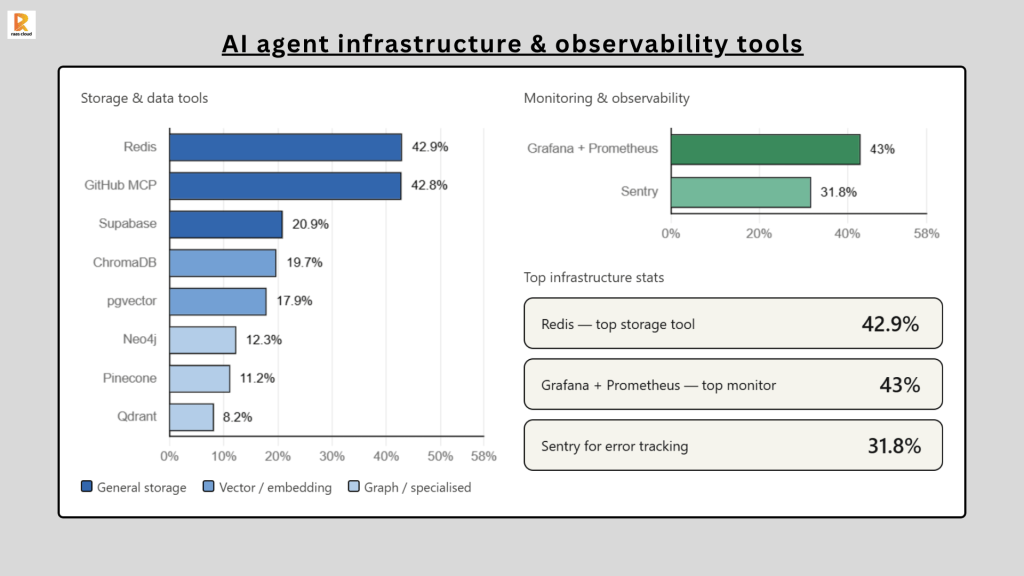
AI agents need strong systems to manage data, workflows, and performance. Developers use a mix of storage tools, frameworks, and monitoring platforms. Both open source and enterprise tools support this setup. These tools help teams build reliable and scalable AI systems.
- Data storage plays a key role, with Redis used by 42.9% of developers for managing agent data.
- GitHub MCP servers are also common, reaching 42.8% usage for handling agent workflows.
- Some developers prefer modern platforms, as 20.9% use Supabase for backend and data needs.
- 19.7% rely on ChromaDB, which supports vector-based AI applications.
- Structured database use continues, with 17.9% using pgvector for embedding storage.
- Graph-based storage is also used, where 12.3% of developers work with Neo4j.
- Specialized vector tools like Pinecone see 11.2% adoption among developers.
- 8.2% of users rely on Qdrant for handling AI data workloads.
- Monitoring remains important, with Grafana and Prometheus used by 43% of developers for observability.
- Error tracking tools are also common, as 31.8% use Sentry to monitor system issues.
Human vs AI Preference in Development
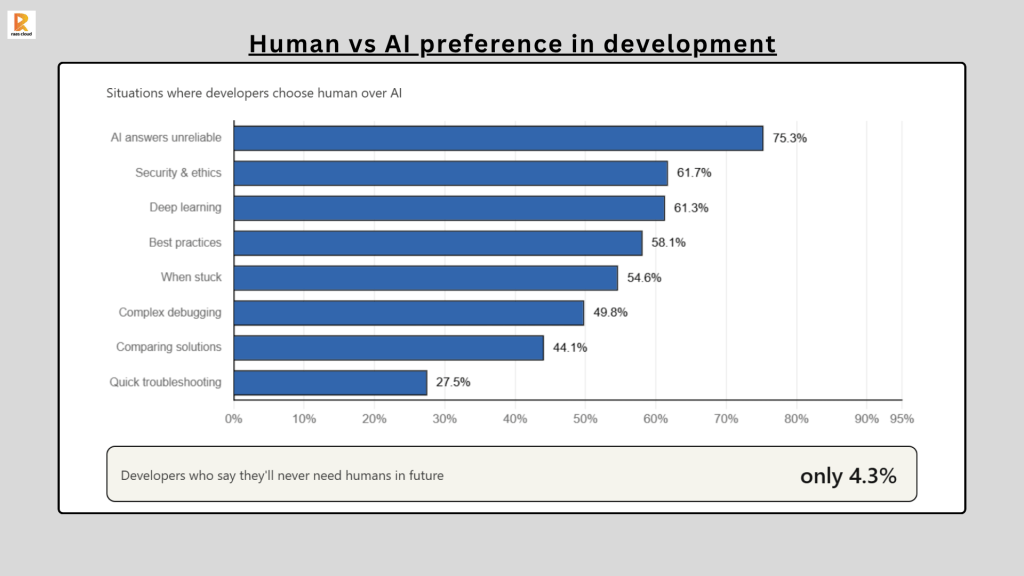
Developers use AI tools often, but they still depend on human support in many situations. Trust, understanding, and risk drive this behavior. For complex or sensitive tasks, people remain the final decision makers. This shows that AI supports developers but does not replace them.
- Developers turn to humans when trust is low, with 75.3% seeking help when AI answers feel unreliable.
- For security and ethics, 61.7% of developers rely on human input instead of AI.
- Learning and deep understanding still depend on people, as 61.3% prefer human explanations.
- 58.1% of developers ask humans for best practices, especially in structured development work.
- When they get stuck, many developers choose human help, which reaches 54.6%.
- Complex debugging often needs human input, with 49.8% seeking help for unfamiliar code.
- Comparing different solutions is another case, used by 44.1% of developers.
- 27.5% rely on humans for quick troubleshooting, even for smaller issues.
- Very few developers reject human help, with only 4.3% saying they will not need people in the future.
Vibe Coding and Developer Behavior Shift
Developers are trying new ways of coding with AI, but not all trends become popular. Some methods get attention but stay limited in real use. At the same time, AI is changing how developers think, learn, and solve problems. These shifts show how developer behavior is evolving.
- Most developers are not using vibe coding, with 72% saying it is not part of their workflow.
- A small group strongly avoids it, as 5% clearly state they do not want to use vibe coding at all.
- 12% of developers actively use vibe coding, which shows early but limited adoption.
- Confidence is changing with AI use, and 20% of developers say AI reduces their own problem-solving ability.
- Some developers step back from frequent use, where 23.5% say they do not use AI tools regularly.
Additional Industry Signals and Tool Growth
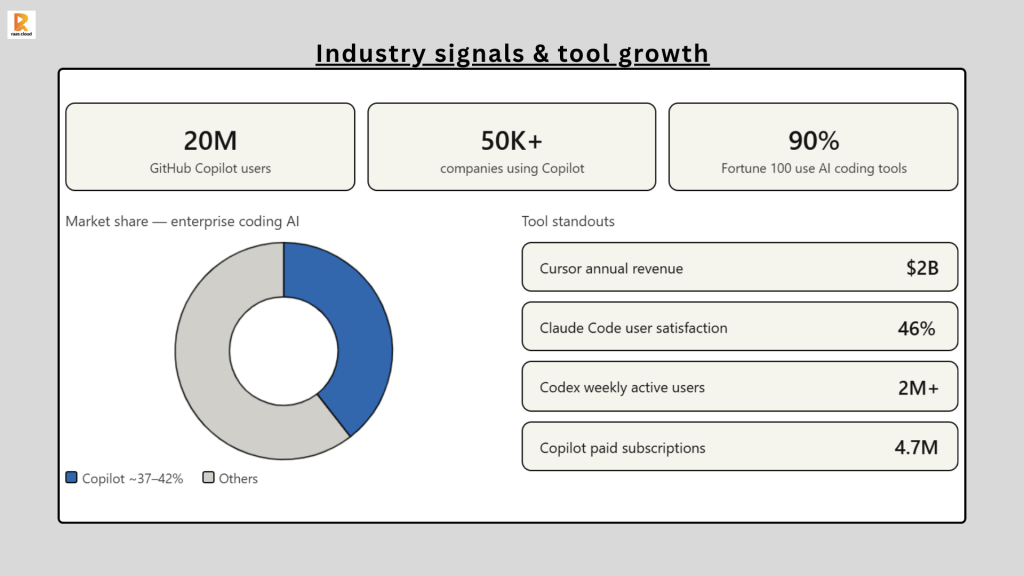
AI coding tools are growing fast across the industry. Both startups and large companies are investing in new tools. Adoption is rising at both individual and enterprise levels. This shows strong demand and rapid competition in the AI coding space.
- Regular usage is now very common, and 85% of developers use AI tools for coding, debugging, or review tasks.
- 20 million users have adopted GitHub Copilot, which shows how fast AI coding tools are scaling.
- Paid adoption is also rising, with subscriptions reaching 4.7 million users globally.
- The number of organizations using these tools is growing, crossing 50,000 companies worldwide.
- Enterprise reliance is strong, as 90% of Fortune 100 companies use AI coding tools like Copilot.
- New competitors are growing fast, with Cursor reaching $2 billion in annual revenue.
- Market competition is increasing, with Copilot holding around 37% to 42% enterprise market share.
- Developer preference varies across tools, where Claude Code reaches 46% satisfaction among users.
- Usage of newer tools is also rising, with Codex reaching over 2 million weekly active users.
💡 Further resources:
- How Small Businesses Can Use AI Without An In-house Tech Team
- Enterprise AI Implementation
- How to Build an AI Agent for Customer Support
Turn AI Coding Into Real Results With RAAS Cloud
AI coding is changing how software gets built, but real results depend on how well you use it. Many teams use AI tools, but struggle to turn them into scalable and reliable systems. Speed alone is not enough. You need the right strategy, clean implementation, and strong integration.
This is where the right technology partner makes a difference.
With over 60+ projects, 40+ clients, and a team of 50+ experts, RAAS Cloud support companies in building scalable, secure, and practical AI solutions. With proven AI Consulting Services experience across industries, their team supports everything from AI strategy and roadmap planning to implementation and optimization.
They help you build custom AI-powered applications, automate workflows, deploy intelligent chatbots, and use predictive analytics to improve decision-making. Their focus stays on creating systems that are scalable, secure, and aligned with real business goals.
If you want to move beyond experiments and build AI systems that actually deliver results, RAAS Cloud gives you the expertise and execution needed to make it happen.
Data Sources
- https://www.inboundmarketer.co/how-much-code-will-be-ai-generated-between-2025-2030/
- https://survey.stackoverflow.co/2025/ai
- https://modall.ca/blog/ai-in-software-development-trends-statistics
- https://www.grandviewresearch.com/industry-analysis/generative-ai-coding-market-report
- https://www.reuters.com/legal/transactional/ai-startup-valuations-raise-bubble-fears-funding-surges-2025-10-03/
- https://www.iconiqcapital.com/growth/reports/2025-state-of-ai
- https://cloud.google.com/transform/roi-of-ai-how-agents-help-business
- https://blog.workday.com/en-us/the-strategic-bets-companies-are-making-on-ai.html
- https://itsconchur.substack.com/p/41-of-code-is-now-ai-generated-should
- “https://www.coderabbit.ai/whitepapers/state-of-AI-vs-human-code-generation-report
- https://www.coderabbit.ai/blog/state-of-ai-vs-human-code-generation-report”
- https://devecosystem-2025.jetbrains.com/
- https://www.gartner.com/en/newsroom/press-releases/2026-1-15-gartner-says-worldwide-ai-spending-will-total-2-point-5-trillion-dollars-in-2026
- https://www.getpanto.ai/blog/github-copilot-statistics
- https://survey.stackoverflow.co/2025/ai
- https://www.veracode.com/blog/spring-2026-genai-code-security/
- https://www.getpanto.ai/blog/github-copilot-statistics
- https://techcrunch.com/2026/03/02/cursor-has-reportedly-surpassed-2b-in-annualized-revenue/
- https://www.bloomberg.com/news/articles/2026-03-12/ai-coding-startup-cursor-in-talks-for-about-50-billion-valuation
- https://www.digitalapplied.com/blog/ai-dev-tool-power-rankings-march-2026-claude-gemini-windsurf
- https://dev.to/alexcloudstar/claude-code-vs-cursor-vs-github-copilot-the-2026-ai-coding-tool-showdown-53n4
- https://www.mckinsey.com/capabilities/tech-and-ai/our-insights/the-ai-revolution-in-software-development
- https://www.mckinsey.com/capabilities/quantumblack/our-insights/the-state-of-ai
- https://www.mckinsey.com/capabilities/quantumblack/our-insights/the-state-of-ai
- https://resources.anthropic.com/2026-agentic-coding-trends-report
- https://resources.anthropic.com/2026-agentic-coding-trends-report
- https://www.deloitte.com/us/en/insights/industry/technology/technology-media-telecom-outlooks/software-industry-outlook.html
- https://www.deloitte.com/us/en/insights/industry/technology/technology-media-telecom-outlooks/software-industry-outlook.html
- https://newsroom.ibm.com/2025-05-06-ibm-study-ceos-double-down-on-ai-while-navigating-enterprise-hurdles
- https://thinksys.com/qa-testing/qa-trends-report-2026/
- https://github.blog/news-insights/octoverse/octoverse-a-new-developer-joins-github-every-second-as-ai-leads-typescript-to-1/
- https://www.morganstanley.com/insights/articles/ai-software-development-industry-growth
- https://github.blog/news-insights/octoverse/octoverse-a-new-developer-joins-github-every-second-as-ai-leads-typescript-to-1/

Dhanalakshmi Kadirvelu is a Business Intelligence and Data Analytics expert with a strong focus on software development and data engineering. She creates efficient data models, builds interactive dashboards, and integrates analytics into software systems using Power BI, OBIEE, and SQL. Her work helps development teams use data effectively to create smarter software solutions and improve business performance.