When a company decides to build or modernize an ERP system, it is never a short-term product decision. ERP software becomes the backbone of your business operations, handling finance, inventory, HR, procurement, and reporting. All your company’s critical data and workflows depend on how well this system is designed and maintained.
If the team chooses the wrong tech stack for ERP, the impact lasts for years. Poor decisions lead to performance issues, integration failures, rising maintenance costs, and long-term technical debt that becomes difficult to reverse. ERP systems today need to be scalable, secure, integration-ready, and flexible enough to evolve with business growth.
At RAAS Cloud, we offer ERP software development services and have built 50 plus ERP systems for global businesses across multiple industries. Based on our experience working with different ERP architectures and technology stacks, we have prepared this guide to help CTOs make the right tech stack decisions. You will find deep industry insights and practical guidance that most ERP blogs never share, helping you plan an ERP system that works reliably for the long term.
What Makes ERP Software Technically Different From Other Systems
While we understand that this guide is written for CTOs who already have strong technical knowledge, it is still important to align on what truly defines an ERP system at a technical level.
ERP software is not just another business application. It is a centralized platform that manages multiple core business functions such as finance, procurement, inventory, HR, manufacturing, and reporting within a single system. Every module in an ERP shares data, rules, and dependencies, which makes technical decisions far more critical than in standalone applications.
What Makes ERP Different?
Here is what technically separates ERP software from other systems:
- A single source of truth where multiple departments read and write to the same core data sets
- Strong transactional integrity requirements across finance, inventory, and operations
- High concurrency with hundreds or thousands of users performing simultaneous actions
- Deep dependency between modules where one workflow impacts several business functions
- Complex role-based access control at both feature and data level
- Heavy reliance on integrations with CRM, payroll, banking, tax, and reporting systems
- Long system lifespan with continuous upgrades rather than full rebuilds
- Strict auditability and traceability requirements for every critical business action
These characteristics make ERP systems far more sensitive to architectural and tech stack choices than most applications. A decision that works for a SaaS product may fail badly in an ERP environment. Now, let us take a look at the core ERP architecture models in 2026 and how CTOs should evaluate them.
Core ERP Architecture Models in 2026
Every ERP software is built on an architectural foundation that decides how well it scales, integrates, and survives long-term business change. In 2026, ERP architecture decisions are less about trends and more about controlling complexity, data consistency, and operational risk.
Here are the core ERP architecture models CTOs should evaluate carefully.
Monolithic ERP vs Modular ERP
Most ERP systems fall into one of these two categories. Understanding the difference is critical before choosing a tech stack.
| Aspect | Monolithic ERP | Modular ERP |
| Codebase structure | Single tightly coupled codebase | Separate modules with defined boundaries |
| Deployment | Entire ERP deployed together | Modules can be deployed independently |
| Data consistency | Easier to enforce | Requires clear data contracts |
| Scalability | Harder to scale selectively | Individual modules can scale |
| Change impact | Small change affects entire system | Changes isolated to modules |
| Best suited for | Small to mid-sized ERP with stable scope | Growing ERP with evolving business needs |
From our experience, monolithic ERP systems work only when the scope is limited and unlikely to change. As soon as finance, inventory, and operations start evolving independently, modular ERP becomes far more manageable.
Microservices for ERP Where They Actually Make Sense
Microservices are often overused in ERP projects, leading to unnecessary complexity. In ERP systems, microservices make sense only for specific domains that meet these conditions:
- The domain has high independent scalability needs
- The domain has clear data ownership
- The domain integrates with multiple external systems
Examples where microservices work well in ERP:
- Reporting and analytics engines
- Notification and alert systems
- Integration hubs for external platforms
- Document processing and audit logging services
Core transactional domains like general ledger or inventory balance should rarely be split into microservices because they depend heavily on strong consistency and transactional guarantees.
Event-Driven ERP Architecture for Finance, Inventory, and Ops
Event-driven architecture has become extremely valuable for modern ERP systems. Instead of tightly coupled synchronous workflows, ERP modules communicate using business events.
Examples of ERP events:
- Invoice created
- Inventory stock updated
- Purchase order approved
- Payment received
- Shipment dispatched
This approach allows:
- Finance to react to operational changes without blocking transactions
- Inventory to update availability asynchronously
- Operations to trigger workflows without hard dependencies
Event-driven ERP architectures improve resilience and allow better scalability, especially when combined with modular or hybrid designs.
When Hybrid ERP Architecture Makes Sense
In most real-world ERP systems, a pure monolithic or pure microservices approach rarely works. This is where hybrid architecture becomes the most practical choice.
At RAAS Cloud, we often recommend a hybrid ERP architecture where:
- Core transactional modules like finance and inventory remain tightly controlled
- Supporting modules like reporting, integrations, and notifications run independently
- Event-driven communication connects modules without breaking data integrity
For example, in one ERP system we built for a manufacturing client, the core finance and inventory modules were kept modular but tightly coupled, while reporting, supplier portals, and external ERP integrations were built as independent services. This reduced deployment risk while allowing the business to scale reporting and integrations without touching core financial logic.
Key Components of a Modern ERP Tech Stack
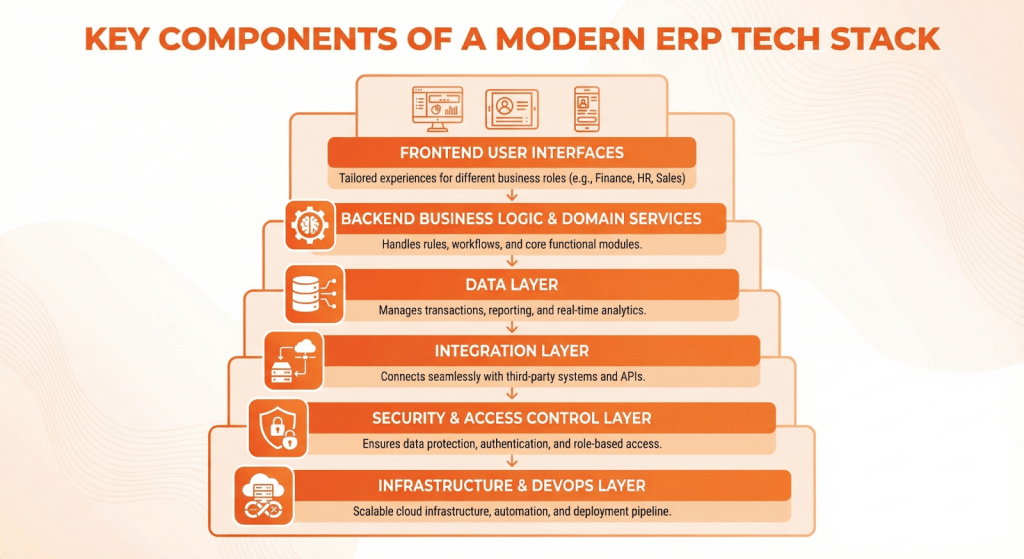
ERP systems are built on multiple interconnected components that work together to support complex business operations. Each layer plays a specific role and must be designed carefully to avoid performance bottlenecks and long-term maintenance issues. Let us take a closer look at the key components that form the foundation of a modern ERP tech stack.
1. Frontend user interfaces for different business roles
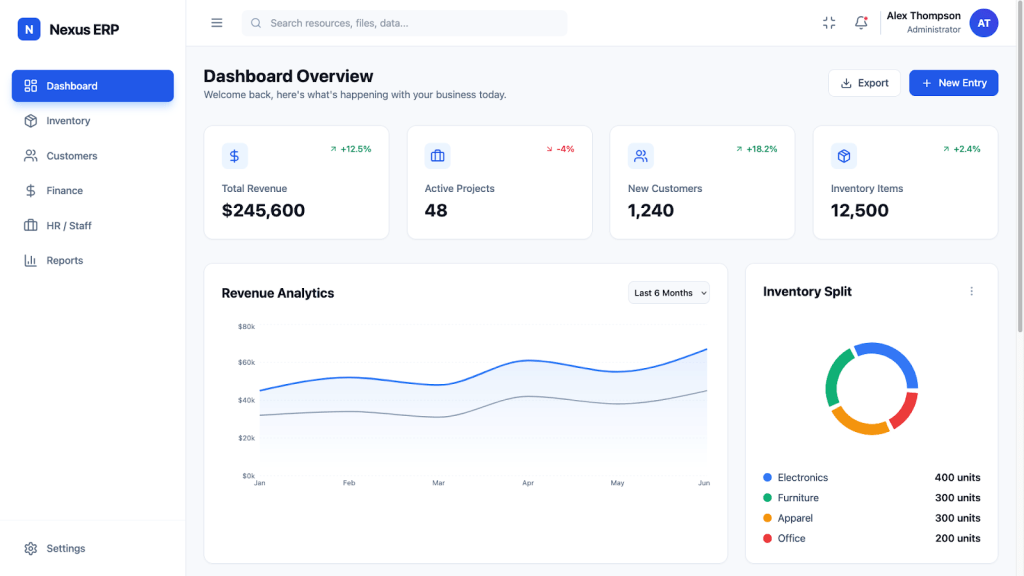
ERP systems serve many users with very different responsibilities. Finance teams, warehouse managers, HR, procurement, and leadership all interact with the system in different ways. The frontend layer must support role-based dashboards, task-driven screens, and data-heavy workflows without slowing users down.
ERP frontends are not about visual polish alone. They must handle large forms, tables, validations, and real-time status updates efficiently. Poor frontend design leads to low adoption even if backend logic is strong. This layer must also support permissions so users only see what is relevant to their role, which directly affects security and usability.
2. Backend business logic and domain services
The backend is the core of any ERP system. This is where all business rules, validations, workflows, and calculations live. ERP backend logic handles critical processes like accounting entries, inventory movements, approvals, payroll calculations, and compliance checks. This layer must be stable, predictable, and easy to extend over time.
ERP backends usually follow strong domain modeling so changes in one module do not break others. Poor backend design leads to fragile systems that become difficult to modify as the business grows. This is why backend technology choices matter more in ERP than in most applications.
3. Data layer for transactions and reporting
The data layer manages how information is stored, updated, and retrieved across the ERP system. It must support both high-volume transactions and complex reporting without conflicts. ERP data design requires careful separation between operational data and analytical workloads to avoid performance issues.
Key responsibilities of the data layer include:
- Transactional data storage
- Historical record keeping
- Reporting and analytics queries
- Data integrity and consistency
- Backup and recovery processes
A well-designed data layer ensures accurate reporting and reliable system behavior even under heavy load.
4. Integration layer for third-party systems
Modern ERP systems rarely work in isolation. They must integrate with CRM tools, payroll systems, banking platforms, tax services, logistics providers, and BI tools. The integration layer manages how data flows between ERP and external systems. This layer must handle data mapping, error handling, retries, and security.
Poor integration design is one of the most common reasons ERP projects fail. A strong integration layer ensures that external system issues do not break core ERP operations and that data stays consistent across platforms.
5. Security and access control layer
ERP systems handle sensitive financial, employee, and operational data. The security layer controls who can access what and under which conditions. This includes role-based access, data-level permissions, audit logs, and compliance controls. Security must be built into the system from the start rather than added later.
ERP security also needs to support internal audits, regulatory requirements, and traceability of actions. Weak access control can expose critical data or allow unauthorized changes that impact business operations.
6. Infrastructure and DevOps layer
The infrastructure layer defines how the ERP system is hosted, deployed, monitored, and scaled. ERP systems require high availability, predictable performance, and controlled deployments.
DevOps processes help manage updates without disrupting daily operations. This layer includes cloud setup, environments, monitoring, backups, and deployment pipelines. Poor infrastructure planning leads to downtime during upgrades and difficulty scaling as users increase. A well-managed DevOps layer ensures the ERP system runs reliably and can evolve safely over many years.
Recommended Tech Stack for ERP Software (2026 Edition)
Below, we have shared a practical and proven set of technologies that work well for building modern ERP systems in 2026. These recommendations are based on real-world ERP projects, long-term maintainability, scalability needs, and integration requirements.
| Layer | Recommended Technologies | Why CTOs Choose Them |
| Frontend | React, Angular | Role-based dashboards, scalability |
| Backend | Java (Spring Boot), .NET Core, Python (Django), Node.js | Stability and domain modeling |
| Database | PostgreSQL, MySQL, MS SQL | Transaction safety |
| Cache | Redis | Performance under load |
| Messaging | Kafka, RabbitMQ | Async workflows |
| Cloud | AWS, Azure | Compliance and scalability |
| DevOps | Docker, Kubernetes, Terraform | Controlled deployments |
| Security | OAuth 2.0, RBAC, JWT | Enterprise access control |
Choosing Backend Tech for ERP: Practical CTO Guidance
For most CTOs, the most confusing part of ERP architecture is choosing the backend technology. Unlike typical web applications, ERP systems must handle strict data consistency, long-running workflows, and heavy concurrency. Let us take the major backend options one by one and explain where each truly fits in ERP systems.
When Java or .NET is the safest ERP choice
Java and .NET remain the safest choices for ERP cores that handle finance, inventory, and compliance-heavy workflows. These platforms excel at strong domain modeling, transaction management, and long-term stability. They perform well under high concurrency and support mature frameworks for security, auditing, and enterprise integrations.
We typically recommend Java or .NET when ERP systems require strict financial accuracy, complex approval flows, and predictable performance over many years.
Where Python excels in ERP modules
Python works best for ERP modules that focus on flexibility, speed of development, and data-heavy logic. Reporting engines, analytics modules, automation workflows, and integration services are ideal use cases.
Python also performs well when ERP systems include AI-driven forecasting, demand planning, or data transformation layers. We usually avoid Python for the core financial ledger but strongly recommend it for supporting services that need rapid iteration.
When Node.js works and when it becomes risky
Node.js can work well for ERP modules that are event-driven or integration-heavy, such as notification services or real-time updates. It is fast for I O bound operations and scales well for concurrent API calls.
However, Node.js becomes risky when used for core ERP logic involving complex transactions or heavy computation. Without careful design, it can introduce data consistency issues and make long-term maintenance harder.
RAAS Cloud’s Backend Selection Framework for ERP Projects
At RAAS Cloud, our backend decisions are driven by real project outcomes, not preferences. Out of 50 plus ERP projects, in nearly 20 systems we used Java or .NET as the core backend due to heavy financial and inventory workflows. Python was used extensively for reporting, automation, and integration layers across many projects.
One of the most complex ERP systems we built managed operations across 120 plus locations, processing thousands of daily transactions.
In that system, we used a hybrid backend approach with Java for core transactions, Python for analytics and automation, and event-driven services to keep the system scalable and resilient. This structured approach helps CTOs build ERP systems that remain reliable as business complexity grows.
Cloud Infrastructure Choices for ERP Systems
Apart from choosing the right backend and database technologies, your cloud infrastructure decision also plays a critical role in how reliable, scalable, and compliant your ERP system will be. ERP systems run 24 by 7 and support core business operations, so infrastructure choices directly impact uptime, performance, and long-term cost. Here are the major cloud infrastructure options and where each works best.
AWS
AWS is a strong choice for ERP systems that need high scalability, global reach, and a wide range of managed services. It works well for ERP platforms that handle large transaction volumes, complex integrations, and multi-region deployments.
AWS offers mature tools for databases, messaging, monitoring, and security, making it suitable for growing and enterprise-grade ERP systems. It is best for companies that expect rapid expansion or operate across multiple countries.
- Typical monthly cost: $500 to $5,000 plus depending on usage
- Best for: Large ERP systems, multi-location businesses, global operations
- Why choose it: Mature services, strong security controls, flexible scaling
Microsoft Azure
Azure is often the best choice for organizations already using Microsoft tools like Active Directory, Office 365, or Dynamics. It integrates well with enterprise identity systems and supports hybrid cloud setups.
- Typical monthly cost: $600 to $4,500 plus depending on scale
- Best for: Finance-heavy ERP systems, regulated industries, hybrid setups
- Why choose it: Strong enterprise compliance and hybrid cloud support
Google Cloud Platform
GCP is a good option for ERP systems that rely heavily on data analytics, forecasting, and automation. It performs well for reporting workloads and data processing pipelines. GCP is often chosen for ERP platforms that need advanced analytics but have lighter transactional workloads. It may require more planning for enterprise governance compared to AWS or Azure.
- Typical monthly cost: $400 to $3,500 plus depending on workloads
- Best for: Data-heavy ERP reporting and analytics modules
- Why choose it: Cost-efficient compute and advanced analytics tools
Hybrid and Private Cloud
Some ERP systems still require hybrid or private cloud setups, especially in industries with strict data residency or compliance rules. In these cases, core ERP modules run in controlled environments while reporting or integration layers run in public cloud. This approach provides better control while still allowing scalability where needed.
- Typical monthly cost: $800 to $6,000 plus depending on infrastructure
- Best for: Regulated industries, legacy system integration, compliance-driven ERP
- Why choose it: Maximum control over sensitive data and workloads
How to Choose the Right ERP Tech Stack Without Regret
With that, we have covered how ERP systems differ, how architectures work, and how each tech stack decision impacts performance, cost, and long-term stability. One important thing to remember is that ERP tech stack choices should never be made for short-term gains. An ERP system is built to support 5 to 10 years of business operations, so every technology decision must be evaluated with longevity in mind.
Even if it feels less exciting, boring but proven technology often performs best at the ERP core. Innovation should be applied carefully and intentionally, usually at the edges such as reporting, automation, or integrations, without putting core business data at risk. New technologies can add value, but only when they do not compromise reliability and maintainability.
RAAS Cloud is a long-term ERP technology partner for some of the USA’s leading enterprises in manufacturing, finance, technology, and operations. If you are looking to build, modernize, or scale your ERP system, let us get in touch and design a tech stack that supports growth without regret.

Dhanalakshmi Kadirvelu is a Business Intelligence and Data Analytics expert with a strong focus on software development and data engineering. She creates efficient data models, builds interactive dashboards, and integrates analytics into software systems using Power BI, OBIEE, and SQL. Her work helps development teams use data effectively to create smarter software solutions and improve business performance.