

The global logistics and supply chain industry is entering a new era of digital transformation. In the US alone, the demand for automation, real-time visibility, and predictive operations is growing faster than ever. Businesses are adopting advanced technologies to improve delivery accuracy, reduce costs, and enhance decision-making.
When companies begin developing logistics or supply chain software, one of the biggest questions they face is which tech stack to choose. The right combination of tools and frameworks can directly impact performance, scalability, and integration across complex systems.
RAAS Cloud has years of experience building scalable logistics and supply chain platforms for global clients. In this guide, we will explore the best tech stack for logistics and supply chain software in 2026, covering the ideal frontend, backend, cloud, and integration tools. By the end, you will have a clear framework to choose the right technologies for your next logistics platform.
Understanding Modern Logistics & Supply Chain Software
Logistics and supply chain software mainly helps businesses manage, track, and optimize the movement of goods across suppliers, warehouses, and customers. It improves visibility, efficiency, and coordination across the entire value chain.
A few years back, most logistics systems were limited to static dashboards and manual entries. Now, they have evolved into intelligent, data-driven ecosystems powered by automation, cloud computing, and AI. These systems not only monitor shipments but also predict delays, optimize routes, and enable real-time decision-making.
Below is an overview of how a modern logistics and supply chain software functions and connects its core processes:
- Real-time shipment tracking and GPS-based fleet monitoring
- Multi-warehouse inventory synchronization and automated stock updates
- Predictive analytics for demand forecasting and route optimization
- Role-based dashboards for operations, warehouse, and finance teams
- API and EDI integrations with ERP, TMS, and WMS platforms
- IoT-enabled asset tracking for temperature, speed, and vehicle conditions
- AI-powered workflow automation for order assignment and dispatch
- Cloud-based data management and performance scaling across geographies
- Compliance management and audit-ready reporting for cross-border operations
- Custom notification systems for exceptions, delays, or critical alerts
These functions work together to create a connected, efficient, and scalable logistics ecosystem that enables businesses to operate faster and smarter.
Key Components of a Logistics & Supply Chain Tech Stack
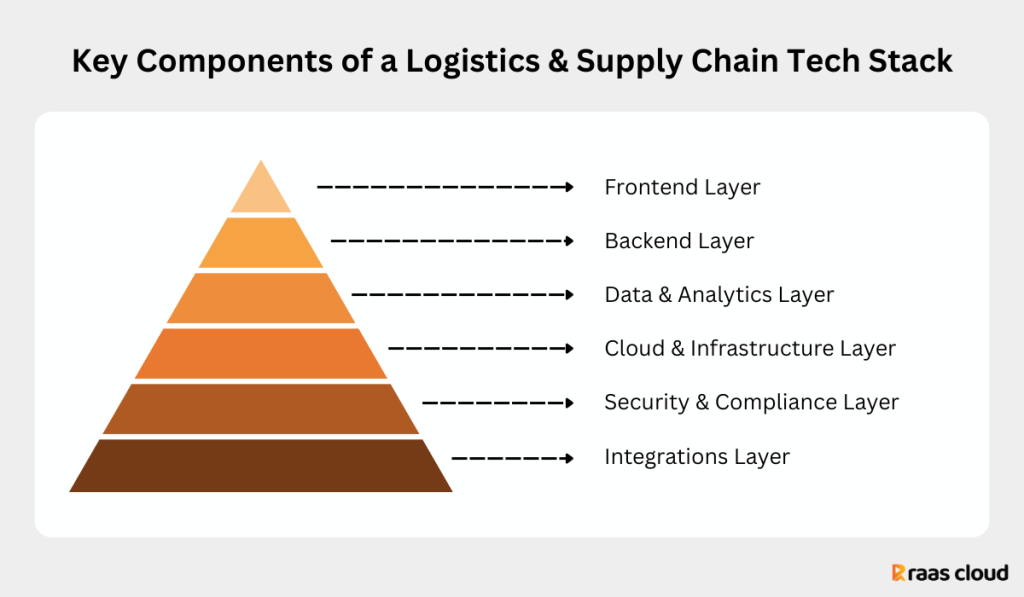
When our team at RAAS Cloud builds logistics or supply chain platforms, we make sure the technology foundation is both scalable and adaptable. These are the essential layers that form the backbone of every high-performing logistics software system.
Frontend Layer
The frontend layer is what users interact with, including dashboards, tracking portals, and admin panels. It handles real-time data visualization, route monitoring, and workflow management. A well-structured frontend ensures smooth user experience across devices, whether used by logistics managers, drivers, or warehouse teams.
Backend Layer
The backend layer powers the system’s logic, automation, and communication between modules. It manages tasks like shipment tracking, order processing, and route optimization. This layer also connects databases, APIs, and business rules, ensuring every function operates reliably and securely behind the scenes.
Data & Analytics Layer
The data and analytics layer collects, processes, and transforms data from multiple sources into actionable insights. It enables predictive analysis, demand forecasting, and performance tracking. This layer also supports decision-making by converting operational data into meaningful reports and trends.
Cloud & Infrastructure Layer
The cloud and infrastructure layer provides the foundation for hosting, scaling, and maintaining the platform. It includes virtual servers, storage systems, and CI/CD pipelines. A solid infrastructure ensures uptime, handles fluctuating workloads, and allows the software to scale globally without performance issues.
Security & Compliance Layer
This layer protects the system from breaches, data leaks, and unauthorized access. It includes encryption, user access management, data backup, and compliance with standards like GDPR or SOC 2. Strong security ensures reliability and builds trust with enterprise and logistics clients.
Integrations Layer
The integration layer connects the logistics platform with third-party systems like ERP, TMS, CRM, and IoT devices. It enables seamless data exchange across suppliers, carriers, and customers. Proper integration ensures operational continuity and minimizes manual intervention across the supply chain network.
Recommended Tech Stack for Logistics & Supply Chain Software (2026 Edition)
Our team at RAAS Cloud has dedicated experts for logistics, supply chain, and transportation software development. We use the latest and most suitable technologies to ensure performance, scalability, and real-time visibility across operations. Here are some of the best tools and frameworks we recommend for logistics and supply chain platforms in 2026.
| Layer | Recommended Technologies |
| Frontend Layer | React.js, Angular, Vue.js |
| Backend Layer | Node.js, Python (Django, FastAPI), Java (Spring Boot), Go |
| Database Layer | PostgreSQL, MongoDB, Redis |
| Cloud & Infrastructure Layer | AWS, Azure, Google Cloud, Docker, Kubernetes, Terraform |
| Data & Analytics Layer | Apache Spark, TensorFlow, Power BI, Snowflake |
| Integrations & APIs Layer | REST, GraphQL, MuleSoft, Zapier |
| IoT & Real-Time Tracking | MQTT, Apache Kafka, AWS IoT Core |
| Security & Compliance Layer | OAuth 2.0, JWT, SSL/TLS, SOC 2, GDPR Standards |
These technologies are proven to deliver the right balance of scalability, performance, and security for modern logistics and supply chain systems.
Being a trusted software development and IT outsourcing company, we are very flexible with our approach and our team suggests the most suitable stack based on your business model, data needs, and long-term vision. If you already have an existing infrastructure, we assess it carefully and recommend compatible tools or migration strategies to enhance performance without disrupting operations.
Cloud Infrastructure Choices: AWS vs Azure vs GCP
While building logistics and supply chain software, one of the most important choices to make is selecting the right cloud infrastructure. Each platform offers unique strengths in scalability, pricing, and integration. Here are some insights on how AWS, Azure, and GCP compare for logistics and enterprise-grade applications.
AWS (Amazon Web Services)
AWS is one of the most popular and widely used cloud platforms for logistics and supply chain applications. It offers a vast ecosystem of services including compute, storage, IoT, and data analytics. For logistics software, AWS works well for real-time tracking, IoT-based monitoring, and predictive analytics. Its global presence makes it ideal for companies operating across multiple regions.
Pricing: Pay-as-you-go model with flexible reserved and spot instance options. Monthly costs typically start from $200–$800 for smaller setups and scale based on usage.
- Pros: Highly scalable, reliable uptime, strong IoT and data analytics capabilities.
- Cons: Complex pricing structure and steeper learning curve for smaller teams.
Azure (Microsoft Azure)
Azure is well-suited for enterprise logistics solutions, especially for organizations already using Microsoft ecosystems like Dynamics 365, Power BI, or Office 365. It integrates well with ERP systems and supports secure data management across regions. Azure’s hybrid cloud capabilities also make it a good fit for companies transitioning from on-premise systems to the cloud.
Pricing: Subscription-based model with flexible resource tiers. Average monthly cost ranges between $300–$1,000 depending on scale and workloads.
- Pros: Strong integration with Microsoft tools, enterprise-level security, excellent hybrid cloud options.
- Cons: Slightly higher setup complexity and fewer AI-focused logistics tools compared to AWS.
GCP (Google Cloud Platform)
GCP is best for logistics companies looking to leverage data analytics, AI, and real-time insights. It provides strong support for big data processing, machine learning, and modern containerized infrastructure. GCP is often chosen by startups and global SaaS providers who prioritize innovation, automation, and cost efficiency.
Pricing: Transparent usage-based pricing with discounts for sustained workloads. Average monthly costs start around $150–$600 for small to medium operations.
- Pros: Excellent AI and data analytics tools, easy-to-manage interface, and cost efficiency.
- Cons: Smaller market share compared to AWS and Azure, fewer enterprise-level integrations.
In most cases, AWS suits companies looking for global scalability, Azure is ideal for enterprises needing ERP or Microsoft integrations, and GCP works best for startups or data-driven logistics platforms.
Integrations That Define the Modern Logistics Stack
Logistics and supply chain management require your software to connect seamlessly with multiple external systems, from inventory tools to payment gateways and IoT devices. Here are some of the most important integrations that your logistics or supply chain software will require in 2026.
ERP Integrations
Enterprise Resource Planning (ERP) integrations help align financials, procurement, and operations in one place. Connecting your logistics software with ERP systems like SAP, Oracle NetSuite, or Microsoft Dynamics 365 ensures consistent data across warehouses, shipments, and invoices.
It also improves forecasting and reduces errors caused by manual entries. These integrations are essential for companies managing multiple warehouses or regional operations.
Payment Systems
Integrating payment gateways makes it easier for logistics companies and 3PL providers to manage freight billing, vendor payments, and digital transactions.
Tools like Stripe, PayPal, Authorize.net, and Square can be integrated to automate invoicing, process refunds, and manage recurring payments securely. For enterprise clients, B2B billing systems such as QuickBooks Online or Bill.com can also be linked to streamline financial management.
IoT and Telematics
IoT and telematics integrations are at the heart of modern logistics platforms. They enable real-time visibility for vehicles, containers, and shipments. Devices connected via GPS, RFID, and temperature sensors send data to the central platform using IoT protocols like MQTT or AWS IoT Core.
These integrations allow you to track routes, monitor cargo conditions, and predict maintenance needs. Solutions like Geotab, Samsara, and Verizon Connect are commonly used across US-based logistics operations.
Data Pipelines
Data pipeline integrations help logistics companies collect, process, and analyze large volumes of operational data. Platforms such as Apache Kafka, Airflow, and Snowflake can handle event streaming and data transformation from multiple sources like ERPs, IoT sensors, and CRMs. This data is then visualized in dashboards or analytics tools like Tableau or Power BI to make data-driven decisions. Building strong data pipelines ensures real-time analytics and faster response to changing logistics conditions.
3PL & API Integrations
Third-Party Logistics (3PL) and API integrations allow your system to communicate with external service providers and carriers. This includes shipping APIs like FedEx, UPS, DHL, and USPS, as well as 3PL platforms such as ShipEngine, EasyPost, and ShipBob. These integrations automate shipment tracking, rate comparison, and label generation, making it easier to manage end-to-end logistics within one interface.
At RAAS Cloud, we make sure every logistics solution we build is integration-ready from day one. Our team has worked on more than 300+ integrations, ensuring compatibility with ERPs, payment systems, IoT platforms, and carrier APIs.
Whether you need a single integration or a fully connected ecosystem, we’ll help your software communicate effortlessly with the tools your business already uses.
Why Logistics Companies Choose RAAS Cloud?
RAAS Cloud has developed logistics and supply chain software solutions for over 30 businesses across the US, helping them improve efficiency, automate operations, and scale globally.
Businesses choose RAAS Cloud because we combine deep domain expertise with flexible engagement models to extend your in-house team. Here are some other reasons why logistics companies trust us:
- Proven experience in building transportation, warehouse, and supply chain management systems
- Dedicated logistics tech experts with hands-on experience across 50+ technologies
- Flexible engagement models (project-based, dedicated team, or hybrid)
- Access to top 1% pre-vetted developers and engineers
- 48-hour developer matching for urgent requirements
- Free 7-day trial before onboarding any developer
- 300+ successful API and system integrations delivered
- Strong cloud, IoT, and AI expertise for modern logistics automation
- Transparent communication and agile project execution
- Global delivery capabilities with onshore and offshore coordination
Ready to build your logistics platform? Let’s discuss your project requirements and get your development team assembled within 48 hours.

Dhanalakshmi Kadirvelu is a Business Intelligence and Data Analytics expert with a strong focus on software development and data engineering. She creates efficient data models, builds interactive dashboards, and integrates analytics into software systems using Power BI, OBIEE, and SQL. Her work helps development teams use data effectively to create smarter software solutions and improve business performance.