
Most SaaS founders focus heavily on growth, customer acquisition, and shipping new features quickly. But while the product scales, cloud bills often grow silently in the background.
For many SaaS startups, cloud spend eventually becomes the second largest expense after payroll.
We at RAAS Cloud have worked with SaaS companies across different growth stages and helped optimize cloud infrastructure costs by up to 45% without affecting application performance, scalability, or reliability. In many projects, the biggest savings did not come from cutting resources aggressively.
They came from building smarter cloud strategies, improving DevOps workflows, automating infrastructure management, and fixing architectural inefficiencies that were increasing costs month after month.
This guide will cover how SaaS startups can identify cloud waste, optimize infrastructure intelligently, improve cloud efficiency, and build scalable systems without slowing down growth or compromising user experience.
We will also share practical frameworks, real optimization strategies, and common mistakes we have seen while working on cloud environments for growing SaaS platforms.
Why Cloud Costs Become Unmanageable in SaaS Startups
The real problem is not always that cloud platforms are expensive. In many cases, 25% to 30% of cloud infrastructure spend gets wasted because of inefficient resource usage, rushed architecture decisions, lack of monitoring, and poor infrastructure management practices.
Here are some of the biggest reasons why cloud costs become unmanageable in SaaS startups as they grow.
1. The “Ship Fast First” Problem
SaaS startups often operate in a highly competitive environment where releasing features quickly becomes the top priority. Teams focus on faster deployments, rapid scaling, and maintaining uptime, while cloud infrastructure optimization gets pushed aside.
As a result, developers frequently overprovision compute resources, keep temporary environments running, and deploy quick fixes that later become permanent parts of the architecture.
Over time, this “ship fast first” approach leads to significant cloud waste, poor resource utilization, and rising cloud infrastructure costs. Without proper cloud cost monitoring and DevOps governance, SaaS companies can end up paying for resources they barely use.
2. Multi-Tenant SaaS Complexity
With multi-tenant SaaS architecture, multiple customers share the same cloud infrastructure, databases, storage, and application resources. While this model improves scalability and operational efficiency, it also creates major cloud cost optimization challenges.
Many SaaS startups struggle to track infrastructure cost per customer, identify high-resource tenants, or allocate cloud spending accurately across workloads. A few heavy users can silently consume excessive compute, database, or storage resources and increase overall cloud spend.
3. Cloud Sprawl During Scaling
Cloud sprawl is one of the most common reasons behind uncontrolled cloud spending in growing SaaS startups.
As teams scale applications, add services, and expand infrastructure, cloud environments become cluttered with unused virtual machines, idle Kubernetes clusters, orphaned storage volumes, old snapshots, duplicate databases, and forgotten staging environments.
In many cases, resources created for testing or temporary deployments continue running for months without ownership or visibility. This not only increases cloud infrastructure costs but also creates operational and security risks.
Without proper cloud governance, automation, and infrastructure management practices, cloud sprawl can significantly reduce SaaS profitability and scalability.
We have created a table below to show the common SaaS cloud waste:
| Common SaaS Cloud Waste | Business Impact |
| Idle databases | Higher monthly burn |
| Over-sized nodes | Poor margins |
| Unused storage snapshots | Hidden recurring costs |
| Excessive logging | Unexpected billing spikes |
| Inter-region traffic | Silent network cost leakage |
How to Audit Your Current Cloud Spend
After identifying the common reasons behind rising cloud costs, the next step is understanding exactly where your cloud budget is being spent and where the waste exists. Here is how SaaS startups can properly audit their current cloud infrastructure spend.
1. Identify Your Top Cost Drivers
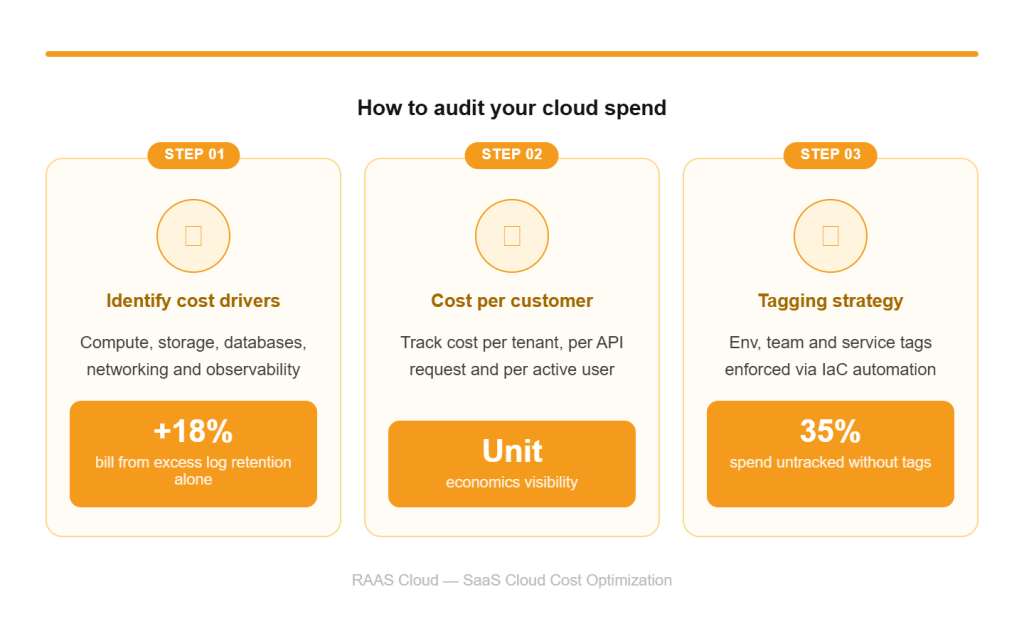
The first step in cloud cost optimization is identifying which services are contributing the most to your monthly cloud bill.
Many SaaS startups focus only on compute costs while ignoring hidden expenses coming from storage, networking, observability tools, backups, and managed databases. A proper cloud cost audit helps you understand where your infrastructure budget is actually going.
In most SaaS environments, the major cloud cost drivers usually include:
- Compute resources like EC2 instances, virtual machines, Kubernetes nodes, and containers
- Cloud storage including object storage, snapshots, backups, and archival storage
- Managed databases such as PostgreSQL, MySQL, MongoDB, and Redis
- Networking costs including inter-region data transfer, CDN traffic, and load balancers
- Logging and monitoring platforms generating large observability costs
- CI/CD pipelines and development environments running continuously
For example, in AWS, many startups discover that services like Amazon RDS, EKS clusters, CloudWatch logs, and inter-region data transfer contribute heavily to monthly cloud spend.
In one SaaS infrastructure audit, we found that excessive log retention alone was increasing the monthly cloud bill by over 18% without delivering any operational value.
2. Measure Cost Per Customer
To properly optimize cloud infrastructure costs, SaaS startups should move beyond total cloud spend and start measuring unit economics. This helps teams understand how infrastructure usage scales with customers, workloads, and product growth. Without customer-level cost visibility, it becomes difficult to identify inefficient tenants, expensive workloads, or services that are reducing profit margins.
Some of the most important cloud cost metrics include:
- Cost per tenant
- Cost per API request
- Cost per active user
- Cost per workload
These metrics help SaaS companies make better infrastructure decisions, improve scalability planning, and optimize resource allocation more effectively.
SaaS Cloud KPI Table
| Metric | Why It Matters |
| Infrastructure cost per customer | Helps measure customer profitability |
| Cost per API request | Identifies expensive backend operations |
| Cost per active user | Tracks infrastructure efficiency during scaling |
| Kubernetes idle capacity | Detects overprovisioned resources |
| Database cost growth | Monitors storage and query optimization needs |
| Cloud cost-to-revenue ratio | Measures overall infrastructure efficiency |
| Deployment cost per release | Improves DevOps and CI/CD efficiency |
3. Tagging Strategy That Actually Works
Tags can play a major role in cloud cost management, but many SaaS startups either use inconsistent tagging practices or do not use tagging properly at all. Without a structured tagging strategy, cloud environments become difficult to audit, optimize, and manage as the infrastructure scales.
We audited an employee engagement SaaS platform where nearly 35% of the cloud spend could not be mapped to any team, environment, or service because resources were either untagged or tagged inconsistently.
This created what we call “unallocated spend black holes,” where infrastructure costs existed but nobody had ownership or visibility.
To build an effective cloud tagging strategy, SaaS companies should implement:
- Mandatory tagging architecture
- Environment tagging like production, staging, and development
- Team ownership tagging
- Product and service tagging
- Automation enforcement through DevOps workflows and Infrastructure as Code
After implementing a proper tagging structure and automated policy enforcement, the company was able to improve cloud cost visibility significantly, identify unused resources faster, and reduce unnecessary infrastructure spending within a few weeks.
Cost Optimization Strategies for SaaS Platforms
Now comes the most important part of cloud cost optimization for SaaS startups. Let us look at the practical strategies that can help reduce cloud spend without affecting scalability, performance, or user experience.
1. Right-Sizing Cloud Resources
One of the most common issues we see in SaaS cloud environments is oversized infrastructure running far below actual utilization.
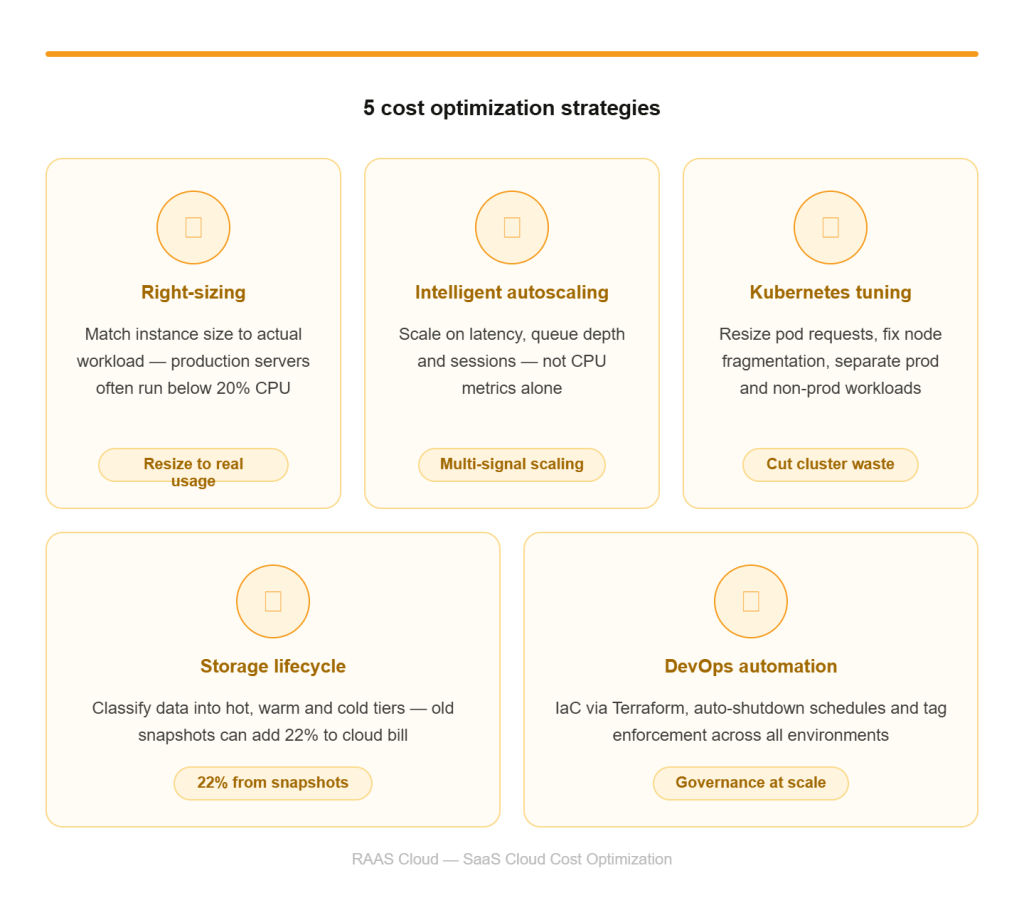
In many audits, production servers with 8 vCPUs and 32 GB RAM were consistently operating below 20% CPU usage because teams provisioned resources for peak traffic that only happened occasionally.
Right-sizing is not about aggressively reducing resources. It is about matching infrastructure capacity with real workload behavior. We usually start by analyzing 30 to 60 days of CPU, memory, disk IOPS, and traffic patterns before making adjustments.
Rightsizing databases, Kubernetes nodes, and background worker instances alone can significantly reduce cloud infrastructure costs without affecting application performance or uptime.
2. Intelligent Autoscaling for SaaS Workloads
Most SaaS startups configure autoscaling based only on CPU utilization, which often creates inefficient scaling behavior. In real production environments, CPU usage alone rarely reflects actual workload pressure. We have seen SaaS platforms scale too late during traffic spikes because queue processing, request latency, or concurrent sessions increased before CPU metrics changed. Intelligent autoscaling uses multiple signals such as memory usage, API response time, queue depth, active users, and workload concurrency to make better scaling decisions.
We also recommend separate autoscaling policies for frontend services, background workers, and data processing pipelines. This helps avoid unnecessary scaling costs while maintaining application stability during peak demand.
3. Kubernetes Cost Optimization
Kubernetes gives SaaS startups flexibility and scalability, but poorly optimized clusters can become one of the biggest sources of cloud waste.
In several cloud audits, we found clusters where resource requests and limits were configured far higher than actual workload requirements, causing expensive node overprovisioning. Another common issue is node fragmentation, where workloads are spread inefficiently across multiple nodes, leaving unused capacity that still gets billed.
We typically optimize Kubernetes costs by analyzing pod utilization, resizing requests and limits, implementing cluster autoscaling, and separating production from non-production workloads.
4. Storage and Data Transfer Optimization
Storage costs in SaaS platforms often increase quietly over time because backups, snapshots, logs, and archived data continue accumulating without proper lifecycle management. In one SaaS project, old snapshots and unused log storage alone were contributing nearly 22% of the total cloud bill.
We usually begin by classifying data into hot, warm, and cold storage categories based on access frequency and retention requirements.
Another major issue is inter-region and cross-service data transfer costs, especially in microservices architectures. Optimizing CDN usage, reducing unnecessary replication, and reviewing internal traffic flow between services can significantly reduce hidden networking expenses that many startups overlook during scaling.
5. DevOps Automation and Infrastructure Governance
Manual infrastructure management becomes a major cost problem as SaaS platforms scale. Temporary resources remain active, development environments keep running unnecessarily, and cloud configurations drift over time.
We strongly recommend implementing Infrastructure as Code using tools like Terraform to standardize deployments and improve cost visibility across environments.
Automated governance policies can enforce tagging rules, shutdown schedules, resource limits, and security configurations across the cloud infrastructure.
In several SaaS environments, simple automation like auto-shutdown policies for staging environments and automated cleanup for unused resources reduced monthly cloud spend noticeably within weeks. Strong DevOps governance also improves operational consistency, security, and long-term scalability.
A Realistic Cloud Cost Optimization Roadmap for SaaS Startups
Cloud cost optimization is not something SaaS startups should approach in the same way at every stage of growth. The infrastructure priorities of an early-stage startup are completely different from a scaling SaaS company handling thousands of customers and large workloads.
One of the biggest mistakes startups make is either overengineering too early or waiting too long before introducing cloud governance and optimization practices.
A realistic cloud optimization roadmap focuses on solving the right problems at the right stage while balancing scalability, engineering speed, infrastructure reliability, and profitability.
Stage 1: Early Startup (0–100 Customers)
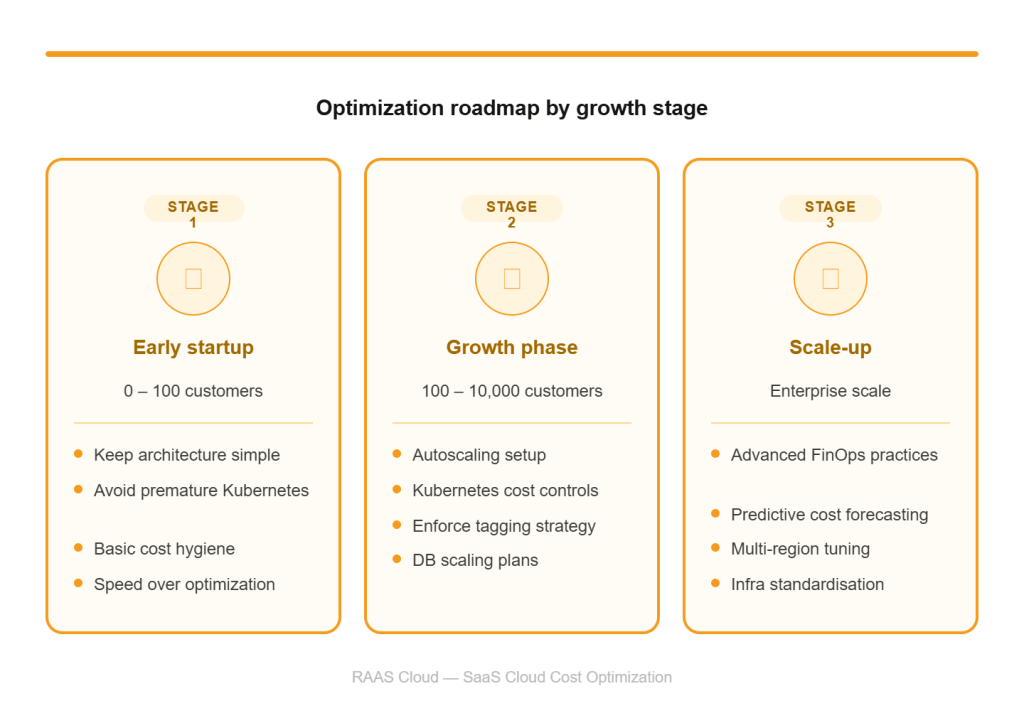
At the early startup stage, the main focus should be on simplicity, speed, and avoiding unnecessary cloud waste. Many founders make the mistake of adopting overly complex cloud architectures, Kubernetes clusters, or multi-cloud setups before product-market fit is established. This often increases cloud infrastructure costs and operational complexity without delivering real business value.
Stage 2: Growth Phase (100–10,000 Customers)
As the customer base grows, cloud infrastructure becomes more dynamic and significantly harder to manage efficiently. Traffic spikes, onboarding growth, background jobs, analytics workloads, and API usage start increasing rapidly.
At this stage, SaaS startups usually begin facing rising Kubernetes costs, database scaling challenges, and unpredictable cloud bills.
Stage 3: Scale-Up SaaS
At the scale-up stage, cloud optimization becomes a continuous business function rather than a periodic engineering task. Infrastructure costs can directly impact margins, pricing models, and long-term profitability.
Large SaaS environments often include multi-region deployments, complex Kubernetes workloads, heavy data processing pipelines, advanced observability systems, and compliance-driven infrastructure requirements.
The focus here should be on advanced FinOps practices, predictive cloud cost forecasting, governance automation, and infrastructure standardization across teams.
How RAAS Cloud Helps SaaS Startups Optimize Cloud Infrastructure
At RAAS Cloud, we work closely with SaaS startups and growing technology companies to solve real cloud infrastructure challenges that directly impact scalability, performance, and profitability.
Our team deals with cloud architecture optimization, DevOps automation, Kubernetes management, infrastructure governance, cloud migration, and SaaS cloud cost optimization across multiple industries and workloads.
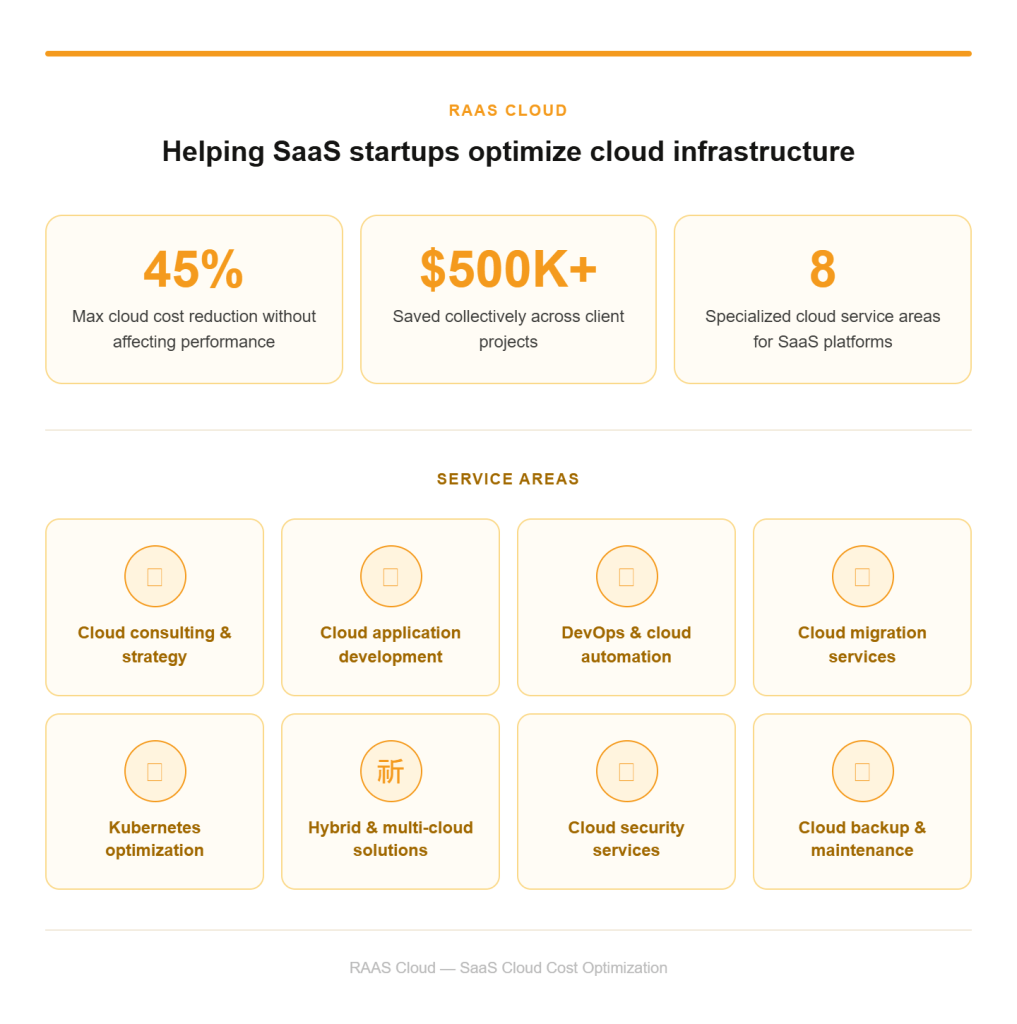
Over the years, we have helped clients reduce unnecessary cloud spending by more than $500,000 USD collectively through infrastructure audits, Kubernetes optimization, intelligent autoscaling, storage optimization, cloud governance implementation, and automation-driven DevOps practices.
In many projects, the biggest improvements came from identifying hidden infrastructure waste, fixing inefficient scaling setups, improving observability practices, and implementing better workload management strategies.
We offer Cloud Consulting & Strategy Services along with Cloud Application Development, DevOps & Cloud Automation, Cloud Migration Services, Kubernetes optimization, Hybrid & Multi-Cloud Solutions, Cloud Security Services, Cloud Storage Solutions, and Cloud Backup & Maintenance support.
Whether you are an early-stage SaaS startup trying to build scalable cloud infrastructure or a fast-growing platform struggling with rising cloud bills, our team can help you optimize your cloud environment, improve operational efficiency, and build a cost-effective infrastructure foundation for long-term growth.

Dhanalakshmi Kadirvelu is a Business Intelligence and Data Analytics expert with a strong focus on software development and data engineering. She creates efficient data models, builds interactive dashboards, and integrates analytics into software systems using Power BI, OBIEE, and SQL. Her work helps development teams use data effectively to create smarter software solutions and improve business performance.