
Healthcare is going digital, and dental care is no exception. Patients today expect to book appointments, access their treatment history, and connect with their dentist from their phones, just like they do with every other service in their lives. The numbers back this up.
The global mHealth market was valued at $36.68 billion in 2024 and is projected to reach $88.70 billion by 2032, growing at a CAGR of 11.8%. The dental practice management software segment alone is on track to hit $5 billion by 2030.
If you run a dental clinic or are planning to launch one, having a dedicated app is no longer a nice-to-have. It is quickly becoming the standard for practices that want to reduce no-shows, improve patient communication, and run a tighter operation.
That said, most clinic owners and practice managers get stuck at the same question: how much does it actually cost to build a dental clinic app, and what kind of app do I even need?
To help you get clear answers, we put together this guide. Our team at RAAS Cloud has developed over 75 dental apps across a range of practice sizes and specialties, so the numbers and recommendations you will find here come from real proposals and real deliverables, not rough guesses from the internet.

Mobile Apps That Drive Real Results
From idea to launch, our team builds high quality apps for startups, SMBs, and enterprise businesses.
Free consultation · No commitment
Why Dental Clinics Need a Dedicated App (And Why Now)
As we touched on earlier, the technology shift in healthcare is already well underway. But let us get specific. Here are the reasons why building a dedicated app for your dental clinic is not just a smart move right now, it is quickly becoming the only move.
Reduce No-Shows via Automated Reminders
No-shows are one of the biggest revenue leaks in any dental practice. A patient misses their appointment, that slot goes unfilled, and your front desk spends time making follow-up calls that should not be necessary in the first place. A well-built dental app fixes this at the root.
Automated reminders sent via push notification or SMS, confirmation prompts that patients can tap in seconds, and easy rescheduling options built right into the app mean fewer gaps in your schedule and less administrative back-and-forth. Practices that implement automated reminder systems typically see no-show rates drop by 30 to 40 percent. That alone can pay for the cost of the app many times over.
Streamline Patient Intake, Records, and Billing
Think about how much time your staff spends on paperwork, manually entering patient information, pulling up records, and chasing payments. A dedicated app moves all of that into one place. Patients fill out intake forms digitally before they even walk through the door. Their records are stored securely and accessible in seconds.
Billing gets automated, payment reminders go out without anyone lifting a finger, and insurance information stays organized without the usual back-and-forth. The result is a front desk that runs faster, makes fewer errors, and has more time to actually focus on patients rather than paperwork.
Enable Teledentistry and Post-Treatment Follow-Ups
Not every patient concern requires an in-person visit. A patient who had a filling done last week and is experiencing minor sensitivity does not need to come in and sit in the chair just to get a two-minute answer. Teledentistry features built into your app let you handle consultations, follow-ups, and quick check-ins virtually.
Post-treatment follow-up features also help you stay connected with patients between visits, which builds trust and keeps them coming back to your practice rather than searching for another provider.
Competitive Differentiator for Patient Retention
Patient loyalty in dentistry is not guaranteed. People switch providers for all kinds of reasons, and convenience is near the top of that list. If a competing clinic down the street offers online booking, digital records, virtual consultations, and a clean app experience while your practice still runs on phone calls and paper forms, that gap is noticeable.
A dedicated app signals to patients that your practice is modern, organized, and invested in their experience. It gives them a reason to stay and, just as importantly, a reason to refer friends and family.
Types of Dental Clinic Apps
A dental clinic or a solo practitioner might need a very different kind of app depending on how they operate, how many patients they serve, and what problems they are trying to solve. Some apps also combine multiple functions into a single platform, which can be a smart move for practices that want everything in one place. Here is an overview of the different types of dental clinic apps available today.
- Patient-Facing Appointment Apps — Lets patients book, confirm, reschedule, and manage appointments directly from their phone.
- Practice Management Apps — Handles the internal side of the clinic including staff scheduling, patient records, billing, and insurance processing.
- Clinical Apps — Built for chairside use to support tooth charting, treatment planning, imaging, and procedure documentation.
- Teledentistry Platforms — Designed specifically for virtual consultations, remote follow-ups, and video appointments.
- Patient Education Apps — Keeps patients engaged between visits with oral health tips, procedure guides, and post-treatment care instructions.
- All-in-One Hybrid Apps — Combines patient-facing features, practice management, clinical tools, and teledentistry into a single platform.
Now that you have a clear picture of the types of apps out there, let us take a look at the must-have features that go into building one and, more importantly, how much each of them costs to develop.
Must-Have Features For A Typical Dental App
We have kept the features listed here practical and grounded in what actually gets used.
Appointment Scheduling and Real-Time Availability
Patients can book, confirm, reschedule, or cancel appointments directly through the app. Dentists and staff see availability updated in real time, eliminating double bookings and phone tag.
Patient Registration and Digital Profiles
Patients create profiles with their personal details, dental history, insurance information, and uploaded documents. This replaces paper intake forms and keeps records organized and accessible.
HIPAA-Compliant Authentication and Data Security
Secure login, end-to-end data encryption, role-based access controls, and audit logging. This is not optional for any dental app serving US patients. Compliance has to be built in from the ground up, not added later.
Push Notifications and SMS Reminders
Automated alerts for upcoming appointments, payment due dates, post-treatment care instructions, and follow-up prompts. One of the highest-ROI features in any patient-facing dental app.
In-App Messaging
Secure two-way messaging between patients and the clinic team. Patients can ask questions, share concerns, or send photos without needing to call the front desk. Staff can respond on their own schedule.
Billing, Insurance, and Payment Integration
Automated invoicing, insurance verification, co-pay collection, and payment gateway integration. Reduces billing errors and gets payments processed faster without extra admin effort.
Admin Dashboard and Reporting
A backend interface for clinic staff to manage appointments, view patient data, track revenue, monitor no-show rates, and pull reports. Essential for any practice that wants visibility into how the business is performing.
Now, below are some advanced features that are specifically built as per the requirements:
Teledentistry and Video Consultations
Built-in video calling that lets dentists conduct virtual consultations, follow-ups, and second opinions without requiring an in-person visit. A strong differentiator for practices that want to offer flexible care options.
EHR and EMR Integration
Connects the app with existing Electronic Health Record or Electronic Medical Record platforms such as Dentrix or Curve Dental. Ensures patient data flows seamlessly between systems without manual entry or duplication.
AI-Assisted Dental Charting and Diagnostics
Machine learning tools that help dentists analyze X-rays, flag potential issues, and generate charting data faster. Reduces diagnostic time and adds a layer of clinical accuracy that patients notice.
Tooth Scan and Smile Assessment Tools
Patients use their phone camera to do a basic self-assessment of their teeth, which is then reviewed by the dentist through the app. Works well as a patient acquisition tool and a pre-consultation filter.
Multilingual Support
Extends the app’s reach to patients who are more comfortable in a language other than English. Particularly valuable for clinics in diverse metro areas.
Not every dental clinic needs all of these features from day one. In the next section, we break down the key factors that influence your total development cost so you can figure out exactly what your build will realistically require.
How Much Does It Cost to Build a Dental Clinic App?
A dental clinic app typically costs between $15,000 and $200,000 to develop, depending on the features, complexity, and the type of practice it is built for.
That is a wide range, and understandably so. A solo practitioner who needs a clean appointment booking app has very different requirements than a dental chain managing 50 locations with teledentistry, AI diagnostics, and full EHR integration. The cost scales with what you are building and who you are building it for.
So, let us take a look at the major factors that impact the cost and by how much:
Key Factors That Influence Development Cost
Our team has worked on dental apps for solo practitioners treating 3 patients a day and for chains managing 150 plus locations across multiple states. The cost of each project looked very different, and that difference almost always came down to the same set of factors.
Here is what actually moves the needle on your development budget.
App Complexity
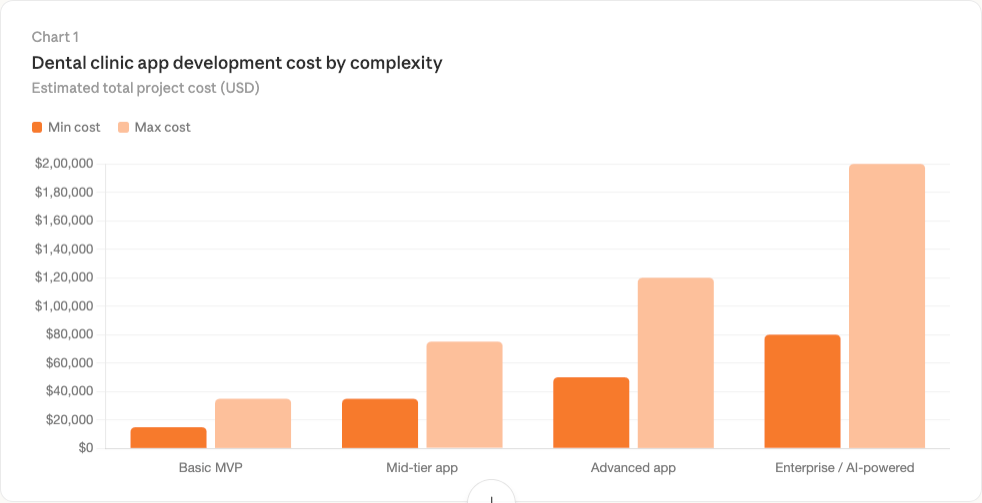
This is the single biggest cost driver. A basic app that handles appointment booking, patient profiles, and reminders sits at a very different price point than one that integrates with your EHR system, supports video consultations, and includes AI-assisted diagnostics. The more features you need, the more development hours go into building, testing, and securing the product.
Here is a practical breakdown of how complexity translates to cost and what each tier typically covers:
| App Type | Estimated Cost | Ideal For |
| Basic MVP | $15,000 to $35,000 | Single clinic looking to digitize core operations: appointment booking, patient profiles, and automated reminders |
| Mid-tier app | $35,000 to $75,000 | Small to mid-size group practice that needs billing, in-app messaging, HIPAA-compliant security, and reporting built in |
| Advanced app | $50,000 to $120,000 | Multi-location practice requiring teledentistry, EHR integration, and advanced patient engagement features |
| Enterprise / AI | $80,000 to $200,000 | Large dental chains that need AI-assisted diagnostics, full EHR ecosystem connectivity, multilingual support, and end-to-end automation |
A good rule of thumb is to start with what your patients actually need today and build toward what your practice will need in two years. Starting lean keeps your initial investment manageable and lets you validate the product before committing to a larger build.
Platform Choice
Do you need an iOS app, an Android app, or both? The answer directly affects your cost and timeline. Building two separate native apps takes more time and budget than building a single cross-platform app using frameworks like Flutter or React Native, which lets one codebase run on both platforms without sacrificing quality.
To make this tangible, here is a real-world example. Say a single-location dental clinic needs a straightforward app with appointment booking, patient profiles, push notifications, and a basic admin dashboard.
Here is how the platform choice alone changes the cost:
| Platform | Approach | Estimated Cost | What it means in practice |
| Android only | Native (Kotlin) | $15,000 to $20,000 | Reaches Android users only, which is roughly 44% of the US smartphone market |
| iOS only | Native (Swift) | $17,000 to $22,000 | Reaches iPhone users only, which is roughly 56% of the US smartphone market |
| Both platforms | Two separate native apps | $28,000 to $40,000 | Full coverage but doubles development effort, testing, and maintenance going forward |
| Both platforms | Cross-platform (Flutter / React Native) | $18,000 to $28,000 | Full coverage at close to the cost of a single native app, with one shared codebase |
At RAAS Cloud, we develop apps for both Android and iOS and also offer access to pre-vetted iOS and Android developers depending on your preference. So whatever path makes the most sense for your practice and your patient base, we have the team to support it.
Development Team Location
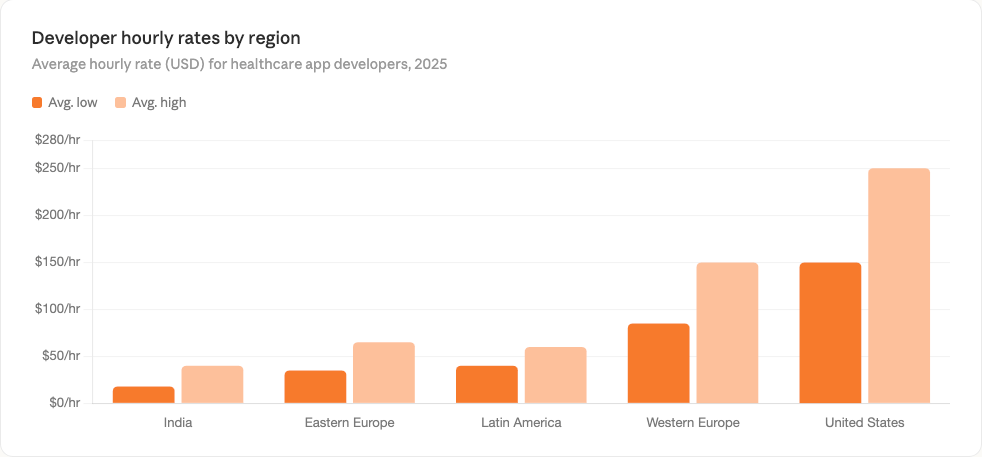
Where your development team is based has a significant impact on what you pay per hour. As you can see in the chart above, rates vary widely across regions:
- India: $18 to $40 per hour
- Eastern Europe: $35 to $65 per hour
- Latin America: $40 to $60 per hour
- Western Europe: $85 to $150 per hour
- United States: $150 to $250 per hour
The technical capability to build a great dental app exists across all of these regions. What changes is the cost, not the quality, when you choose the right partner.
At RAAS Cloud, we offer both offshore and nearshore development options so you are not locked into one model. For clients who prefer a hybrid approach, we can structure a team that combines onshore project management with offshore development. You get the communication and accountability of a local engagement with the cost efficiency of an experienced global team.
UI/UX Design Quality
A dental app that is hard to navigate does not get used. Patients will drop off if the booking flow is confusing, and staff will work around the system if the admin interface is clunky. Good design is not decoration, it is functionality.
We have an in-house design team that specializes in healthcare interfaces. Every app we build goes through a full UX process including user flows, wireframes, and tested prototypes before a single line of code gets written. This upfront investment in design saves significant time and rework during development and results in an app that patients actually enjoy using.
Compliance Requirements (HIPAA)
Any dental app handling patient data in the United States must be HIPAA compliant. This means end-to-end encryption, role-based access controls, secure data storage, audit logs, and Business Associate Agreements with any third-party services that touch patient information. Non-compliance is not just a legal risk, it is a reputational one.
HIPAA compliance is not a feature you add at the end. It has to be designed into the architecture from day one, which adds both time and cost to the build.
Third-Party Integrations
Most dental clinics already use some combination of practice management software, payment processors, insurance verification tools, and cloud storage platforms. The more of these your app needs to connect with, the more integration work goes into the build.
Common integrations in dental apps include platforms like Dentrix, Curve Dental, and Eaglesoft for records, Stripe or Braintree for payments, Twilio for messaging and notifications, and cloud providers like AWS or Google Cloud for storage.
Each integration requires its own development effort, testing, and ongoing maintenance, so it is important to map these out early in the planning process rather than discovering them mid-build.
Development Phases and Timeline
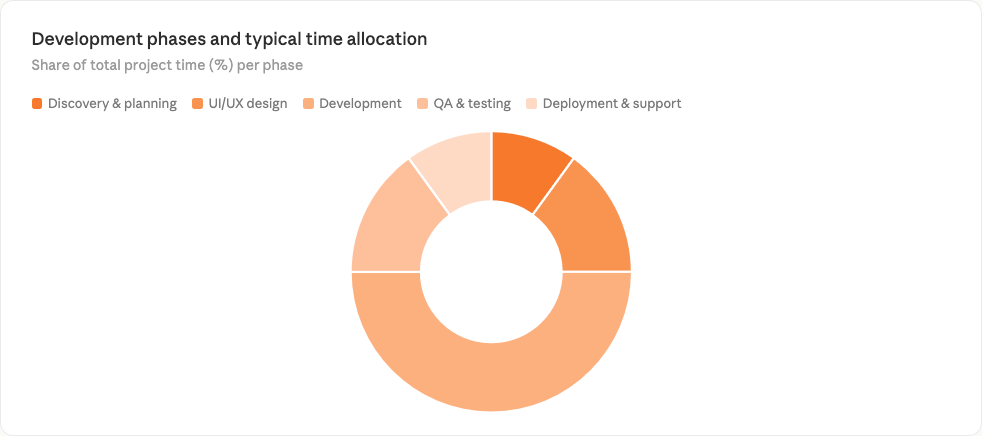
Time is money, and if you are planning to build a dental clinic app, knowing what happens at each stage helps you plan your budget, set realistic expectations, and avoid the kind of scope creep that quietly inflates project costs. Here is a typical development timeline for a dental clinic app broken down by phase.
| Phase | What happens | Typical duration | Approx. cost share |
| Discovery and planning | Requirements gathering, feature scoping, tech stack selection, project roadmap | 1 to 2 weeks | 8 to 10% |
| UI/UX design | User flows, wireframes, prototypes, design system, client review and sign-off | 2 to 4 weeks | 12 to 15% |
| Development | Frontend and backend build, API development, third-party integrations, database setup | 10 to 20 weeks | 50 to 55% |
| QA and testing | Functional testing, security audits, HIPAA compliance checks, device and browser testing | 3 to 5 weeks | 12 to 15% |
| Launch and support | App store submission, deployment, bug fixes, performance monitoring, handoff documentation | 2 to 4 weeks | 8 to 10% |
A Basic MVP typically takes 4 to 5 months from kickoff to launch. A mid-tier app runs closer to 6 to 7 months. Advanced and enterprise builds with EHR integrations, teledentistry, and AI features can take 9 to 12 months depending on the complexity of third-party systems involved.
How to Reduce Dental App Development Costs Without Compromising Quality
We are not the kind of company that wants to hand you a bloated quote and call it comprehensive. We want to give you the most value for your budget without cutting corners on the things that actually matter, like security, compliance, and user experience. So here are some practical ways to keep your dental app development cost in check without ending up with a product you are not proud of.
- Start with an MVP and iterate based on real feedback
- Use cross-platform frameworks (Flutter, React Native)
- Leverage existing HIPAA-compliant backends and cloud infrastructure
- Prioritize features by patient impact, not “nice-to-have”
- Partner with an experienced healthcare app development team that already knows HIPAA and EHR patterns
- Reuse pre-built, tested components for common features like notifications, auth, and scheduling instead of building from scratch
- Avoid over-engineering the first version, a clean and simple app that works is always better than a complex one that does not
- Plan your integrations upfront so third-party connections are scoped into the build from day one, not bolted on later at extra cost
Ready to Build Your Dental Clinic App? Let’s Talk.
One of the most important decisions you will make in this entire process is choosing the right development partner. The cost, the timeline, the quality of the final product, and how smoothly the whole experience goes, all of it comes down to who you build with.
Our team at RAAS Cloud has earned 5-star ratings on Google, Clutch, and more, and that does not happen by accident. It happens because we treat every project like it is our own. We make sure every app we develop goes through a rigorous process from discovery to deployment, and every feature is built, tested, and validated before it ever reaches your patients. No shortcuts, no surprises, no cutting corners on compliance or quality.
If you are a solo practitioner building your first app or a multi-location dental chain looking to modernize your operations, we have the team, the experience, and the process to get it done right.
Schedule a call with us today for a free consultation with no strings attached. We will listen to what your practice needs, give you an honest assessment, and tell you exactly what it would take to build something you are proud of.
We are ranked among the USA’s top software development and IT outsourcing companies for a reason. Come find out why.

Dhanalakshmi Kadirvelu is a Business Intelligence and Data Analytics expert with a strong focus on software development and data engineering. She creates efficient data models, builds interactive dashboards, and integrates analytics into software systems using Power BI, OBIEE, and SQL. Her work helps development teams use data effectively to create smarter software solutions and improve business performance.