
Choosing the right Flutter developers is one of the first steps in building a smooth, high-performing mobile app. Flutter is popular because it delivers fast development, native-like performance, and budget-friendly cross-platform builds. But hiring costs can vary based on skills, experience, location, and the type of app you want to create.
This guide explains how much it costs to hire Flutter developers, what factors affect the price, and how different project levels affect the overall budget.
Should you hire Flutter developers from RAAS Cloud?
Yes, Most founders, CTOs, and product teams choose to hire Flutter developers from an IT staff augmentation company because it gives them reliable talent, faster setup, and strong delivery control. Building an in-house team takes time, money, and constant management. IT Staff augmentation partners like RAAS Cloud remove all these barriers by giving you pre-vetted Flutter developers, a managed workflow, and full support from day one.
Many founders and technical teams choose this option because it reduces hiring risk and provides a structured development process from day one. Agencies also handle onboarding, tracking, communication, and QA, which helps maintain consistent quality throughout the project. This setup is especially helpful for businesses that need to scale quickly, add new skills, or manage complex features without slowing down their roadmap.
With managed teams, clearer workflows, faster start times, and stronger QA support, agencies offer a practical way to keep development stable and predictable.
What are the benefits of hiring Flutter developers from RAAS Cloud
- Pre-vetted talent with real experience: You get access to Flutter developers who are tested for Dart skills, architecture knowledge, UI work, API integration, and problem-solving. This saves you from screening candidates yourself.
- Faster onboarding compared to in-house hiring: Instead of waiting for long interview cycles, you get developers ready to join within a few days, so your Flutter development project does not slow down.
- Structured development process: RAAS Cloud handles the full Flutter app lifecycle. This includes planning, UI build, coding, integration, testing, deployment, and support. You work with one reliable partner.
- Managed teams for smooth delivery: A project manager tracks progress, shares updates, and ensures tasks move correctly. You avoid the headache of daily team supervision.
- Strong QA for stable apps: Every Flutter app goes through manual and automated testing. This removes bugs, improves performance, and ensures the app runs well on both Android and iOS. You can get such Flutter development service when you hire an agency like RAAS Cloud.
- Lower risk in project execution: The agency handles developer performance, delivery timelines, code quality, backup support, and replacements if needed. This keeps your project safe.
- Easy scaling based on your needs: You can add or reduce Flutter developers on demand at any time. This supports MVPs, mid-size apps, or enterprise builds without long commitments.
- Access to cross-platform development skills: Developers work across mobile, web, and desktop using a single codebase. You save effort and costs while delivering a consistent user experience across all platforms.
- Full support beyond development: RAAS Cloud also offers migration, upgrades, plugin development, QA, maintenance, and long-term support for your Flutter app.
How much does it cost to hire Flutter developers?
Hiring Flutter developers typically costs $25 to $120 per hour, depending on experience and project needs. Monthly hiring usually ranges from $4,000 to $18,000 for a dedicated Flutter developer. Junior developers sit on the lower end of this range, while senior engineers with strong skills in app architecture, integrations, and enterprise delivery charge higher.
However, the monthly and hourly rate of hiring flutter developers also changes based on location, development speed, and the complexity of the app you want to build.
We have built this simple tool that you can use to calculate the cost easily:
Flutter Developer Cost Calculator
Flutter developers hiring cost by experience level
| Experience Level | Monthly Cost | Hourly Rate |
| Junior (0–2 years) | $4,000 to $7,000 | $20 to $35 |
| Mid Level (2–5 years) | $7,000 to $12,000 | $35 to $60 |
| Senior (5+ years) | $12,000 to $18,000 | $60 to $120 |

What is the hourly rate of Flutter developers by region?
Flutter developer hourly rates range from $25 to $120 per hour, depending on the region. Countries with higher living costs, such as the United States and the United Kingdom, fall toward the higher end of this range. Developers in the US often charge $80 to $120 per hour, while developers in the UK and Western Europe usually charge $55 to $90 per hour.
Regions like the UAE, Singapore, and the broader Middle East typically fall between $40 and $75 per hour. India offers the most budget-friendly options, with rates usually between $25 and $45 per hour, followed by Eastern Europe at $35 to $60 per hour. These regions still provide strong technical talent and are widely chosen for both MVPs and enterprise projects. Many companies use distributed teams to balance quality, speed, and cost.
What are the factors that affect the cost of hiring Flutter developers?
Before you plan your budget, it is important to understand why Flutter developer rates vary across different projects and skill levels. Several factors influence the final cost, and knowing them helps you choose the right developer and hiring model for your app.
Developer experience
The cost varies widely depending on the developer’s experience. Senior Flutter engineers bring strong knowledge of app architecture, clean code practices, and complex integrations, so their rates are higher. Junior developers are more affordable but need more guidance, which can slow delivery time.
Project size and complexity
Larger projects with many screens, complex user flows, or heavy data handling require more development time. Apps that include real-time features, advanced logic, or custom workflows naturally increase the overall cost.
Feature requirements
Each added feature changes the budget. Payments, chat systems, maps, notifications, AI features, and analytics take more time to design, build, and test. Simple apps cost less, while feature-rich apps need more skilled effort.
API and backend integrations
Projects that integrate with CRM systems, ERP tools, cloud platforms, or custom backends require additional time for setup, testing, and performance checks. These integrations increase cost because they require careful debugging and data handling.
Design and user interface needs
The level of design detail affects cost. Basic layouts are faster to build, while custom UI, animations, transitions, and brand-specific visuals require deeper Flutter expertise and more hours of work.
Testing and quality assurance
Apps expected to run smoothly for large audiences or enterprise users need strong QA processes. Wider device testing, automated test scripts, and performance checks increase the effort and cost.
Security and compliance standards
Some industries need extra security checks and compliance measures. Apps for finance, healthcare, and enterprise workflows require secure coding, encryption, and rule-based audits, which adds to development time and cost.
Hiring model and engagement type
Your hiring choice also affects the budget. Building an in-house team is the most expensive path due to salaries, tools, and HR overhead. Freelancers cost less but increase delivery risk. Agencies like RAAS Cloud offer a balanced model with vetted developers, managed teams, flexible plans, and stable costs.
How does the project type change the cost of hiring Flutter developers?
The type of app you want to build directly impacts the cost. Simple apps require fewer screens and basic logic, while complex and enterprise apps need deeper architecture, integrations, and long-term support. Below are the three main project types and how their scope affects pricing.
1. Basic Flutter App (Simple MVP)
A simple MVP costs $8,000 to $30,000.
This app includes a small number of screens, basic navigation, simple forms, login, and one or two API connections. These projects suit early-stage startups that want to validate an idea quickly. The work mainly focuses on UI, basic workflows, and smooth performance.
What it includes: Basic UI, user login, simple backend links, and standard app layouts.
Cost factors: Number of screens, basic API needs, design effort, and testing time.
Cost Breakdown: Basic Flutter App (Simple MVP)
| Cost Component | Percentage of Total Cost | Description |
| Design | 10%–20% | Basic UI layouts, simple screens |
| Frontend Development | 40%–50% | Core app screens, navigation, forms |
| API Setup | 10%–15% | One or two simple API connections |
| Backend or Firebase Setup | 10% | Basic data structure and auth |
| Testing & Bug Fixes | 10%–15% | Device checks, usability testing |
| Deployment | 5% | App Store and Play Store setup |

2. Mid-Level Flutter App (Business App)
A mid-level app costs $30,000 to $80,000.
These apps include custom UI elements, stronger workflows, role-based access, payment systems, dashboards, maps, and deeper integrations. They suit growing businesses and funded startups that need more stable and scalable apps.
What it includes: Custom design, advanced features, secure login, payments, admin panel, notifications, and API integrations.
Cost factors: Integration complexity, security needs, backend support, custom UI, and performance optimization.
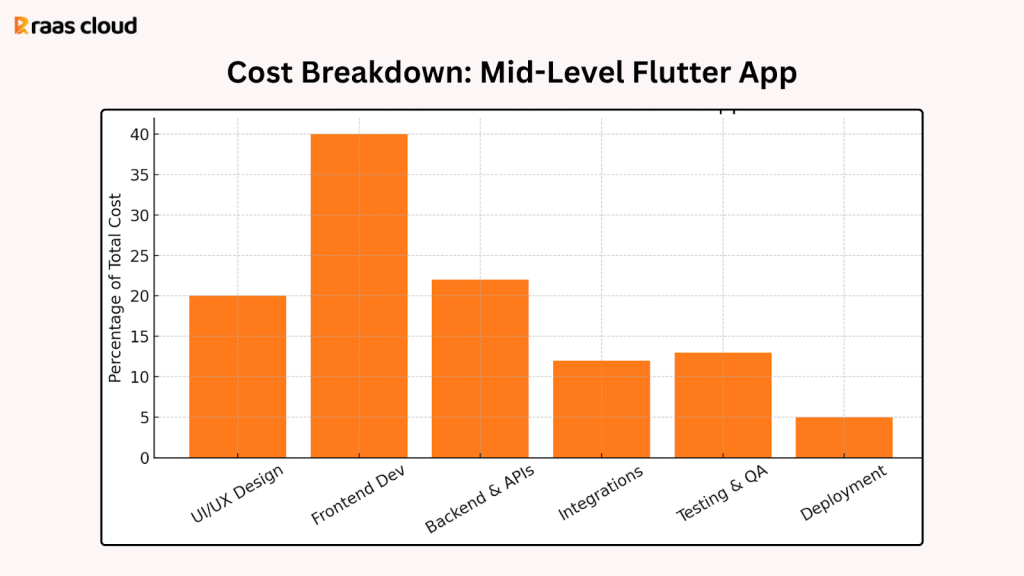
Cost Breakdown: Mid-Level Flutter App (Business App)
| Cost Component | Percentage of Total Cost | Description |
| Custom UI/UX Design | 15%–25% | Advanced layouts, branded UI |
| Frontend Development | 40% | Full app screens, workflows |
| Backend & APIs | 20%–25% | Business logic, dashboards, data syncing |
| Integrations | 10%–15% | Payments, maps, notifications |
| Testing & Performance QA | 10%–15% | Stability, security, and load testing |
| Deployment & Admin Setup | 5% | Store deployment and admin tools |
3. Enterprise-Grade Flutter App (Large and Complex Systems)
An enterprise app costs $80,000 to $200,000+.
These apps handle high traffic, real-time data, large user bases, and strict security rules. They are common in fintech, healthcare, logistics, travel, and large retail. Enterprise apps need cloud setups, automated testing, CI/CD pipelines, detailed analytics, and external system integrations.
What it includes: Multi-user roles, cloud architecture, encrypted data, API-heavy workflows, custom dashboards, offline mode, and automation tests.
Cost factors: Compliance requirements, scalability needs, performance tuning, large database structures, advanced DevOps setup, and long-term maintenance.
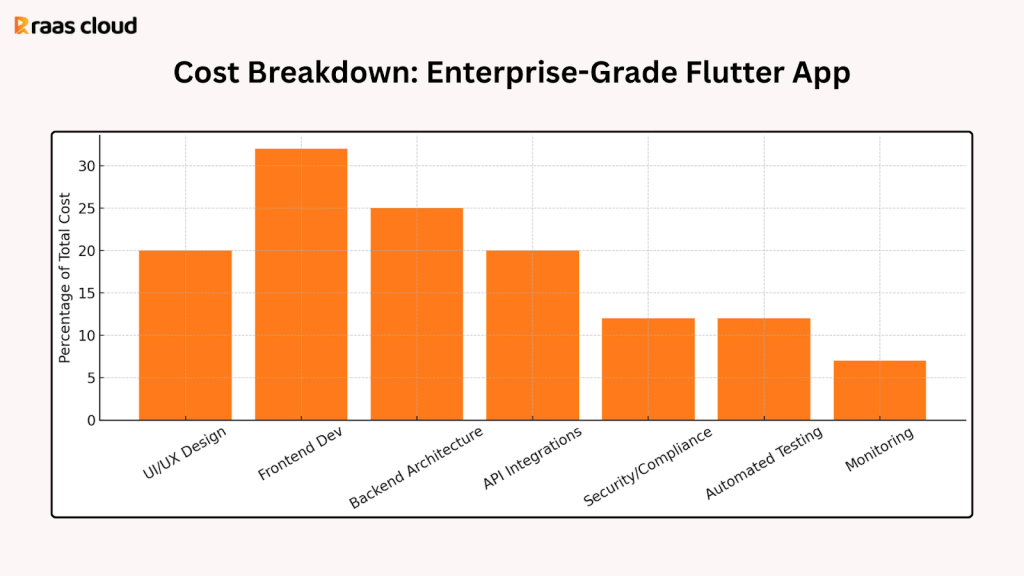
Cost Breakdown: Enterprise-Grade Flutter App
| Cost Component | Percentage of Total Cost | Description |
| Enterprise UI/UX Design | 20% | Detailed flows for multiple user types |
| Frontend Development | 30%–35% | Large-scale screens and complex features |
| Backend Architecture | 20%–30% | Microservices, cloud setup, data layers |
| API-Heavy Integrations | 15%–25% | CRM, ERP, financial systems, analytics |
| Security & Compliance | 10%–15% | Encryption, regulatory standards |
| Automated Testing & CI/CD | 10%–15% | Test suites, deployment pipelines |
| Deployment & Monitoring | 5%–10% | Cloud hosting, performance tracking |
💡 Further resources:
- Cost To Hire Python Developers
- How Much Does It Cost to Hire Dedicated Developers in the US?
- How to Do Software Development Outsourcing Without Risking Quality?
Why do brands hire Flutter developers at RAAS Cloud?
Brands and enterprises choose RAAS Cloud because we offer expert Flutter developers who deliver fast, stable, and scalable apps with a clear development process. You can also contact top offshore Flutter developers without any hassle. Our team brings strong experience across mobile, web, and enterprise systems, backed by strict vetting and consistent quality checks.
Feel free to reach out and explore how our developers can help you achieve your goals.

Dhanalakshmi Kadirvelu is a Business Intelligence and Data Analytics expert with a strong focus on software development and data engineering. She creates efficient data models, builds interactive dashboards, and integrates analytics into software systems using Power BI, OBIEE, and SQL. Her work helps development teams use data effectively to create smarter software solutions and improve business performance.