

If you are planning to build a small project using React, you will quickly realize that hiring the right developer is not easy. You may struggle with high costs, unclear pricing, and too many options with no clear way to choose.
React developers charge differently based on experience, location, and project scope. Without proper understanding, you can either overpay or hire someone who cannot deliver the expected results.
At RAAS Cloud, the focus is on simplifying this process. You get access to pre-vetted React developers, flexible hiring models, and a faster way to start your project without long hiring cycles.
In this guide, you will learn how much you should pay a React developer for a small project, what factors affect the cost, and how to make the right hiring decision based on your budget and needs.
What Is Considered a Small React Project?
A small React project has a fixed scope, limited screens, and simple data flow. It avoids complex architecture like microservices, advanced state management, or large-scale backend logic.
Here are some examples of React small projects:
Simple UI Applications with Controlled State
In this type of project, the developer builds a small interface using 5 to 10 components. These components include inputs, buttons, modals, and display sections. State is managed locally using useState or useReducer. There is no need for tools like Redux or Zustand.
The logic stays inside the component or is passed through props. For example, a loan calculator app takes user input, runs a formula, and shows the result instantly. There is no database, no login, and no external data dependency.
Single Page Landing Page with Component Based Structure
This project uses React to build a single page with reusable sections. The page usually has 4 to 6 sections such as hero, features, pricing, testimonials, and contact form. Each section is a separate component.
The app may use useEffect once to load data, such as testimonials, from a JSON file or an API. Animations are handled using simple libraries or CSS. Routing is not required; at most, a basic router is used for smooth scrolling. There is no user authentication or dashboard logic.
Basic Dashboard with Limited Data Flow
A small dashboard includes 2 to 4 pages using React Router. It shows data in tables or charts using libraries like Chart.js or Recharts. The data is fetched from one or two API endpoints using fetch or axios.
State is managed locally or with Context API. There is no complex caching, no pagination logic for large datasets, and no real time updates using websockets. A simple login screen may exist, but without advanced role based access.
Feature Level Development Inside an Existing Codebase
This type of project focuses on one feature inside a larger React app. The developer works on a limited part of the codebase, often within 3 to 6 files.
Tasks include creating a new component, adding a form with validation, updating UI styles, or fixing bugs. The developer follows the existing structure and does not change the core setup like routing or global state.
Simple API Integration with Direct Data Handling
Here, the React app connects to a backend using REST APIs. The developer uses useEffect to fetch data and stores it in local state. The app can display lists, submit forms, or update data.
There is no advanced error boundary setup, no retry logic, and no complex API orchestration. The data flow is linear. For example, fetch data on page load, display it, and allow basic actions like add or delete.
👉 Learn when NOT to Use React (Hard Truths for Founders)
No Advanced State or Performance Optimization
These projects do not require global state tools like Redux. They do not include memoization strategies like useMemo or useCallback for performance tuning. The component tree is small, so performance is not a concern.
What is the average cost to hire a React developer?
React developer pricing is not random. It follows clear models based on how the work is structured. The three most common models are hourly pricing, fixed project pricing, and location based pricing. Each model has its own use case, risk level, and cost behavior.
Understanding React Developer Pricing Models:
Before you look at numbers, you need to understand what you are paying for. You are not just paying for code. You are paying for time, problem solving, and execution speed.
Hourly pricing is flexible. It adapts when your requirements change. Fixed pricing is controlled. It locks cost but needs clear scope. Location based pricing changes the base rate even for the same skill level.
Hourly Rates for React Developers
Hourly pricing means you pay only for the time spent on your project. This model is used when the scope is not fully fixed or when you expect ongoing changes.
1. What Makes Hourly Pricing Unique
The biggest advantage is flexibility. You can start small, test the developer, and scale work based on results. You can also stop anytime without committing to a full project cost.
The risk is time overrun. If the developer takes longer than expected, your cost increases. This model needs clear tracking and communication.
2. Beginner React Developer (0 to 2 years)
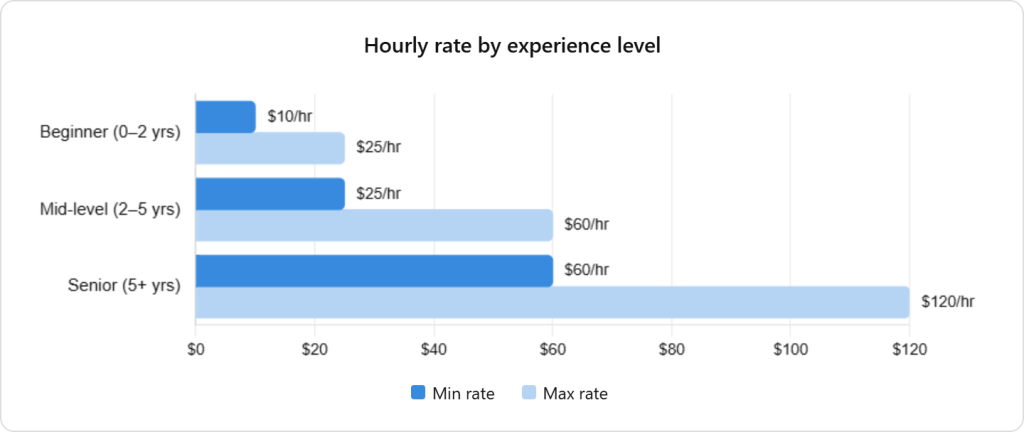
A beginner usually charges $10 to $25 per hour. They work best on clearly defined tasks like building simple components or fixing UI issues. They follow instructions well but may struggle with decision making or debugging complex issues.
You will spend less money per hour, but the total time may be higher.
3. Mid Level React Developer (2 to 5 years)
A mid level developer charges $25 to $60 per hour. They understand component structure, hooks, API handling, and basic performance optimization. They can build a small project from start to finish without much support.
This level gives the best balance between cost and output. Most small projects fit here.
4. Senior React Developer (5+ years)
A senior developer charges $60 to $120 per hour or more. They write clean, scalable code and solve problems faster. They also plan structure before coding, which reduces future issues.
You pay more per hour, but the total project time is often lower. This is useful when deadlines are tight or quality is critical.
Fixed Price for Small React Projects
Fixed pricing means you agree on a total cost before work starts. The developer estimates the full effort and gives one final price.
1. What Makes Fixed Pricing Unique
The biggest advantage is cost certainty. You know your total budget before the project begins. This works well when your requirements are clear and will not change. However, the limitation is low flexibility. If you add new features later, the cost will increase. Every change requires renegotiation.
2. Basic Small Project
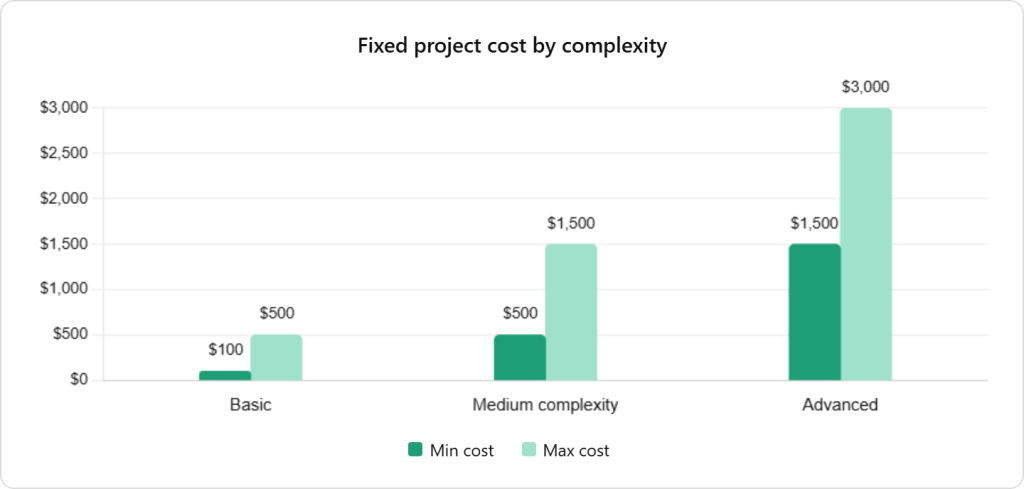
A simple project like a React landing page or small tool costs around $100 to $500. The work includes static UI, basic responsiveness, and minimal logic. These projects are fast and usually completed in a few days.
3. Medium Complexity Small Project
Projects with multiple components, API calls, and some user interaction cost between $500 to $1500. This includes dashboards, forms with validation, and dynamic content. In this case, the developer spends more time on data handling and structure.
4. Advanced Small Project
More refined small projects cost between $1500 to $3000. These include multiple screens, better UI design, authentication, and cleaner architecture. Even though it is still called small, the internal logic is more structured and requires better planning.
Cost Based on Developer Location
Location directly affects pricing because developers charge based on local market rates and demand.
What Makes Location Based Pricing Unique
The same skill level can have very different pricing. A developer in one country may charge three times more than another developer with similar experience.
This creates an opportunity to reduce cost without reducing quality, if you hire from the right region.
India and South Asia
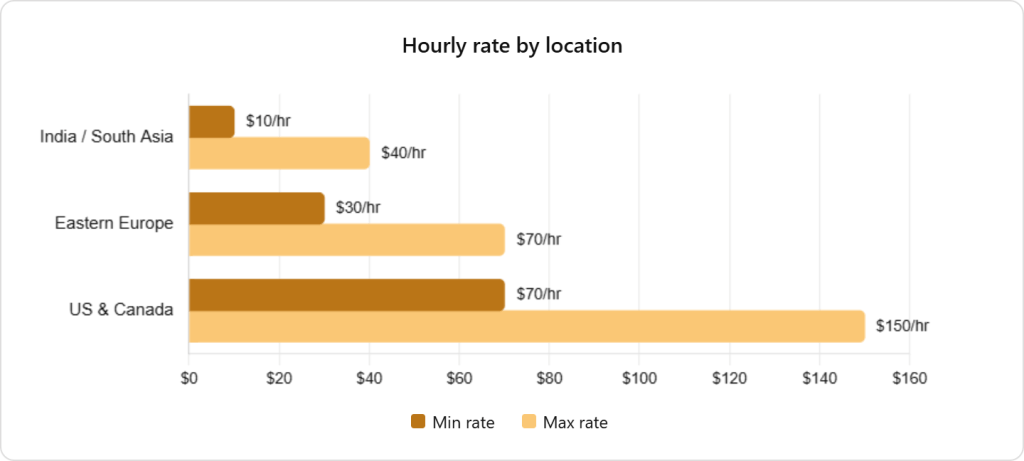
Developers in India usually charge $10 to $40 per hour. The region has a large talent pool and competitive pricing. Many developers have strong technical skills but may vary in communication and consistency. This is the most cost efficient option if you’re only looking to build react based small projects.
Eastern Europe
Developers here charge $30 to $70 per hour. They offer strong coding standards and good communication. The cost is higher than India but lower than Western countries.
This region is known for balanced quality and reliability.
United States and Canada
Developers charge $70 to $150 per hour or more. The cost is high due to local demand and living standards. They often bring strong experience, better documentation, and smoother communication.
This is suitable when you want premium quality and faster collaboration.
Freelancers vs Agencies
Freelancers work alone. They charge less because they have low overhead. They are ideal for small and clearly defined projects.
Agencies charge more because you get a team, project manager, QA support, and structured delivery. This reduces your involvement but increases cost.
What You Should Realistically Pay
For most small React projects, a mid level freelancer from a cost effective region is the best choice. You can expect to pay between $300 to $1500 for quality work.
If your project needs better design, faster delivery, or long term stability, the cost can go higher depending on who you hire and how you structure the work.
Challenges in Hiring a Skilled React Developer in the US
Hiring a React developer in the US is not just about finding someone who knows React. It involves cost, availability, quality, and speed. Each challenge affects your timeline and budget.
High Hiring Cost and Budget Pressure
The biggest challenge in the US market is cost. React developers in cities like San Francisco or New York often charge $80 to $150 per hour. Even mid level developers can exceed small project budgets.
This creates a problem for startups and small businesses. You either overspend or compromise on experience. Hiring full time also adds costs like benefits, taxes, and infrastructure.
⭐ How RAAS Cloud helps
RAAS Cloud removes this cost pressure by offering pre vetted developers at more competitive rates. You avoid recruitment, training, and overhead costs while still accessing skilled talent. This makes small project hiring more financially practical.
👉 Hire ReactJS Developers at RAAS Cloud (Top 1% React Talent)
Limited Availability of Quality Talent
Even with a large tech ecosystem, finding available and skilled React developers is difficult. Top developers are already working in big tech companies or long term contracts. The hiring cycle becomes slow because good candidates are not actively looking.
This leads to delays in project start and missed deadlines.
⭐ How RAAS Cloud helps
RAAS Cloud provides access to a ready pool of pre screened React developers. Instead of searching for months, you can onboard talent quickly. This reduces hiring time and helps you start projects faster without waiting for local availability.
Time Consuming Hiring and Screening Process
Hiring in the US involves multiple steps like sourcing, screening, interviews, and technical tests. This process can take weeks or even months. You also need technical knowledge to evaluate candidates properly.
If you make a wrong hire, the cost of replacement is high.
⭐ How RAAS Cloud helps
RAAS Cloud solves this by offering pre vetted developers who are already tested for skills and experience. You skip the entire screening process and directly work with qualified talent. They also offer flexible hiring models and a trial option to reduce risk.
Lack of Flexibility for Small Projects
Most US developers prefer long term or full time roles. This makes it hard to hire for small or short term projects. You may end up paying for more hours than needed or struggle to find someone interested in limited work.
This reduces cost efficiency for small React projects.
⭐ How RAAS Cloud helps
RAAS Cloud offers flexible engagement models like fixed price, part time, or time based hiring. This allows you to match your exact project scope without overcommitting. You can scale up or down based on your needs, which is ideal for small projects.
Why Businesses Choose RAAS Cloud
RAAS Cloud has delivered 60+ projects, served 40+ clients, and built a team of 50+ skilled professionals across 30+ services. They focus on fast onboarding, cost efficiency, and access to top tier React talent.
This makes them a practical solution for businesses that want to avoid hiring challenges in the US while still getting quality results.

Dhanalakshmi Kadirvelu is a Business Intelligence and Data Analytics expert with a strong focus on software development and data engineering. She creates efficient data models, builds interactive dashboards, and integrates analytics into software systems using Power BI, OBIEE, and SQL. Her work helps development teams use data effectively to create smarter software solutions and improve business performance.