As AI adoption grows across industries, more businesses are now training AI models using their own data, workflows, documents, and internal processes. This helps create systems that are more accurate, more relevant to the business, and better aligned with real operational needs.
But one of the biggest questions most SMEs and enterprises still have is simple: how much does it actually cost to train a custom AI model?
The answer depends on several factors including the type of AI model, the amount and quality of data, infrastructure requirements, integration complexity, and long-term maintenance.
In this guide, we are breaking down the real costs involved based on our experience of working on 15+ custom AI model projects across industries like healthcare, SaaS, eCommerce, logistics, and enterprise automation. We will cover everything from data preparation and GPU costs to hidden expenses, deployment, and ongoing model maintenance so you can plan your AI investment more realistically.
What Does It Actually Cost to Train a Custom AI Model?
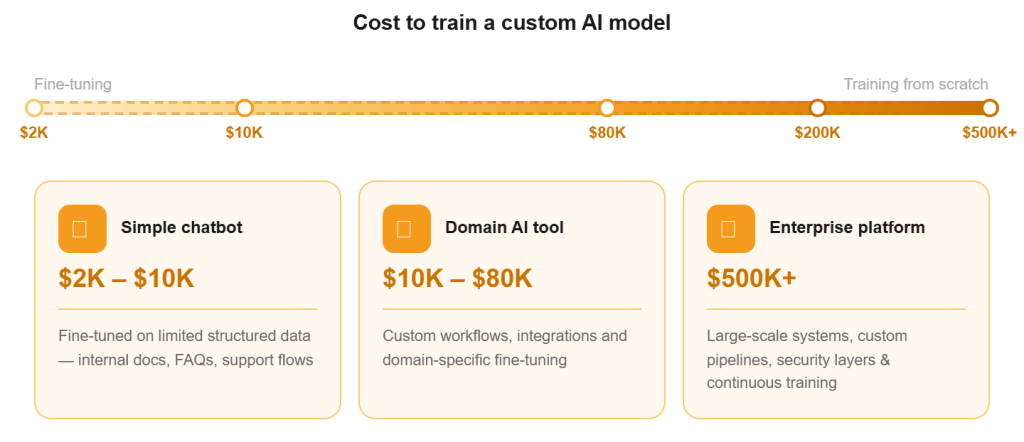
A simple AI model can be trained at a cost as low as $2,000 to $10,000, especially when businesses are fine tuning an existing foundation model using a limited and structured dataset. On the other hand, for enterprises building large scale AI systems with custom workflows, heavy data processing, security layers, and continuous training pipelines, the cost can easily go beyond $500,000 or even more.
A good example of how expensive large scale AI training can become is Stable Diffusion, one of the most widely used texts to image AI models. The model was reportedly trained using 256 Nvidia A100 GPUs on Amazon Web Services for around 150,000 GPU hours, with an estimated training cost of nearly $600,000.
The actual cost depends on several factors including what exactly you are trying to build, what type of AI model is being trained, how much data needs to be processed, how clean the data is, how many training iterations are required, and what level of accuracy the business expects from the final output.
Another important factor is the level of customization involved. Some businesses only need a model that understands their documents and workflows. Others require advanced capabilities like real time predictions, multilingual processing, image understanding, voice analysis, or integration with internal ERP and CRM systems. Each additional layer increases both development and operational cost.
To understand the real investment required, it is important to break down each cost factor separately. Let’s look at the key elements that directly impact the cost of training a custom AI model and how businesses can plan their budgets more realistically.
The 7 Biggest Factors That Determine Cost
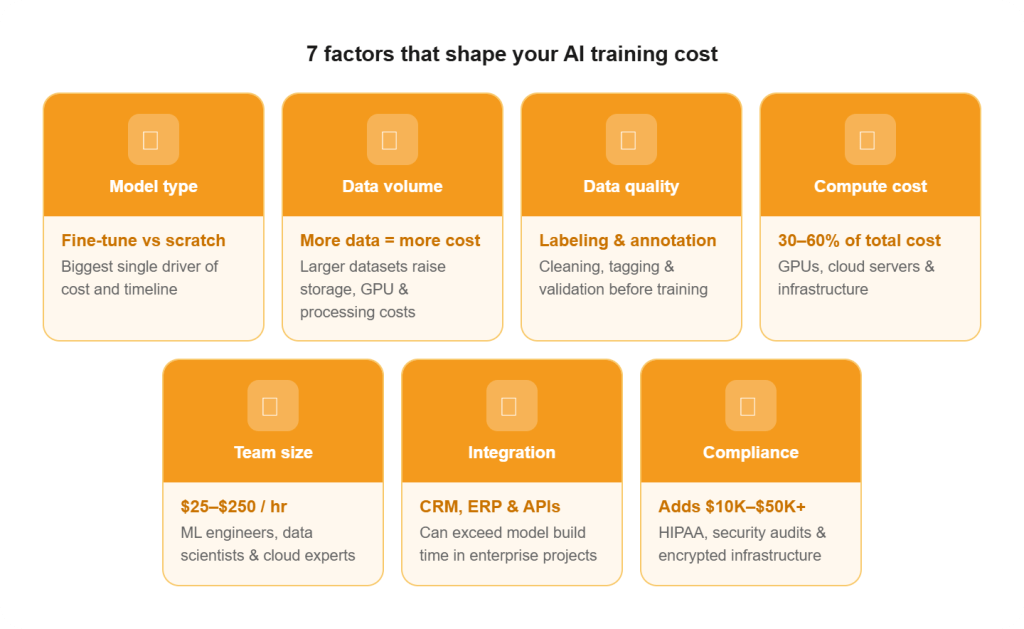
Below, we have highlighted the 7 biggest factors that directly impact the cost of training a custom AI model and why understanding them is important before planning your AI budget.
1. Model Type
There are many ways companies train custom AI models depending on their business goals, use case complexity, available data, and expected output quality. Some businesses only need lightweight fine tuning on an existing AI model, while others require fully custom training pipelines built from scratch.
- Fine tuning an existing foundation model
- Training a domain specific model
- Training from scratch
- Multimodal models cost more than text only models
The type of model you choose has a direct impact on development cost, infrastructure requirements, training time, and long term maintenance. In many cases, businesses overspend by choosing a more complex model architecture than they actually need.
Depending on your business goals, data availability, and expected AI capabilities, choosing the right training approach can significantly reduce overall development cost. If you are planning to build a custom AI solution, our AI experts can help you identify the right model strategy and optimize the training process for minimum cost and maximum efficiency.
2. Data Volume
Every AI model needs data to learn patterns, context, and decision making. This training data can include documents, conversations, images, videos, spreadsheets, support tickets, medical records, transaction history, or any other business specific information. In AI, this is commonly referred to as the training dataset.
In general, the more high quality training data a model gets, the better its performance becomes. But at the same time, larger datasets also increase storage, processing, labeling, and GPU training costs. This is why businesses need the right balance between data quantity and data quality instead of simply collecting massive amounts of data.
For example, GPT-3 was trained on hundreds of billions of tokens collected from sources like Common Crawl, books, Wikipedia, and web content. Training models at that scale requires massive infrastructure and compute investment, which is why most businesses today prefer fine tuning existing models on smaller, domain specific datasets instead of training from scratch.
3. Data Quality and Labeling Effort
Data is rarely ready for AI training in its raw form. In most projects, the data needs to be cleaned, structured, filtered, labeled, and validated before it can be used effectively. This process is important because even a powerful AI model can produce poor results if the training data is inconsistent or inaccurate.
For supervised AI training, datasets are often prepared using techniques like annotation, classification, tagging, sentiment labeling, object detection, entity recognition, and human review workflows. The more specialized the use case is, the higher the labeling effort and cost usually become.
At RAAS Cloud, we help businesses prepare AI ready datasets through data cleaning, structuring, annotation, validation, and preprocessing services to improve model accuracy while reducing unnecessary training costs.
4. Compute Requirements
Compute cost is often one of the biggest expenses in custom AI model training and in many large projects, it can account for 30% to 60% of the overall AI development cost.
In simple terms, compute refers to the processing power required to train, test, and run AI models. This usually includes GPUs, cloud servers, storage systems, memory usage, and networking infrastructure.
The larger and more complex the AI model becomes, the more compute power it requires. For example, a simple customer support chatbot fine tuned on internal company documents may only require a small cloud GPU setup for a few hours or days. But applications like autonomous driving systems or large text to image models require thousands of GPU hours running continuously across multiple high performance servers.
For example, a lightweight AI chatbot for a SaaS company may cost only a few hundred dollars in compute during training, while training a large computer vision model for medical imaging or manufacturing inspection can cost tens of thousands of dollars in GPU usage alone.
5. Team Involved
AI model training is rarely handled by a single developer. Depending on the complexity of the project, businesses usually need a combination of AI engineers, data specialists, cloud experts, and domain professionals to build, train, deploy, and maintain the system properly.
Here is the usual team structure involved in custom AI development projects:
| Role | Responsibility | Average Hourly Rate |
| ML Engineer | Model training and optimization | $50 to $180/hour |
| Data Scientist | Data analysis and model evaluation | $60 to $200/hour |
| Data Engineer | Data pipelines and preprocessing | $40 to $150/hour |
| MLOps Engineer | Deployment and infrastructure automation | $60 to $180/hour |
| AI Researcher | Advanced model architecture and experimentation | $80 to $250/hour |
| QA Engineer | Testing and validation | $25 to $80/hour |
| Domain Expert | Industry specific validation and guidance | Varies by industry |
The final team size will depend on the type of AI system being developed. A small internal AI assistant may only require 2 to 3 specialists, while enterprise grade AI platforms often involve cross functional teams working for several months.
At RAAS Cloud, we offer pre vetted AI developers, ML engineers, data specialists, and cloud experts across 50+ technologies to help businesses build custom AI solutions at cost effective rates. We support offshore, nearshore, and dedicated hiring models based on project requirements and scaling needs.
Also Read: What is the True Cost of Hiring AI Developers?
6. Integration Complexity
Once the AI model is trained, it still needs to be integrated with business systems, applications, workflows, and data sources to become practically usable. This integration layer is an important part of the overall development cost because the AI system usually needs to communicate with multiple platforms in real time.
Some common integrations include CRMs, ERPs, internal dashboards, customer support platforms, mobile apps, APIs, cloud storage systems, analytics tools, and third party business software. In many enterprise projects, the integration effort can take longer than the actual model training itself.
For smaller AI projects, integration complexity may not impact the budget significantly. But if you need custom APIs, real time processing, role based access control, enterprise security layers, workflow automation, or integration with legacy systems, the development cost can increase substantially.
7. Compliance and Risk
Some industries like healthcare, banking, insurance, cybersecurity, and government sectors have strict compliance and data protection requirements for AI systems. These regulations add additional development, infrastructure, legal, and security costs because businesses need to ensure that sensitive data is processed, stored, and accessed securely.
For example, a healthcare AI platform handling patient records in the United States need to comply with HIPAA requirements. This can involve encrypted storage, access logging, audit trails, secure cloud infrastructure, and compliance reviews. In many cases, HIPAA compliant cloud infrastructure and security implementation alone can add $10,000 to $50,000+ to the overall project cost depending on system complexity.
Similarly, financial AI systems may require fraud monitoring, identity verification, explainable AI outputs, and strict governance controls, all of which increase both development and operational expenses.
Cost Comparison: Fine Tuning vs Training From Scratch
When businesses build custom AI solutions, they usually choose between two approaches. The first is fine tuning an already available foundation model like GPT, Llama, or Mistral using business specific data. The second is training a completely new AI model from scratch using custom datasets and infrastructure.
For most SMEs and mid sized businesses, fine tuning is usually the more practical and cost effective option. Training from scratch is generally preferred only when businesses need full model ownership, highly specialized capabilities, or proprietary AI architectures.
| Factor | Fine Tuning Existing Model | Training From Scratch |
| Typical Cost | $5,000 to $80,000 | $100,000 to several million dollars |
| Training Time | Few hours to few weeks | Several weeks to several months |
| Data Requirement | Thousands to millions of records | Millions to billions of records |
| Compute Requirement | Moderate GPU usage | Extremely high GPU clusters |
| Infrastructure Cost | Low to medium | Very high |
| Time to Market | Fast | Slow |
| Best For | Chatbots, internal AI tools, automation, assistants | Proprietary AI platforms, research, advanced enterprise AI |
| Maintenance Cost | Lower | Higher |
| Accuracy Improvement | Domain specific optimization | Full architecture level control |
| Risk Level | Lower development risk | Higher technical and financial risk |
| Popular Examples | Fine tuned customer support AI | GPT style large language models |
| Recommended For | SMEs, startups, enterprise automation | Large tech companies and research labs |
Planning the Right AI Investment
The cost of training a custom AI model varies because AI development is not a one size fits all process. Every business has different goals, different datasets, different infrastructure requirements, and different expectations from the final AI system. A simple internal AI assistant and a large enterprise grade AI platform can differ massively in both complexity and cost.
The key is not just building an AI model, but building the right AI solution that delivers real business value without unnecessary development and infrastructure expenses.
At RAAS Cloud, we work closely with businesses to assess their use case, existing data, technical requirements, and scalability goals before providing a custom AI development proposal. Our team helps businesses choose the most practical and cost effective approach for AI model training, deployment, and long term maintenance.
We are one of the most cost effective AI development teams serving businesses across the USA, helping startups, SMEs, and enterprises build custom AI solutions with minimal overhead costs, faster deployment timelines, and complete technical support.
If you are planning to build a custom AI model or explore AI for your business, get in touch with our team and share your requirements. We will help you identify the right AI strategy, estimate realistic development costs, and build a scalable solution aligned with your business goals.

Dhanalakshmi Kadirvelu is a Business Intelligence and Data Analytics expert with a strong focus on software development and data engineering. She creates efficient data models, builds interactive dashboards, and integrates analytics into software systems using Power BI, OBIEE, and SQL. Her work helps development teams use data effectively to create smarter software solutions and improve business performance.