

Since the rise of agile development and continuous delivery, DevOps has become a critical part of how modern software products are built, tested, and deployed.
Most growing organizations now prefer outsourcing their DevOps operations instead of building and maintaining in-house teams. Outsourcing offers access to skilled engineers, advanced tools, and faster deployment cycles without the cost and management overhead. IT outsourcing companies like RAAS Cloud help businesses design scalable DevOps strategies, automate infrastructure, and manage continuous delivery pipelines with precision.
Today, our team of experts has put together this practical guide to help you understand what DevOps outsourcing really involves. We’ll walk through how pricing works, the key benefits you can expect, and the right time to consider it for your business. Whether you’re a startup aiming for faster releases or an enterprise optimizing infrastructure costs, this guide will help you make informed decisions about DevOps outsourcing.
What is DevOps Outsourcing?
DevOps outsourcing means hiring an external team or company to manage your software development and IT operations processes. Instead of building everything in-house, you work with experts who specialize in automation, CI/CD pipelines, cloud management, monitoring, and deployment.
The goal is to create faster release cycles, improve collaboration between development and operations, and maintain stable, scalable systems.
There are a few common delivery models for DevOps outsourcing.
- Managed Services: A third-party company handles your entire DevOps function, from setup to ongoing monitoring.
- Dedicated Team: You get a team of DevOps engineers who work full-time on your project and act as an extension of your internal team.
- Staff Augmentation: You hire one or more DevOps experts to fill specific skill gaps within your existing team.
The main difference between hiring a few DevOps engineers and outsourcing the whole function lies in responsibility and scalability. When you hire individual engineers, your company still needs to handle management, workflows, and tool selection.
In contrast, outsourcing DevOps shifts the operational and technical responsibility to a specialized provider. This approach gives you access to a broader range of skills, proven frameworks, and round-the-clock support while freeing your team to focus on core product development.
Why Do Companies Outsource DevOps?
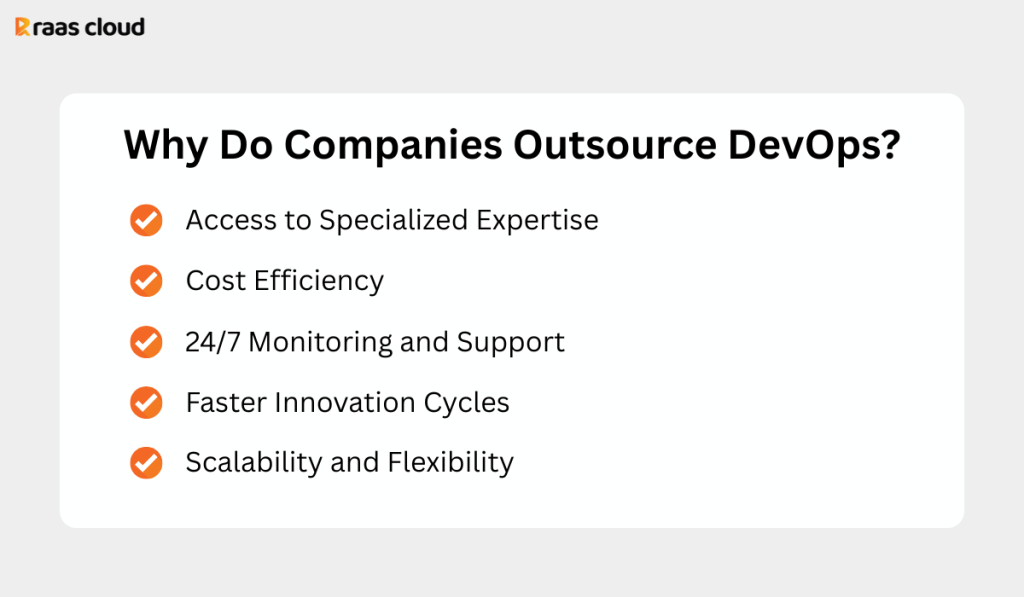
We have listed below the most common reasons companies choose to outsource their DevOps operations and how it helps them achieve faster releases, stronger infrastructure, and better cost control.
1. Access to Specialized Expertise
Outsourcing DevOps gives you direct access to engineers who work daily with modern tools like Docker, Kubernetes, Jenkins, and Terraform. These professionals understand complex cloud architectures and can build automated workflows that match your business needs.
Instead of spending months hiring and training in-house staff, you instantly gain access to certified experts who have already handled similar environments. This helps you avoid setup mistakes, improve deployment reliability, and adopt best practices from day one. It’s an efficient way to bring advanced skills into your project without long-term overhead.
2. Cost Efficiency
Building a full DevOps setup internally requires major investments in recruitment, tools, and training. Outsourcing helps reduce these costs by giving you access to an experienced team on a flexible pricing model.
You only pay for the time or services you use, which makes budgeting simpler and more predictable. In addition, outsourcing partners already have existing licenses, infrastructure, and frameworks in place. This eliminates the need for upfront spending while still ensuring professional-grade results. For most companies, it’s a smarter way to achieve enterprise-level operations without the expense of maintaining them in-house.
3. 24/7 Monitoring and Support
Outsourced DevOps teams keep your systems running around the clock. They monitor infrastructure, pipelines, and production environments to detect and fix issues before they impact users.
- Real-time alerts and incident management
- Automated backups and disaster recovery planning
- Continuous performance monitoring across environments
This level of support ensures higher uptime and stability, even during peak usage. With specialists available across different time zones, businesses can maintain uninterrupted service without hiring multiple shifts internally. It’s a strong advantage for global or customer-facing products that require continuous availability.
4. Faster Innovation Cycles
A dedicated DevOps outsourcing partner helps you move from manual deployments to automated pipelines. This change alone can reduce release times from weeks to hours. Automation ensures that testing, integration, and deployment happen quickly and reliably across environments.
Because infrastructure management is handled by experts, your developers can focus on building new features instead of troubleshooting releases. The result is a consistent cycle of delivery, feedback, and improvement that drives faster innovation. Companies that adopt outsourced DevOps often see measurable gains in release speed and product quality within months.
5. Scalability and Flexibility
DevOps outsourcing gives you the freedom to scale your infrastructure and resources up or down as needed. Whether you are launching a new feature, expanding to new markets, or facing seasonal demand, your outsourcing partner can quickly adjust the setup.
This flexibility prevents resource wastage and avoids the long delays of internal hiring. You can access additional engineers or advanced cloud solutions whenever your project grows. It also allows you to experiment with new technologies or tools without heavy investment, keeping your operations agile and cost-effective.
When Should You Consider DevOps Outsourcing?
Outsourcing DevOps is not just a cost decision but a strategic one that can help your business grow faster and run more efficiently. It becomes especially valuable when your internal teams reach their limits or when you need to modernize infrastructure without major delays.
If you notice recurring deployment issues, increasing workload, or skill gaps in automation, it may be time to bring in outside expertise. Here are some common situations where outsourcing DevOps makes sense:
- When development teams are growing and deployment frequency increases.
- When internal teams lack automation or cloud expertise.
- When product releases are delayed due to manual bottlenecks.
- When the company plans to migrate to cloud or multi-cloud environments.
- When security, compliance, and reliability are becoming harder to manage.
DevOps Outsourcing Pricing Models
At RAAS Cloud, we understand that every business has different goals, timelines, and technical needs. That’s why our DevOps outsourcing is designed around flexible pricing models that adapt to your project stage and workload. Here are the main models we offer and when to use them:
1. Fixed-Price Model
Ideal for small, clearly defined projects such as setting up CI/CD pipelines or automating specific workflows. You agree on a defined scope, timeline, and cost upfront.
Best for: Short-term projects with predictable requirements.
RAAS Cloud Insight: Works well when the outcome is measurable, for example, “Deploy a staging-to-production CI/CD pipeline on AWS.”
2. Time & Material Model
Used for projects with evolving requirements where flexibility is key. You pay based on the actual hours or resources used.
Best for: Ongoing system improvements or when project scope may change.
RAAS Cloud Insight: Ideal for scaling automation or integrating DevOps practices across multiple products.
3. Dedicated Team Model
A full-time DevOps team works exclusively on your projects, functioning as an extension of your internal team.
Best for: Large enterprises or products with continuous release cycles.
RAAS Cloud Insight: Gives maximum control and long-term knowledge retention, perfect for businesses with multiple environments or frequent updates.
4. Hybrid Model
Combines elements of the above models to balance predictability and flexibility.
Best for: Businesses that want managed stability but occasional deep custom work.
RAAS Cloud Insight: Often used by clients during cloud migrations with stable monthly cost for monitoring, flexible scope for modernization.
Each model at RAAS Cloud is supported by transparent reporting, defined SLAs, and the freedom to scale up or down based on performance and business priorities.
How Much Does DevOps Outsourcing Cost?
The cost of DevOps outsourcing usually ranges between $30 to $100 per hour, depending on the provider’s expertise, project complexity, and location.
However, the actual cost can vary significantly based on your infrastructure size, automation goals, and level of ongoing support required. At RAAS Cloud, we customize pricing to match your specific requirements rather than offering flat packages.
Here are the key factors that influence DevOps outsourcing costs:
- Team size and seniority of DevOps engineers
- Type of cloud platforms used (AWS, Azure, GCP, or hybrid)
- Level of automation and CI/CD pipeline complexity
- Monitoring, security, and compliance requirements
- Engagement duration (short-term vs. continuous support)
- Project management and SLA commitments
- Location and time zone of the outsourcing partner
Here we have added a simple cost estimator to give you a simple overview of the costs. Give it a try:
DevOps Cost Estimator By RAAS Cloud
Estimated Monthly Cost: $9,600
Total Cost for 6 Months: $57,600
Build a Stronger, Faster, and More Reliable DevOps Pipeline
If you are an organization looking to scale development, improve deployment speed, or strengthen infrastructure reliability, DevOps outsourcing can be a smart and cost-effective move. Instead of building everything from scratch, you can partner with experts who already have the tools, frameworks, and experience to accelerate your growth.
Let RAAS Cloud handle the technical complexity while your team focuses on building great products. Our DevOps specialists will assess your current setup, design a tailored automation strategy, and ensure smooth implementation. You can get started by scheduling a quick consultation with our team to explore the best outsourcing model for your business goals.

Dhanalakshmi Kadirvelu is a Business Intelligence and Data Analytics expert with a strong focus on software development and data engineering. She creates efficient data models, builds interactive dashboards, and integrates analytics into software systems using Power BI, OBIEE, and SQL. Her work helps development teams use data effectively to create smarter software solutions and improve business performance.