AI has quietly moved from being an experimental initiative to something that’s shaping how enterprises operate day to day. It’s being used to streamline repetitive work, improve decision-making, and create more personalized customer experiences often behind the scenes.
Yet, most organizations don’t struggle with understanding AI. The real challenge lies in implementing it in a way that actually works. Many initiatives start with strong intent, run a few pilots, and then lose momentum because there’s no clear path to scale or integrate them into existing workflows.
The problem is not only about building AI but also about making it useful.
That’s where a structured roadmap helps turn scattered efforts into systems that deliver real, measurable impact.
In this guide, we break down the complete enterprise AI implementation process, helping you move from idea to execution with clarity and confidence.
Why Enterprise AI Implementation Fails Without a Roadmap
Many AI initiatives fail not because of technological limitations, but because of gaps in planning and execution. Organizations often jump into AI with the mindset of adopting the latest tools rather than solving specific business problems. This leads to solutions that are technically sound but lack real-world impact.
Another common issue is the disconnect between teams. Leadership may define high-level goals, while data and engineering teams focus on execution without a shared understanding of priorities. This lack of alignment results in fragmented efforts and slow progress.
In addition, many enterprises underestimate the importance of data readiness and infrastructure. AI systems rely heavily on high-quality data, and without it, even the most advanced models cannot perform effectively.
To avoid these challenges, organizations need a strategic approach from the start. Working with experienced teams through AI development consulting can help identify the right use cases, align stakeholders, and create a clear implementation plan before significant resources are invested.
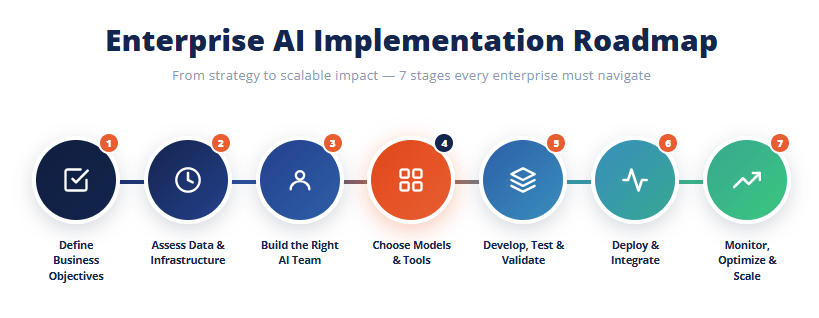
Step 1: Define Clear Business Objectives
The foundation of any successful AI initiative is a clear understanding of the problem it aims to solve. Instead of starting with technology, organizations should begin by identifying specific business challenges where AI can create measurable impact.
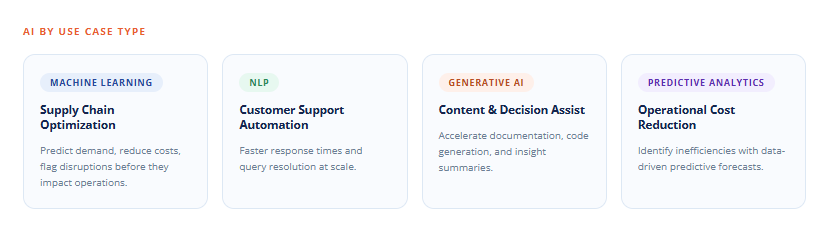
This could include improving customer support response times, optimizing supply chain operations, reducing operational costs, or enhancing decision-making through predictive insights. The key is to focus on outcomes rather than tools.
Defining clear objectives also helps in prioritizing use cases. Not every problem needs an AI solution, and trying to address too many areas at once can dilute focus. Starting with a few high-impact, achievable use cases allows organizations to demonstrate value quickly and build momentum for larger initiatives.
Step 2: Assess Data Readiness and Infrastructure
Data is the backbone of any AI system, and its quality directly affects the accuracy and reliability of outcomes. Before building models, organizations need to evaluate whether their data is clean, structured, and accessible.
Many enterprises face challenges such as fragmented data sources, inconsistent formats, or lack of proper data governance. Addressing these issues is essential before moving forward with implementation.
Infrastructure is equally important. AI systems require the ability to process large volumes of data, train models efficiently, and deploy solutions at scale. This often involves cloud platforms, data pipelines, and scalable computing resources.
Organizations that are unsure about their readiness can benefit from expert guidance at this stage. Through AI development consulting, businesses can identify gaps in data and infrastructure and create a roadmap to address them effectively.
Step 3: Build or Hire the Right AI Team
One of the most critical factors in successful AI implementation is having the right talent. Building an in-house team with data scientists, machine learning engineers, and AI specialists can be time-consuming and expensive.
This is why many organizations adopt a more flexible approach by choosing to hire AI developers who already have experience working on real-world AI projects. This allows businesses to accelerate development without the overhead of long hiring cycles.
Hiring the right talent also ensures that your AI solutions are built with best practices in mind, reducing the risk of errors and inefficiencies. However, before making hiring decisions, it’s important to understand the associated costs and plan accordingly.
👉 If you’re evaluating this approach, you can explore how to hire AI developers based on your project needs.
👉 You can also get a clearer picture of investment requirements by understanding how much it costs in AI development.
Step 4: Choose the Right AI Models and Tools
Selecting the right models and tools is a crucial step that directly impacts the success of your AI initiative. The choice should be driven by your specific use case, data availability, and long-term scalability requirements.
For example, some use cases may require machine learning models for predictive analytics, while others may benefit from natural language processing or generative AI capabilities. The goal is to choose solutions that align with your business objectives rather than following industry trends.
It’s also important to consider how these tools will integrate with your existing systems. AI solutions should not operate in isolation; they need to work seamlessly within your current workflows and technology stack.
Making the right decisions at this stage reduces the need for rework and ensures that your implementation remains efficient and scalable over time.
Step 5: Develop, Test, and Validate AI Solutions
AI development is an iterative process that requires continuous testing and refinement. Once models are built, they need to be trained on relevant data and evaluated for accuracy, reliability, and performance.
Testing should go beyond technical metrics. It should also consider how the solution performs in real-world scenarios and whether it delivers the intended business outcomes.
Validation is critical before deployment. Rushing this phase can lead to inaccurate results, user dissatisfaction, and loss of trust in the system. A structured approach ensures that the solution is ready for practical use and aligned with expectations.
Step 6: Deploy and Integrate into Business Workflows
Deployment is where AI transitions from a concept to a functional part of the business. However, simply deploying a model is not enough—it needs to be integrated into existing workflows so that teams can use it effectively.
This may involve embedding AI into internal tools, dashboards, or customer-facing applications. The focus should be on making the solution accessible and easy to use.
Adoption is a key factor in success. Teams need to understand how the system works and trust its outputs. Without proper integration and user adoption, even well-built AI solutions can fail to deliver value.
Step 7: Monitor, Optimize, and Scale
AI implementation does not end with deployment. It is an ongoing process that requires continuous monitoring and improvement.
Over time, data patterns may change, and models may need to be retrained to maintain accuracy. Performance should be regularly evaluated to ensure that the system continues to deliver value.
As successful use cases emerge, organizations can scale these solutions across different departments and functions. This allows AI to become a core capability rather than a one-time initiative.
Enterprises that treat AI as a long-term investment see significantly better outcomes compared to those that approach it as a short-term project.
How RAAS Cloud Supports Enterprise AI Implementation
Implementing AI at an enterprise level requires more than just technical expertise—it requires a structured approach that connects strategy with execution. This is where RAAS Cloud plays a key role.
RAAS Cloud works with businesses to simplify the entire AI journey, from identifying the right use cases to building and scaling solutions. By combining AI consulting, development, and flexible hiring models, they help organizations move forward without unnecessary delays or complexity.
Their approach ensures that AI initiatives are aligned with business goals from the start. Whether it’s selecting the right technologies, building scalable systems, or augmenting teams with experienced developers, RAAS Cloud provides the support needed at every stage.
Instead of treating AI as a standalone project, they focus on integrating it into real business workflows, ensuring long-term value and impact.
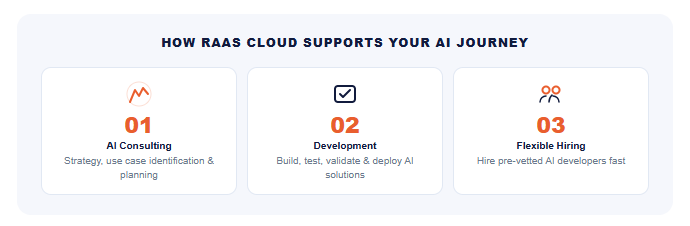
👉 If you’re planning to implement AI in your organization, you can connect with the RAAS Cloud team to explore the right approach for your business.
Making Enterprise AI Work in the Real World
Enterprise AI success is not defined by how advanced the technology is, but by how effectively it solves real business problems. Organizations that succeed are those that approach AI with clarity, discipline, and a long-term perspective.
They start with well-defined objectives, build strong data foundations, and invest in the right expertise. More importantly, they focus on continuous improvement rather than one-time implementation.
AI is not just a tool it is a capability that evolves over time. The sooner organizations recognize this and adopt a structured approach, the faster they can unlock its full potential.

Dhanalakshmi Kadirvelu is a Business Intelligence and Data Analytics expert with a strong focus on software development and data engineering. She creates efficient data models, builds interactive dashboards, and integrates analytics into software systems using Power BI, OBIEE, and SQL. Her work helps development teams use data effectively to create smarter software solutions and improve business performance.