

Generative AI is transforming how businesses build software, automate workflows, improve customer experiences, and drive innovation. As adoption accelerates, reliable data becomes essential for understanding market growth, enterprise investment, user behavior, industry adoption, and emerging trends.
This statistical roundup brings together the latest generative AI statistics from trusted industry reports, research firms, and technology organizations to give you a comprehensive view of the market.
For transparency and further reading, we have also included the original data sources referenced throughout this report.
Key Generative AI Adoption Statistics at a Glance
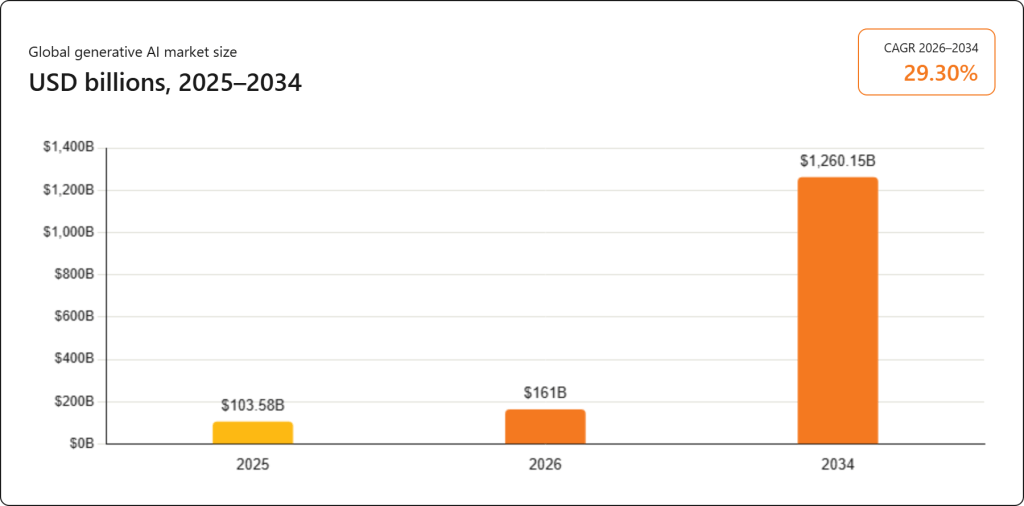
- The global generative AI market was valued at USD 103.58 billion in 2025 and is projected to reach USD 1,260.15 billion by 2034, growing at a 29.30% CAGR.
- 55% of organizations have adopted AI overall, although fewer than one-third have deployed it across multiple business functions.
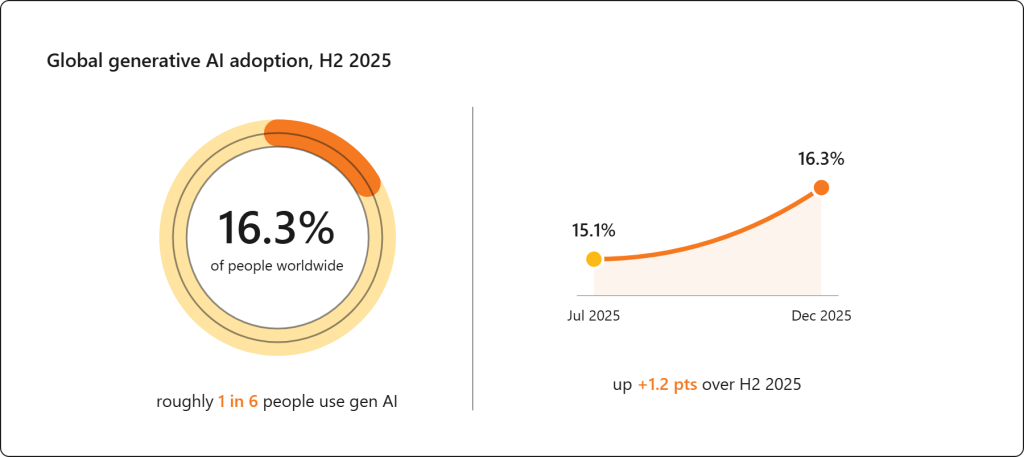
- Global generative AI adoption reached 16.3% of the world’s population in the second half of 2025, up from 15.1% in the first half of the year.
- 73% of surveyed people in India use generative AI, compared with 49% in Australia, 45% in the United States, and 29% in the United Kingdom.
- 86% of IT leaders expect generative AI to play a major role in their organizations, while 82% plan to integrate AI agents within the next one to three years.
- 80% of organizations increased their investment in generative AI after 2023, highlighting growing enterprise confidence in AI adoption.
- 56% of organizations use generative AI to improve efficiency and productivity, making it the most common business use case.
- 92% of organizations plan to hire professionals with generative AI expertise in 2025, reflecting strong demand for AI skills.
- 78% of business leaders believe governments should introduce more regulation for generative AI, while 72% say greater global collaboration is needed for responsible AI development.
- 65% of organizations plan to rely on third-party vendors for generative AI deployment, while only 25% expect to build AI solutions entirely in-house.
Generative AI Market Statistics
Generative AI has become one of the fastest-growing technology markets, attracting significant investments across industries. Market forecasts and country-level revenue estimates reveal where demand is rising and which economies are expected to lead future growth.
- The global generative AI market was valued at USD 103.58 billion in 2025 and is projected to reach USD 161 billion in 2026 and USD 1,260.15 billion by 2034, growing at a CAGR of 29.30% from 2026 to 2034.
Projected Generative AI Market Size by Country (2026)
The United States is expected to dominate the generative AI market in 2026, while several major economies continue to expand investments in AI technologies. The table below compares the projected market size across leading countries.
| Country | Projected Market Size (2026) |
| United States | USD 52.316 Billion |
| Germany | USD 10.824 Billion |
| China | USD 9.624 Billion |
| Japan | USD 9.427 Billion |
| United Kingdom | USD 7.180 Billion |
| India | USD 2.756 Billion |
- Generative Adversarial Networks (GANs) are projected to account for 57.51% of the generative AI market in 2026.
Generative AI Adoption Statistics
Adoption rates provide a clear measure of how quickly generative AI is becoming part of everyday life and business operations. Comparing countries, organizations, and user groups helps identify where AI adoption is accelerating and where growth opportunities remain.
- Roughly one in six people worldwide now use generative AI tools, with global adoption increasing from 15.1% to 16.3% during the second half of 2025.
- 55% of organizations have adopted AI overall, while fewer than one-third have adopted it across more than one business function.
- According to IBM’s Global AI Adoption Index 2022, 53% of IT professionals said their organizations accelerated AI adoption during the previous two years in response to the pandemic.
- The United Arab Emirates led global generative AI adoption among the working-age population in late 2025 with 64.0%, followed by Singapore (60.9%).
- The United States reached 28.3% adoption, while South Korea increased from 25.9% to 30.7% during 2025.
Generative AI Adoption Rate by Country
Generative AI adoption differs significantly across countries due to variations in digital infrastructure, awareness, and technology adoption. The following table compares the share of surveyed users who reported using generative AI.
| Country | Generative AI Adoption Rate |
| India | 73% |
| Australia | 49% |
| United States | 45% |
| United Kingdom | 29% |
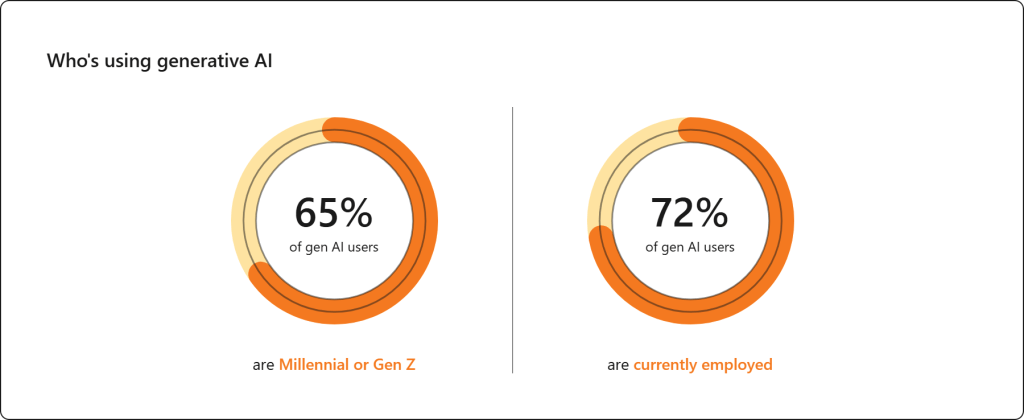
- 65% of generative AI users belong to the Millennial or Gen Z age groups, and 72% are currently employed
How People Use Generative AI
People use generative AI for very different reasons, from improving workplace productivity to learning new skills and experimenting with creative tasks. User preferences and adoption barriers reveal what motivates continued usage and what still prevents wider acceptance.
- 75% of users rely on generative AI to automate work tasks and communications, while nearly 6 in 10 believe they are becoming proficient with the technology.
- Outside work, 38% use generative AI for fun or experimentation, and 34% use it to learn about topics that interest them.
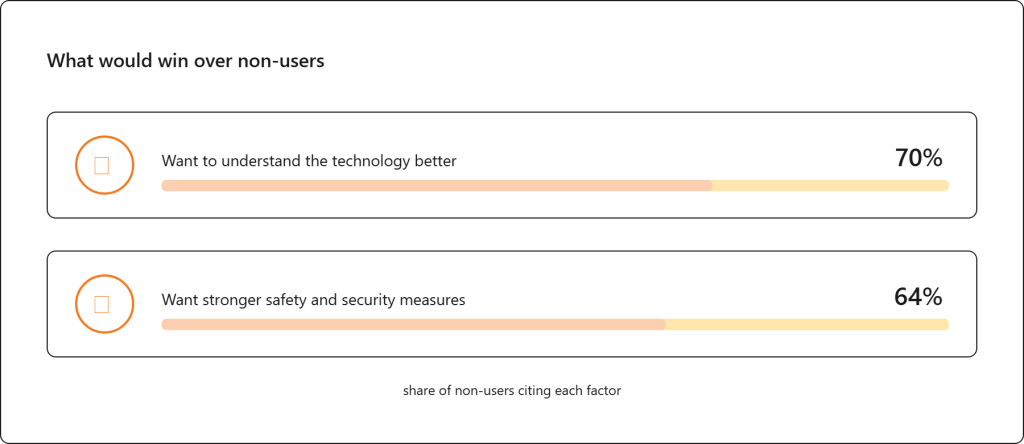
- 70% of non-users say they would use generative AI more if they understood the technology better, while 64% want stronger safety and security measures.
- 45% say they would use generative AI more if it were integrated into the software and tools they already use.
Enterprise Adoption and Investment
Businesses are moving from AI experimentation to large-scale implementation backed by growing budgets. Enterprise spending, deployment plans, and executive priorities offer a practical view of how organizations are preparing for an AI-driven future.
- 86% of IT leaders expect generative AI to play a major role in their organizations, while 82% plan to integrate AI agents within the next one to three years.
- 80% of organizations increased their investment in generative AI since 2023, while 20% maintained existing investment levels.
- 24% of organizations have integrated generative AI into some or most business functions, up from 6% one year earlier.
- 45% of IT decision makers ranked generative AI as their top IT budget priority for 2025, compared with 30% who prioritized security tools.
- 18% of organizations expect to spend between USD 5 million and USD 20 million on generative AI over the next three years.
Generative AI in the Workplace
The impact of generative AI extends beyond automation into software development, hiring, employee training, and customer experience. Workplace metrics help evaluate whether AI initiatives are delivering measurable business outcomes and where organizations continue to face obstacles.
- Organizations reported an average 6.7% improvement in customer engagement and satisfaction after deploying generative AI.
- 61% say generative AI enables innovative software features and services, while 49% report improvements in software quality.
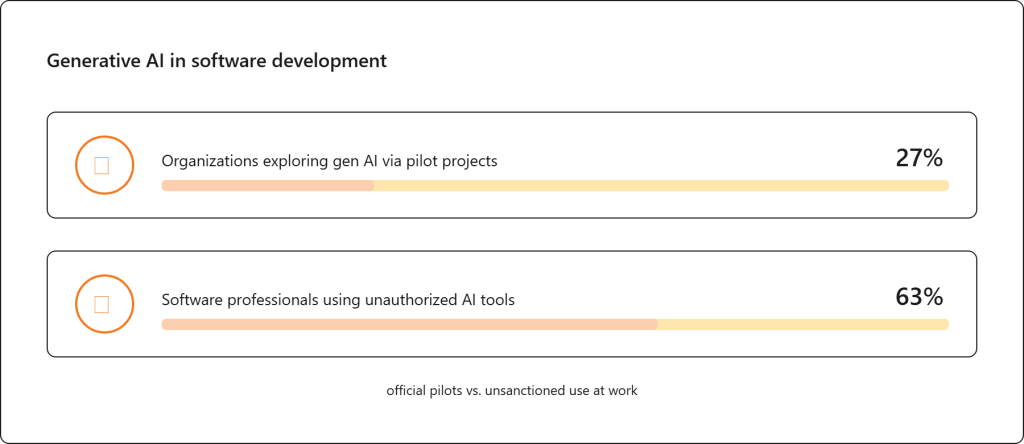
- 27% of organizations are exploring generative AI through software engineering pilot projects, while 63% of software professionals already use unauthorized AI tools at work.
- Organizations ran an average of 45 generative AI experiments in 2024, but only 20 are expected to reach production by 2025, representing a 44% deployment rate.
- 92% of organizations plan to hire employees with generative AI expertise in 2025, and 26% expect at least half of new roles to require these skills.
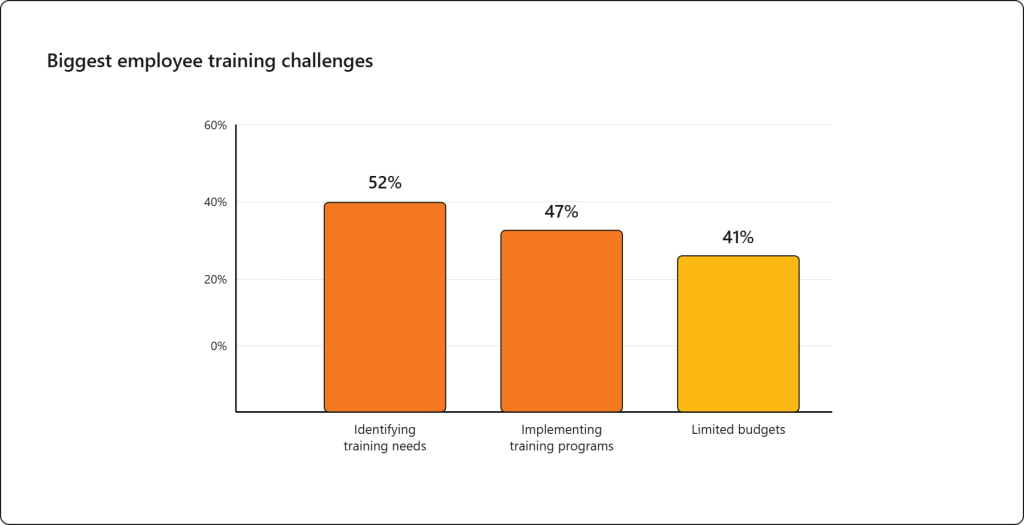
- The biggest employee training challenge is identifying training needs (52%), followed by implementing training programs (47%) and limited budgets (41%).
- 47% of organizations believe they are effectively educating employees about generative AI.
- The biggest barriers to production are a shortage of skilled workers (55%), high development costs (48%), and AI bias and hallucinations (40%).
- Only 27% of organizations have the platforms and tools needed to fully harness generative AI.
Generative AI Deployment Trends
Selecting the right deployment strategy has become a major business decision as organizations balance speed, cost, and technical expertise. Adoption patterns highlight the growing preference for foundation models, third-party platforms, and enterprise-ready AI solutions.
- 58% of organizations plan to build custom applications on foundation models, while 55% will build on fine-tuned models. Only 25% plan to develop models entirely in-house.
- 65% expect to rely on third-party vendors for deployment, including 50% that will combine internal teams with external partners.
- Organizations primarily rely on productivity applications with integrated AI (71%), followed by standard generative AI applications (68%), enterprise AI platforms (61%), and public large language models (56%).
Industry Adoption Statistics
Not every industry adopts generative AI at the same pace. Comparing sectors and business functions reveals where AI creates the greatest operational value and which teams are leading enterprise adoption across organizations.
- Out of the industries surveyed, education (45%) is the most likely to deploy out-of-the-box generative AI applications in 2025, followed by financial services (44%) and ICT (43%).
Generative AI Adoption by Business Function
Generative AI adoption is not evenly distributed across organizations. Technical and customer-facing teams are leading implementation, while support functions continue to adopt AI at a slower pace.
| Business Function | Adoption Rate |
| IT and Cybersecurity | 46% |
| Marketing, Sales, and Customer Service | 41% |
| Product Development and R&D | 41% |
| Strategy and Operations | 35% |
| Supply Chain and Manufacturing | 29% |
| Finance | 25% |
| Human Resources | 23% |
| Legal, Risk, and Compliance | 21% |
Top Business Uses of Generative AI
Organizations invest in generative AI to solve practical business challenges rather than simply adopting new technology. The most common use cases show where companies expect the strongest returns through productivity gains, innovation, cost savings, and better customer experiences.
| Use Case | Organizations Using Generative AI |
| Improve Efficiency and Productivity | 56% |
| Reduce Costs | 35% |
| Encourage Innovation and Growth | 29% |
| Improve Products and Services | 29% |
| Increase Software Development Speed | 26% |
| Shift Employees to Higher Value Work | 26% |
| Increase Revenue | 25% |
| Improve Customer Relationships | 23% |
| Generate Ideas and Insights | 19% |
| Detect Fraud and Manage Risk | 18% |
AI Governance and Responsible AI
As generative AI becomes embedded in business processes, responsible deployment is becoming just as important as innovation. Governance practices, leadership perspectives, regulatory expectations, and operational risks illustrate how organizations are working to build trustworthy AI systems.
- Only 14% of organizations currently have a change management strategy for generative AI, although this is expected to reach 76% by the end of 2026.
- 95% of organizations have implemented at least one responsible AI initiative, including 53% that ensure diverse representation and 52% that promote transparency in AI systems.
- 38% of organizations actively mitigate cybersecurity risks, while 32% work to reduce inaccurate AI outputs.
- About one-third allow employees to use generative AI under company guidelines, but only 15% use identity management systems to track AI use.
- 62% of business and technology leaders are excited about generative AI, while 30% remain uncertain.
- 44% rate their organization’s generative AI expertise as high or very high, and 72% expect generative AI to reshape talent strategies within the next two years.
- 52% of leaders believe that widespread adoption of generative AI will centralize economic power, while 30% believe it will distribute power more evenly.
- 78% believe governments should introduce more AI regulations, and 72% think global collaboration on responsible AI development remains insufficient.
Top Generative AI Governance Concerns
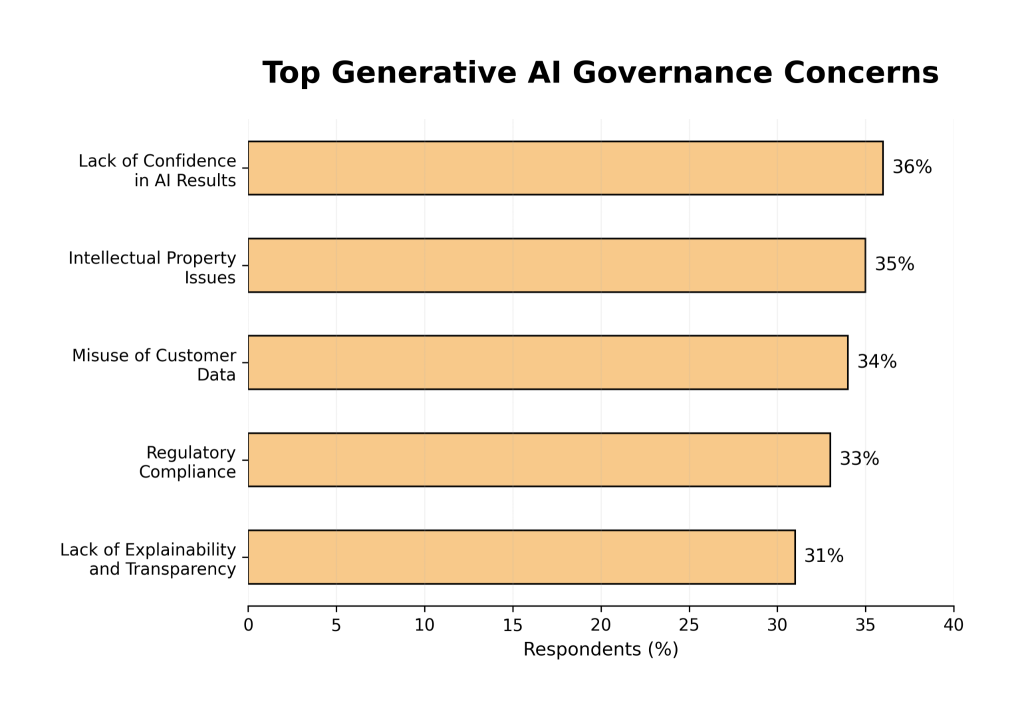
As generative AI adoption grows, organizations face increasing pressure to manage technical, legal, and ethical risks. The following concerns represent the most common governance challenges reported by business leaders.
| Governance Concern | Respondents |
| Lack of Confidence in AI Results | 36% |
| Intellectual Property Issues | 35% |
| Misuse of Customer Data | 34% |
| Regulatory Compliance | 33% |
| Lack of Explainability and Transparency | 31% |
Explore Other Data Resources
- 20+ AI in Software Development Statistics For 2026
- Ecommerce App Development Statistics 2026
- 70+ Latest Generative AI Statistics For 2026
Final Words
Whether you’re evaluating your first AI initiative or scaling existing projects, choosing the right implementation approach is just as important as selecting the right technology.
If you need help defining an AI roadmap, identifying high-impact use cases, or selecting the best AI technologies for your business, RAAS Cloud’s AI consulting services can guide you through every stage of planning and implementation.
For businesses that already have a strategy and need technical expertise, you can hire AI developers from RAAS Cloud with experience in AI agents, large language models, machine learning, computer vision, natural language processing, and enterprise AI applications. Our flexible engagement models help you scale your team without lengthy recruitment cycles.
👉 Contact RAAS Cloud to start building scalable AI solutions.
FAQs
How fast is the generative AI market growing?
The generative AI market is projected to grow at a 29.30% CAGR from USD 103.58 billion in 2025 to USD 1,260.15 billion by 2034. Rising enterprise adoption, AI investments, and demand for automation continue to fuel this rapid growth.
Which countries have the highest generative AI adoption?
India has the highest reported generative AI adoption rate among surveyed countries at 73%. It is followed by Australia (49%), the United States (45%), and the United Kingdom (29%). Among the working-age population, the United Arab Emirates and Singapore lead global adoption.
How are organizations using generative AI?
Improving efficiency and productivity is the most common business use of generative AI, with 56% of organizations adopting it for this purpose. Companies also use AI to reduce costs, improve products and services, accelerate software development, and strengthen customer relationships.
Which industries are adopting generative AI the fastest?
Education leads planned generative AI adoption, with 45% of organizations planning to deploy out-of-the-box AI applications. Financial services (44%) and ICT (43%) follow closely, while IT and cybersecurity remain the most active business functions for AI adoption.
What are the biggest challenges to generative AI adoption?
A shortage of skilled workers is the biggest barrier to generative AI adoption, affecting 55% of organizations. Other major challenges include high development costs (48%), AI bias and hallucinations (40%), and limited AI platforms and tools (27%).
Are organizations increasing their investment in generative AI?
Yes, 80% of organizations have increased their investment in generative AI since 2023. Additionally, 45% of IT decision makers ranked generative AI as their top IT budget priority for 2025, and many organizations expect multimillion-dollar AI investments over the next three years.
What are the biggest governance concerns surrounding generative AI?
Lack of confidence in AI-generated results is the top governance concern, cited by 36% of organizations. Other leading concerns include intellectual property issues, misuse of customer data, regulatory compliance, and limited explainability and transparency.
Data Sources
- https://www.salesforce.com/news/stories/generative-ai-statistics/
- https://www.fortunebusinessinsights.com/generative-ai-market-107837?__cf_chl_f_tk=YCdcWRfnyPTCR4tgYaqHQNLURMRn60.KMQxprSLSbBI-1783272675-1.0.1.1-KdRQTrZVNn1LpCO1XNXGM3nM2mZh.EVWQasOK2_uf6Q
- https://www.capgemini.com/insights/research-library/generative-ai-in-organizations-2024/
- https://www.capgemini.com/insights/research-library/gen-ai-in-software/
- https://pages.awscloud.com/rs/112-TZM-766/images/GC-400-GENAI_acc-inn-genai-EN.pdf?version=1
- https://www.microsoft.com/en-us/corporate-responsibility//topics/ai-economy-institute/reports/global-ai-adoption-2025/
- https://www.deloitte.com/content/dam/assets-shared/docs/services/consulting/2024/gx-state-of-gen-ai-report.pdf
- https://www.mckinsey.com/capabilities/quantumblack/our-insights/the-state-of-ai-in-2023-generative-ais-breakout-year
- https://www.kearney.com/service/digital-analytics/article/the-state-of-generative-ai-adoption-in-business

Dhanalakshmi Kadirvelu is a Business Intelligence and Data Analytics expert with a strong focus on software development and data engineering. She creates efficient data models, builds interactive dashboards, and integrates analytics into software systems using Power BI, OBIEE, and SQL. Her work helps development teams use data effectively to create smarter software solutions and improve business performance.