
Estimating ERP software development cost is confusing because pricing changes based on modules, workflows, integrations, and the region where the system is built.
This makes it hard for businesses to plan budgets and even harder to compare vendors when estimates range from tens of thousands to over a million dollars.
To bring clarity, the project management and technology experts at RAAS Cloud have prepared this detailed guide. It breaks down real ERP development and implementation cost ranges in the USA, explains what drives costs up, and shows how different ERP project types impact your total budget.
The insights are updated for 2026 and are based on ERP projects we delivered in 2025 and earlier years.
What is the ERP software development cost in the USA?
ERP software development in the USA usually costs between $50,000 and $750,000. Small companies pay on the lower side for basic modules, while large businesses with custom workflows, many users, and advanced features often reach the higher end. The price changes based on the number of modules you need, how much customization is required, and the higher hourly rates of US development teams.
How much does an ERP implementation cost?
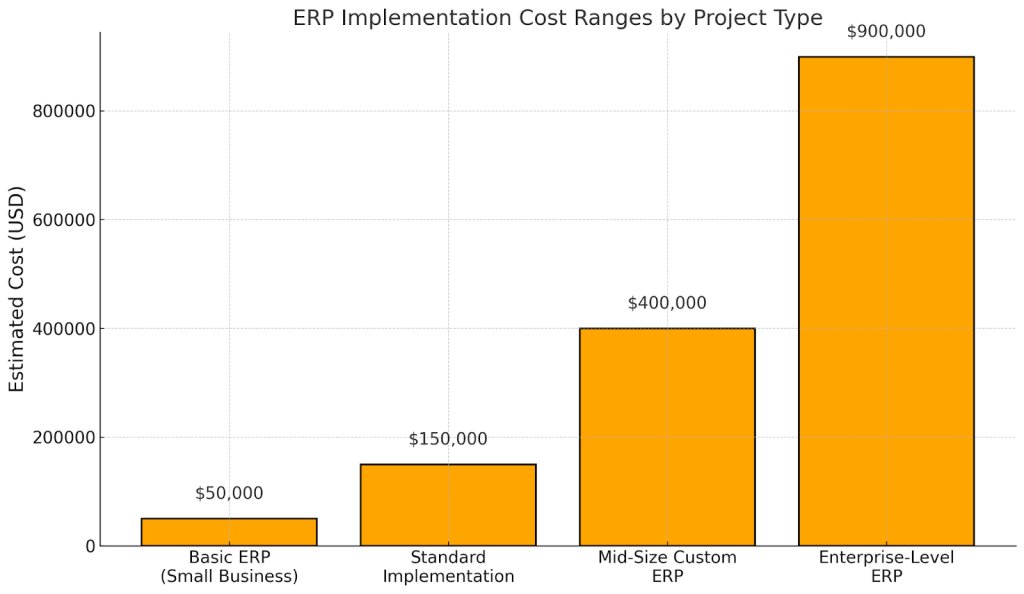
The cost of an ERP implementation can vary a lot because every company has different modules, workflows, and integration needs. In most cases, an ERP implementation costs between $50,000 and $1,000,000, depending on system complexity, custom features, user count, data migration, and the time needed for setup and training.
However, smaller companies pay less because they use standard modules, while mid-size and enterprise teams pay more due to custom workflows, large data migration, and complex system integrations.
For simpler implementations that use standard out-of-the-box modules and require minimal customization can be done for around $30,000 to $50,000.
What factors influence ERP software development costs?
ERP software development costs are influenced by several technical, functional, and operational factors that are often missed during early planning.
At RAAS Cloud, we developed 6 ERP systems in 2025 alone. While preparing proposals for these projects, we noticed clear patterns in what increased scope, introduced changes during execution, and directly impacted final costs. Based on these real project learnings, the following factors explain where ERP budgets usually rise and how businesses can plan more accurately from the start.
1. Number of modules and overall functional scope
Impact on cost: More modules require more development work, which increases the total cost.
ERP systems grow more expensive as you add modules because each module requires its own data models, backend logic, and user interface screens.
For example, a finance module needs accounting rules, ledger structures, and tax logic, while an inventory module needs stock tracking, reorder algorithms, and warehouse workflows. Developers must build these features separately and then integrate them so they work together without conflicts.
This increases the total engineering time, database planning, and testing cycles, which raises the final development cost.
2. Level of customization in workflows and automation
Impact on cost: Custom features need extra coding and testing, raising the project cost.
Customization has a major impact on cost because it moves the project away from simple configuration and into full software development. When a business needs custom approval chains, industry-specific workflows, advanced automation rules, or unique reporting dashboards, the development team must write new backend code, adjust the UI, and modify the core logic.
Custom features also require more testing, because changing the default workflow can affect other modules. The deeper the customization, the more development hours are required, which increases the budget.
3. Data migration size and complexity
Impact on cost: Larger or complex data sets take more time to clean and import, increasing cost.
Data migration is often one of the highest ERP development costs because developers must extract, clean, transform, and load data from multiple legacy systems into a new ERP database.
When the existing data is inconsistent or stored in different formats such as spreadsheets, older ERPs, or SQL databases, the team must build custom scripts, mapping rules, and validation checks. Complex mappings, duplicate removal, and several test migrations increase the time and effort required, which raises the total development and QA cost.
4. Integration complexity with other systems
Impact on cost: Each integration adds technical work and testing, which raises the overall cost.
Integrating an ERP with tools such as CRM platforms, accounting software, supply chain systems, marketplaces, or banking APIs adds serious technical effort. Developers must study external API documentation, build secure API connectors, create synchronization rules, and handle authentication, error recovery, and data conflicts.
In fact, real-time integrations or high transaction volumes require even more advanced logic and performance tuning. Each integration introduces new risks and testing requirements, which raises the overall cost.
5. Number of users and permission requirements
Impact on cost: More users and access roles need extra configuration and performance tuning, increasing cost.
ERP systems with many users need a more detailed access control setup, including role-based permissions, approval levels, and department specific rules.
Developers must build the right permission structure, set up security settings, and test how each user role behaves inside the system. When the user count is high, the team also needs to optimize performance, run load tests, and sometimes scale the infrastructure to handle peak traffic.
These technical steps add development time and increase the implementation cost.
6. UI and UX design complexity
Impact on cost: Advanced or custom interfaces require more design and development time, raising cost.
A simple ERP interface is much cheaper to build than a system with advanced dashboards, custom widgets, drag and drop elements, workflow visualizers, or layouts that change based on the user’s role. Creating these experiences requires detailed wireframes, interactive prototypes, user testing sessions, and careful front-end coding.
For example, more complex ERP interfaces also need reusable components, strong state management, fast load times, and smooth performance across desktops, tablets, and mobile devices.
Put simply, the more interactive and user-friendly the design needs to be, the more development effort and cost it adds to the project.
7. Security, compliance, and data protection needs
Impact on cost: Stronger security controls add extra development and validation work, increasing cost.
Industries like finance, healthcare, manufacturing, and government require stronger security controls, encryption layers, audit logs, data retention rules, and compliance features. To support this, developer team must add secure authentication, role based access control, encrypted data storage, protected API communication, and detailed activity logging.
Compliance frameworks such as HIPAA, SOC 2, GDPR, or industry-specific safety standards require additional coding, testing, and documentation. These elements add complexity and directly increase the cost.
8. Technology stack and deployment model
Impact on cost: Complex stacks or on premise setups need more engineering effort, which increases cost.
The choice of technology stack such as frameworks, programming languages, cloud services, and infrastructure, affects both the development speed and total cost.
For example, cloud-based deployments typically reduce infrastructure setup time, while on-premises deployments require more configuration, server provisioning, and environment management. Using advanced technologies such as microservices, containerization, AI features, or real-time processing also increases development complexity and overall pricing.
9. Developer expertise and location
Impact on cost: When the project requires senior ERP engineers for complex workflows and integrations, their higher hourly rates raise the final cost.
Development teams in regions like the USA or Western Europe charge higher hourly rates compared to teams in Asia or Eastern Europe. Senior engineers with ERP specialization, database architects, and integration experts cost more but often produce cleaner, scalable code that reduces long-term maintenance costs.
So, the overall team composition, like solution architects, developers, QA engineers, DevOps specialists, and UI designers, directly impacts project pricing.
ERP software development cost ranges by project type
| Project Type | Typical Cost Range | What This Usually Includes |
| Small business ERP (basic modules) | $30,000 to $80,000 | Core modules, simple workflows, minimal integrations |
| Mid-sized ERP with customization | $80,000 to $250,000 | Custom workflows, reporting, a few integrations, moderate data migration |
| Advanced ERP for growing companies | $250,000 to $600,000 | Multiple modules, automation, mobile access, complex data migration, and several integrations |
1. Small business ERP (basic modules)
A small business ERP with core features such as finance, HR, inventory, or CRM usually costs from $30,000 to $80,000. These projects stay affordable because they use standard modules, simple workflows, and minimal integrations.
2. Mid sized ERP with moderate customization
A mid sized ERP system with custom workflows, reporting needs, and a few third party integrations typically ranges from 80,000 dollars to 250,000 dollars. These projects require more backend logic, more complex data models, and additional testing.
3. Advanced ERP for growing companies
Projects that include multiple modules, workflow automation, mobile access, complex data migration, and several integrations usually fall between $250,000 and $600,000. Development takes longer because the system must support more departments and more users.
4. Full-scale custom enterprise ERP
A fully custom ERP built for enterprise-level operations, industry-specific rules, large user bases, and deep integration needs often starts from $ 600,000 and can exceed $1 million. These projects require extensive architecture planning, custom UI and UX, advanced security, and high-performance infrastructure.
The hourly ERP software development cost by region
Below is a simple comparison of typical hourly rates in popular countries to help you understand how location directly affects the total ERP development budget.

| Country | Approx Hourly Rate (USD) | Cost Implications for ERP Projects |
| India | $20 – $40 / hour | Low labor cost helps reduce the total ERP build cost for standard or moderately complex ERP systems. |
| UAE | $60 – $100 / hour | Mid to higher cost, you can expect moderate to high ERP implementation cost depending on modules and customizations. |
| United Kingdom (UK) | $90 – $140 / hour | Higher labor rates mean higher total ERP development costs, especially for customization and integrations. |
| United States (USA) | $100 – $150 / hour | ERP project cost tends to be the highest. Projects with custom modules, integrations, and enterprise-level features become expensive. |
| Germany (Western Europe) | Typically similar to UK / Western Europe rates ($80–$140+ / hour) | ERP development cost will be high, especially for compliance, security, or advanced features, due to strong regulations and higher wages. |
Why enterprises choose RAAS Cloud for developing custom ERP software
Many enterprises struggle with outsourcing because traditional vendors often create more challenges than they solve. Teams are scattered, communication is slow, project timelines slip, and the final software rarely matches the company’s actual business processes. These issues lead to missed deadlines, inconsistent code quality, unclear ownership, security concerns, and higher long-term costs due to rework.
RAAS Cloud removes these outsourcing problems by building a partnership-driven development model rather than a transactional one. At RAAS Cloud, we have a dedicated team of senior engineers, architects, and domain experts who work closely with the client through every stage of the project.
After delivering 60+ complex ERP projects across 40 clients, the team understands how to manage enterprise requirements with clarity, proper documentation, and predictable delivery.
👉 If you are planning a custom ERP, our team can guide you through the first step. Connect with us to discuss your requirements.

Dhanalakshmi Kadirvelu is a Business Intelligence and Data Analytics expert with a strong focus on software development and data engineering. She creates efficient data models, builds interactive dashboards, and integrates analytics into software systems using Power BI, OBIEE, and SQL. Her work helps development teams use data effectively to create smarter software solutions and improve business performance.