
Choosing the wrong engagement model is one of the top 3 reasons software projects fail. When you hire or outsource a development team, the way you choose to work together affects your cost, speed, flexibility, control and the final quality of the product. Different companies need different approaches based on their goals, clarity of requirements and how fast they want to move.
At RAAS Cloud we work with multiple engagement models and help organizations pick the one that fits their project reality. Over the years we have seen how the right structure leads to predictable delivery and how the wrong one creates delays, scope conflicts and unnecessary costs.
This guide will give you a clear way to understand each engagement model and how to decide which one is right for your software development project. Our experts use the same thought process when advising clients and by the end you will know exactly what to choose and why.
What Exactly Is an Engagement Model?
While the traditional definition says an engagement model is simply the way a client and a development partner work together, in reality it is much more than that. An engagement model outlines how responsibilities are shared, how risks are managed, how communication flows and how the project will move from idea to delivery.
It works as a combination of factors such as:
- Scope clarity
- Budget structure
- Ownership and accountability
- Delivery process
- Team involvement
- Flexibility for changes
- Risk distribution
In our organization we define an engagement model as the framework that decides how we collaborate with you, how we plan your project and how we share ownership throughout the development lifecycle. Our documentation also covers how teams are allocated, what communication structure is followed and how outcomes will be tracked from the first sprint to the final release.
The Three Engagement Models Explained
Let us now look at the three main engagement models you can choose for your software development project. Each model works best for a different type of requirement, budget structure and level of flexibility.
Fixed Price Model
The Fixed Price model is used when the project requirements are clear, the scope is stable and both teams know exactly what needs to be delivered. The budget and timeline are agreed on in advance. This model works well when there is little room for changes and when the expected outcome is straightforward and measurable.
Key elements include:
- Defined scope
- Pre approved timeline
- Pre approved budget
- Limited changes
- Milestone based delivery
- Clear acceptance criteria
Unique RAAS Cloud Approach
At RAAS Cloud we use a detailed discovery phase before committing to fixed price. Our team validates the scope, checks feasibility, maps dependencies and builds the architecture outline to avoid surprises later. We also add a risk buffer where needed so the delivery stays predictable even if minor complexities appear during development. This leads to a stable project flow without overruns.
Best For
- Projects with clear functional requirements
- MVPs with limited features
- Corporate websites and simple applications
- Compliance driven builds where changes are minimal
- Teams that prefer predictable cost and timeline
Dedicated Team Model
The Dedicated Team model is great when the project requires ongoing development, continuous iteration or long term ownership. Instead of paying for a fixed scope, you work with a team that is fully committed to your product roadmap.
The team becomes an extension of your in house department and brings stability, speed and deeper understanding of your system over time. This model works well when requirements evolve or when you need predictable development capacity every month.
Key elements include:
- Full time developers and specialists
- Long term engagement
- Flexible scope
- Sprint based planning
- Direct communication and collaboration
- Faster response to changes
Unique RAAS Cloud Approach
At RAAS Cloud our dedicated teams are pre vetted and matched to the exact skill needs of the project. We monitor the team with senior level oversight and ensure knowledge retention from sprint to sprint. For example a payment gateway company we worked with scaled their product operations with our dedicated team within 3 weeks. They moved from inconsistent delivery to stable weekly releases because the team already understood PCI requirements, integration flows and security expectations. This kind of context driven execution is what makes the model effective.
Best For
- Products with evolving features
- Fast growing startups
- Long term SaaS development
- Large systems with ongoing iterations
- Companies that want to scale without hiring internally
Time and Material Model
The Time and Material model is used when requirements are not fully defined or when the project needs flexibility for continuous changes. You pay for the actual hours spent and the materials used. This model gives room for experimentation, refining ideas and adapting the roadmap as new insights appear. It works well when the project cannot be locked into a fixed structure.
Key elements include:
- Flexible scope
- Hourly or monthly billing
- Iteration friendly workflow
- Continuous requirement updates
- Priority based task allocation
- Transparency through timesheets
Unique RAAS Cloud Approach
At RAAS Cloud the Time and Material model is supported by strict visibility and planning controls. We use sprint based billing so you always know projected hours in advance. Our internal monitoring shows that teams using this model achieve up to 32 percent faster iteration cycles because decisions are not restricted by predefined scope. We also maintain detailed activity logs so you can track progress at any point without guesswork.
Best For
- R and D focused builds
- Proof of concept development
- Feature extensions for existing products
- Projects with evolving or unclear requirements
- Teams that want flexibility without long term commitment
Also Read: Software Rollout Plan: 8 Steps to a Successful Software
A Decision Making Framework: RAAS Cloud’s 7 Point Engagement Model Selector
Selecting an engagement model becomes simpler when you evaluate your project across measurable factors. At RAAS Cloud we use a 7 point selector that helps determine how stable your project is, how much discovery it needs, and what level of ownership or flexibility is required. This method removes guesswork and aligns the model with the real nature of your development needs.
1. Clarity of Requirements Score
Most teams say their scope is clear, but in reality there are hidden assumptions.
To avoid this, RAAS Cloud uses a simple scoring method:
How to calculate the clarity score (0 to 10 scale):
Give 1 point for each YES:
- Do you have finalized feature list
- Do you have user flows documented
- Do you have screens or wireframes
- Do you have API requirements or integration details
- Is the business logic fully defined
- Are edge cases known
- Are success metrics or acceptance criteria documented
- Is the tech stack already decided
- Do stakeholders agree on the scope
- Are changes unlikely during development
Score meaning:
- 0 to 5: Very low clarity → Use Time and Material
- 6 to 8: Medium clarity → Use Time and Material or Dedicated Team
- 9 to 10: High clarity → Fixed Price becomes feasible
This score prevents teams from choosing Fixed Price based on assumptions rather than actual readiness.
2. Level of Innovation or Experimentation
Some projects are predictable, others require discovery or trial and error.
High Innovation Indicators
- You need to validate features
- UI or UX is not finalized
- Technical feasibility is unknown
- Requirements will evolve based on user testing
- The product depends on experimentation before scaling
Best Fit:
- High innovation → Time and Material
- Medium innovation → Dedicated Team
- Low innovation → Fixed Price
Fixed Price works only when innovation is minimal because experimentation disrupts preset scope, budget and timeline.
3. Timeline Sensitivity
Timeline sensitivity is not only about deadlines but also about how predictable your delivery needs to be.
A. Hard deadline with fixed scope
Example: A compliance release or scheduled launch
Best Fit: Fixed Price or Dedicated Team
B. Deadline exists but scope will evolve
Example: Product needs continuous refinement during development
Best Fit: Dedicated Team
C. No fixed deadline because discovery is ongoing
Example: A module where architecture or feasibility is not confirmed
Best Fit: Time and Material
Timeline pressure should always guide how rigid or flexible your engagement approach must be.
4. Budget Flexibility
Your budget type influences how you should structure the engagement.
Fixed Budget
- You must stay within a strict limit
- Scope needs to be measurable
- Best Fit: Fixed Price for small to medium builds
Flexible Budget
- You can adjust based on findings
- Useful for evolving products
- Best Fit: Time and Material or Dedicated Team
Long Term Budget
- You want predictable monthly cost
- Ideal for multi quarter or multi year product work
- Best Fit: Dedicated Team
Budget planning is more accurate when matched with how stable or evolving the project actually is.
5. Long Term Ownership Requirement
This is about how long the product will continue to evolve after the first release.
When long term ownership matters
- Your product will expand every quarter
- You need fast releases without onboarding new developers each time
- Knowledge retention is important
- Documentation may not cover every detail
Why Dedicated Team fits best
A team working for months understands system behavior, edge cases, architecture decisions and technical debt. This speeds up future releases significantly.
A SaaS company we supported upgraded their product from 8 releases a year to 38 releases a year because the dedicated team already knew the codebase, integrations, past decisions and user expectations. This would have been impossible with a Fixed Price or T and M arrangement.
6. Technical Complexity
Technical complexity plays a major role in choosing the right engagement model. If your project involves multiple integrations, advanced workflows, heavy data processing, AI driven logic or compliance focused development, the work will naturally evolve during execution.
In such cases
- A flexible model works better because unknowns appear as development progresses.
- Time and Material or a Dedicated Team allows room for investigation, problem solving and iteration without breaking a fixed contract.
- Fixed Price suits only low complexity projects where the system is straightforward and predictable.
7. Internal Team Maturity
Your internal team’s capability is another deciding factor. If you do not have a strong technical lead, product manager or QA structure, you will need a partner who can take ownership of planning and guiding the development process. A
Dedicated Team is ideal here because RAAS Cloud fills the gaps with architectural input, sprint structuring and technical oversight. If your team has medium maturity and only needs extra hands, Time and Material works well. If your internal team is highly mature and fully documented, then Fixed Price or Time and Material both become practical options.
RAAS Cloud’s Engagement Matrix(Exclusive Insight)
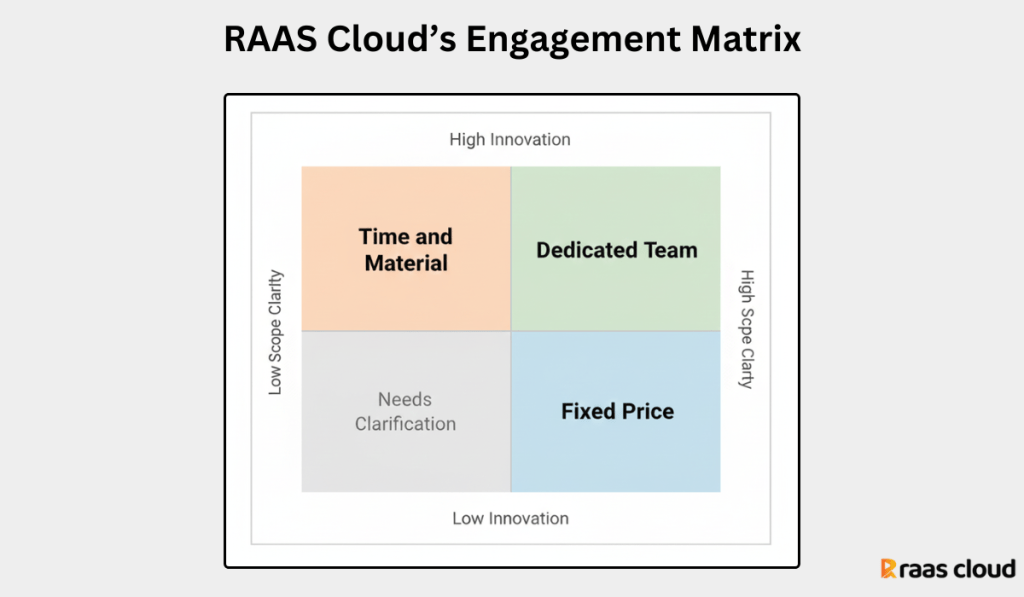
We have built a very simple evaluation tool that helps teams understand their real project needs before choosing an engagement model. We call it the RAAS Cloud Engagement Matrix.
The matrix looks at four driving forces behind every software project: scope definition, risk appetite, timeline rigidity and innovation need. These four elements determine how flexible or structured your engagement should be. When scope is clear and risk appetite is low, a fixed approach works well. When innovation needs are high or when timelines must be met through consistent releases, a dedicated team becomes more suitable. If both risk and innovation are high and scope is evolving, Time and Material gives the safest room for exploration.
The matrix helps businesses position their project on these four axes and instantly see which direction they lean toward. It also makes discussions more objective because both teams talk based on actual project conditions instead of preferences or assumptions.
Choose Smart, Build Fast, Reduce Risk
This is all about choosing a model that matches the real nature of your project. The next time you plan a new build or expand an existing system, use these points to check what you truly need rather than relying on assumptions. A smart engagement choice saves time, reduces risk and gives you a predictable delivery path.
At RAAS Cloud we work with over 50 technologies and can deploy the right developers in less than 48 hours. You can also outsource your entire project if you prefer a managed delivery structure. If you have a project in mind, let us connect and discuss which engagement model will give you the best outcome. You can schedule a discovery call and our team will guide you through the ideal approach based on your goals.

Dhanalakshmi Kadirvelu is a Business Intelligence and Data Analytics expert with a strong focus on software development and data engineering. She creates efficient data models, builds interactive dashboards, and integrates analytics into software systems using Power BI, OBIEE, and SQL. Her work helps development teams use data effectively to create smarter software solutions and improve business performance.