

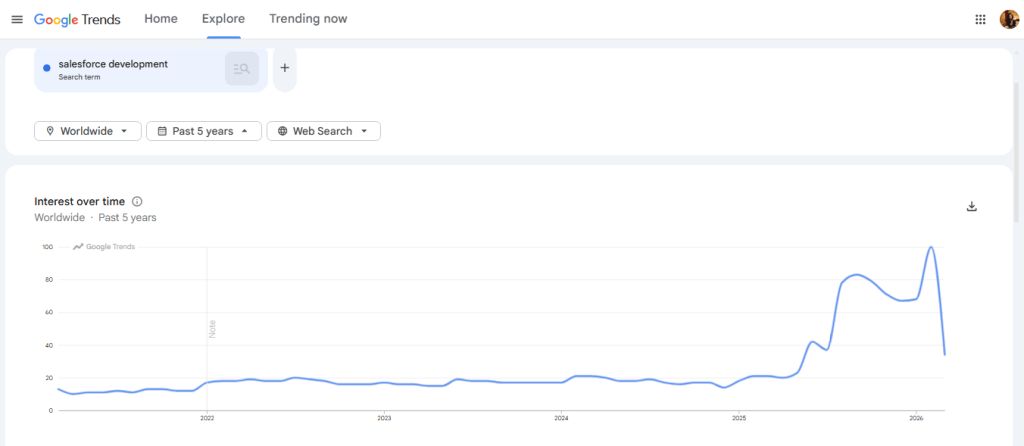
Search demand for Salesforce development has grown significantly in recent years.
Google Trends data over the past five years shows a clear rise in interest, with search activity increasing sharply from 2024 and peaking in 2025 and early 2026. This trend reflects how more businesses now depend on Salesforce to manage sales operations, customer relationships, automation, and data-driven decision-making.
To save you time and energy in researching these companies, we have reviewed and listed the top 10 platforms to hire Salesforce developers in the US.
Top Platforms to Hire Salesforce Developers in the US
- RAAS Cloud — Best for fast hiring of pre-vetted Salesforce developers
- Daffodil Software — Best for enterprise Salesforce architecture and integrations
- Zazz — Best for direct developer selection and hiring control
- LogicRays Technologies — Best for Salesforce customization and AI features
- Soft Suave — Best for contract-based Salesforce developers with trial hiring
- MagicFuse — Best for complex Salesforce engineering and architecture
- LogicRain Technologies — Best for Salesforce customization and ongoing support
- Bacancy — Best for structured Salesforce hiring with trial models
- Jellyfish Technologies — Best for Salesforce integrations and API based projects
- Folio3 CRM — Best for long-term Salesforce maintenance and optimization
Here are the Top 10 Platforms To Hire Salesforce Developers In The US
1. RAAS Cloud
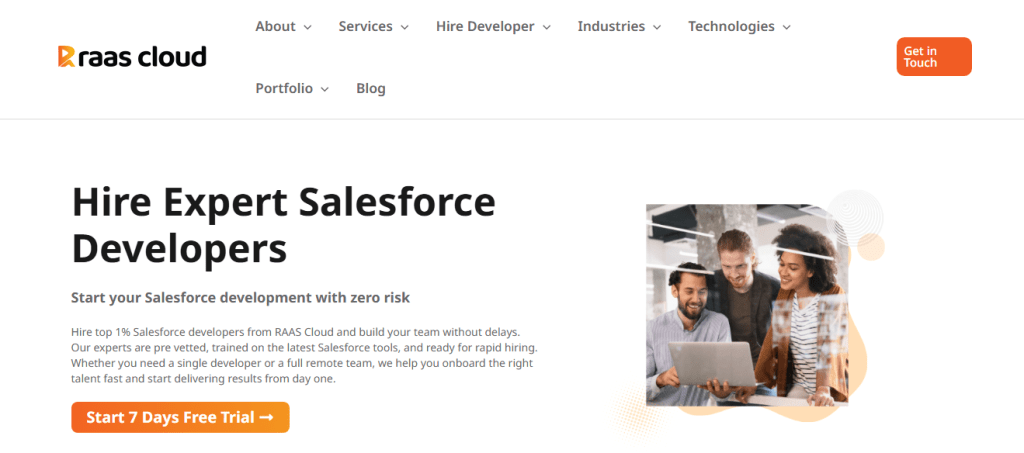
RAAS Cloud is a hiring platform that helps businesses quickly hire skilled Salesforce developers without long recruitment cycles. The platform connects companies with pre-vetted Salesforce developers, administrators, architects, and consultants experienced in real-world CRM projects.
Businesses can hire Salesforce talent for custom development, Apex automation, Lightning Web Components, integrations, data migration, and ongoing Salesforce support. RAAS Cloud offers flexible hiring models, including staff augmentation, dedicated teams, and project-based engagement.
With fast onboarding within 48 to 72 hours, RAAS Cloud enables companies to build, optimize, and scale Salesforce systems efficiently while reducing hiring risk and operational overhead.
Contact RAAS Cloud 👇
- Email: hello@raascloud.io
- Address: 5401, South Kirkman Road, Suite 310, Orlando, Florida 32819
- Phone: +1 (407) 607-2479
2. Daffodil Software
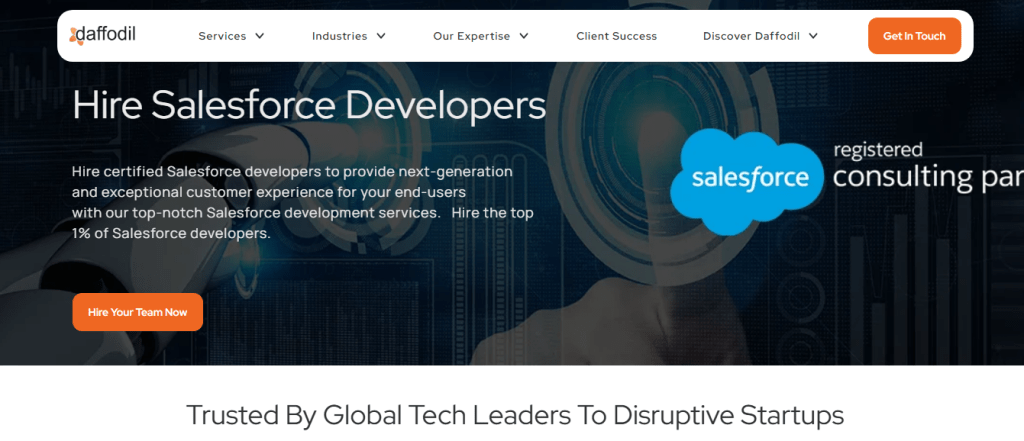
Daffodil Software approaches Salesforce as part of enterprise system architecture rather than a standalone CRM tool. Engagements often involve integrating Salesforce with existing internal platforms, legacy systems, or complex business workflows.
Salesforce work follows defined scopes with emphasis on documentation, governance, and controlled rollout. Development spans Sales Cloud, Service Cloud, Marketing Cloud, and Commerce Cloud, with delivery aligned with long-term system stability rather than rapid staffing.
Contact Daffodil Software
Email: info@daffodilsw.com
Address: 3500 South Dupont Highway, Dover, Delaware 19901, USA
Phone: +1 518 676 2958
3. Zazz
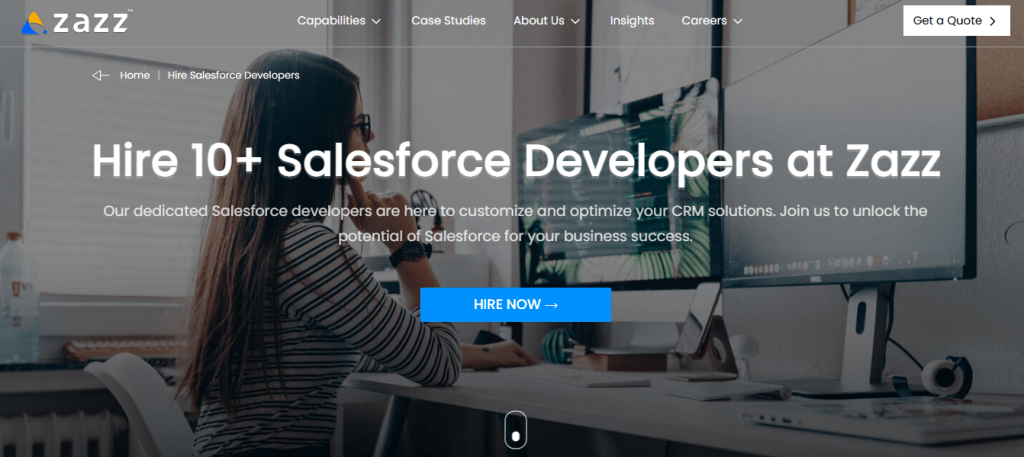
Zazz gives companies direct visibility into Salesforce hiring decisions. Instead of assigning developers, the platform allows businesses to review profiles, compare experience tiers, and select talent based on budget and skill depth. Salesforce developers are available on hourly or monthly contracts, with clear pricing based on seniority.
This hiring model keeps control with internal teams and works well when selection authority matters more than managed delivery.
Contact Zazz
Email: not listed
Address: Suite 3100, 325 North St. Paul Street, Dallas, TX 75201
Phone: not listed
4. LogicRays Technologies
LogicRays focuses on Salesforce implementations that require heavy customization and platform extension.
Projects often include Salesforce AI features, mobile CRM access, Lightning customization, and multi-app integrations. Salesforce is adapted to fit how teams already operate rather than forcing workflow changes.
Development evolves in phases, with features added over time as usage grows and operational complexity increases.
Contact LogicRays
Email: sales@logicrays.com
Address: 89, Trento St, Iselin, New Jersey, 08830
Phone: +1 732 762 7353
5. Soft Suave
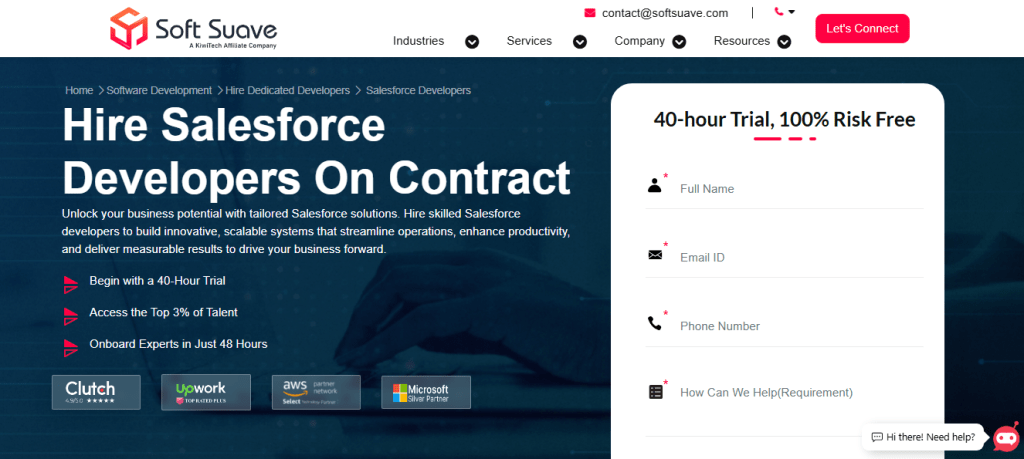
Soft Suave works with US startups and SMBs that want Salesforce developers on a contract basis with a short trial window. Companies often choose this platform when they want to test real-world output before a long-term commitment.
Soft Suave offers a 40-hour trial model and supports hiring Salesforce developers who work remotely across overlapping US time zones.
The platform suits teams that need Salesforce work done steadily while keeping costs predictable. Businesses use Soft Suave when they want contract-based Salesforce support for customization, integrations, migration, and ongoing platform updates without building an in-house team.
Contact Soft Suave
Email: contact@softsuave.com
Address: 3210 Vogel Rd, Ellicott City, Maryland 21043, USA
Phone: +1 (410) 220-6301
6. MagicFuse
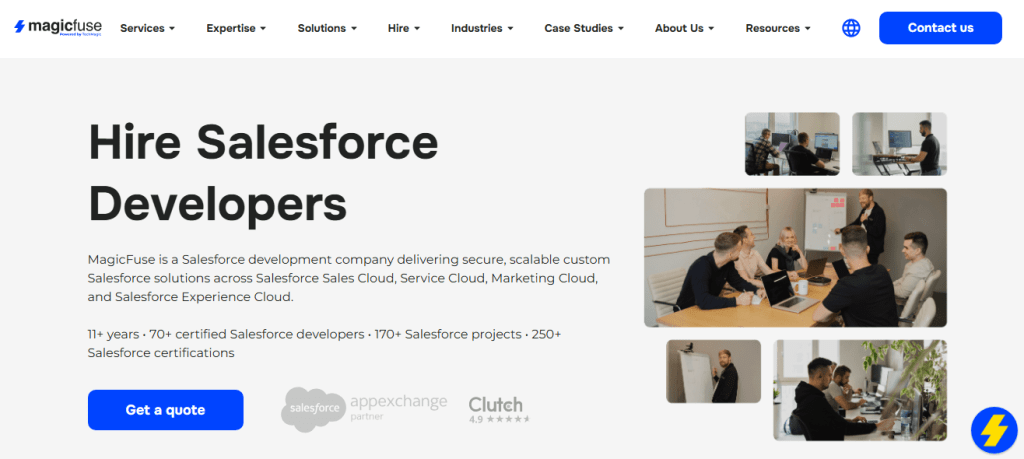
MagicFuse specializes in technically demanding Salesforce work. Projects often involve managed packages, complex Apex logic, performance bottlenecks, security reviews, and compliance constraints.
Developers focus on architecture, testing, and long-term maintainability across Sales Cloud, Service Cloud, Marketing Cloud, and Experience Cloud. Engagements frequently begin after existing Salesforce setups no longer support real business operations.
Contact MagicFuse
Email: hello@magicfuse.co
Address: 27 Whitehall Street, 5th Floor, New York, NY 10004, USA
Phone: Not publicly listed
7. LogicRain Technologies
LogicRain works with US businesses that want Salesforce adapted to their existing sales, service, and operations flow. Teams hire Salesforce developers from LogicRain when CRM setup requires customizations beyond standard layouts.
The developers handle workflow tuning, Lightning updates, system integrations, and ongoing improvements as business needs change.
LogicRain also supports Salesforce administration and managed services, which help companies keep systems stable after launch. This platform fits organizations that want Salesforce work done in close coordination with internal teams, with steady progress and clear ownership of changes over time.
Contact LogicRain
Email: sales@logicrain.com
Address: 6010 W Spring Creek Pkwy Ste 237, Plano, TX 75024, USA
Phone: +1 732 676 6400
8. Bacancy
Bacancy structures Salesforce hiring through defined engagement models and contract clarity. Projects commonly involve ERP, finance, or operations system integrations alongside Salesforce.
Developers are onboarded through a short, risk-free trial before long-term allocation. Salesforce services cover development, migration, customization, and cloud configuration, with delivery managed under fixed timelines and transparent pricing.
Contact Bacancy
Email: career@bacancy.com
Address: 33 South Wood Ave, Suite 600, Iselin, NJ 08830, USA
Phone: not publicly listed
9. Jellyfish Technologies
Jellyfish Technologies supports US businesses seeking Salesforce developers who can work across CRM, integrations, and data-intensive workflows. Companies use this platform when Salesforce projects involve API connections, custom apps, or secure data migration from older systems.
Jellyfish Technologies offers developers with hands-on experience in Sales Cloud, Service Cloud, Marketing Cloud, and Lightning components. The hiring flow allows teams to choose developers, align on scope, and start work without long setup delays. This option fits organizations that need Salesforce work delivered alongside broader software or data projects.
Contact Jellyfish Technologies
Email: enquiry@jellyfishtechnologies.com
Address: 159 West Broadway #200, Salt Lake City, Utah 84101, USA
Phone: +1 801 477 4541
10. Folio3 CRM
Folio3 CRM works with US businesses that already use Salesforce but struggle with long-term upkeep, scaling, or low adoption. Companies often choose Folio3 when Salesforce requires ongoing development rather than a one-time setup.
The team focuses on improving workflows, fixing data issues, and extending Salesforce across Sales, Service, Marketing, and Experience Cloud. Folio3 also supports regulated industries where compliance and data accuracy matter.
This platform is suitable if you want Salesforce developers who stay involved after launch and handle upgrades, optimization, and steady CRM improvements over time.
Contact Folio3 CRM
- Email: salesforce@folio3.com
- Address: 160 Bovet Road, Suite 101, San Mateo, CA 94402, USA
- Phone: +1 408 412 3813
Who is a Salesforce developer?
A Salesforce developer (also called an SFDC developer or Salesforce platform developer) specializes in designing, building, customizing, and maintaining powerful CRM solutions on the Salesforce platform.
In 2026, with rapid advancements in AI features like Agentforce, Einstein, and Data Cloud, Salesforce developers play a critical role in creating scalable, intelligent enterprise applications that drive business efficiency, customer experiences, and automation.
What does a Salesforce developer do?
Understanding Business Requirements and Solution Design
Salesforce developers begin by collaborating closely with stakeholders, business analysts, and end-users to gather detailed requirements and translate them into technical specifications. They analyze existing processes, identify pain points, and design optimal Salesforce-based solutions that align with organizational goals.
This involves creating data models, mapping workflows, and planning integrations while considering scalability, security, and future platform releases. By focusing on user intent and business outcomes, developers ensure custom applications solve real problems efficiently and support long-term growth in dynamic environments.
Developing Custom Applications and Features
A core responsibility is building bespoke applications using Salesforce tools to extend platform functionality beyond out-of-the-box features. Developers code complex logic with Apex for triggers, batch jobs, and controllers, while crafting modern, responsive user interfaces through Lightning Web Components (LWC) and occasionally Aura or Visualforce.
They implement custom objects, fields, relationships, and validation rules to create seamless experiences tailored to specific industries like finance, healthcare, or retail, ensuring applications are intuitive, performant, and aligned with evolving AI-driven capabilities.
Implementing Automation and Process Optimization
Salesforce developers automate repetitive tasks and business processes to boost productivity and reduce manual errors. They leverage declarative tools like Flows, approval processes, and record-triggered automations for quick wins, then escalate to programmatic solutions with Apex when complexity demands it.
This includes building multi-step workflows, dynamic forms, and AI-enhanced automations using features like Prompt Builder or Agentforce.
Integrating Salesforce with External Systems
Integration expertise is essential as developers connect Salesforce to third-party applications, legacy systems, databases, and services via REST/SOAP APIs, MuleSoft, Platform Events, or custom connectors. They handle data synchronization, real-time bidirectional flows, authentication (OAuth/JWT), and error handling to create unified ecosystems.
This enables seamless data exchange with tools like ERP systems, payment gateways, marketing platforms, or external AI services, ensuring accurate, up-to-date information flows across the organization.
Writing, Testing, and Maintaining Code
Developers write clean, efficient, and secure code while adhering to Salesforce governor limits and best practices. They achieve high code coverage through comprehensive unit tests, conduct peer reviews, and debug issues in sandboxes before production deployment.
Ongoing maintenance involves refactoring legacy code (e.g., migrating from Aura to LWC), optimizing performance, and addressing bugs reported in live environments. This ensures reliable, scalable solutions that withstand heavy usage and frequent Salesforce three-times-a-year releases.
Deploying Changes and Managing Releases
Deployment is a critical task where developers use tools like Change Sets, Salesforce DX, packages, or CI/CD pipelines (e.g., Gearset, Copado) to move configurations and code between environments. They plan release cycles, perform regression testing, and coordinate with release managers to minimize downtime.
With Salesforce’s continuous innovation, developers stay proactive by testing preview orgs for new features, documenting changes, and training teams, guaranteeing smooth, low-risk updates that keep the platform current and secure.
Collaborating in Agile Teams and Staying Updated
Salesforce developers thrive in collaborative, agile settings, participating in daily stand-ups, sprint planning, retrospectives, and code reviews alongside admins, architects, consultants, and product owners. They contribute to solution architecture discussions and provide technical guidance.
To remain effective in 2026, they continuously learn through Trailhead, certifications (e.g., Platform Developer I/II), and release notes, mastering emerging technologies like AI agents, low-code enhancements, and Data Cloud integrations for future-proof career growth.
How to choose the right Salesforce developer in the US
Define your Salesforce goals first
Start by understanding what you want Salesforce to do for your business. Some companies need custom CRM features. Others need integrations with ERP systems, marketing tools, or internal platforms. When your goals are clear, you can look for developers with the right project experience.
Check Salesforce certifications and technical skills
Salesforce certifications show that a developer understands platform standards and best practices. Look for certifications such as Platform Developer I or II. Also, review their experience with Apex, Lightning Web Components, APIs, and automation tools.
Review real project experience
A strong Salesforce developer should have hands-on experience with real CRM implementations. Ask about past projects that involved customization, data migration, integrations, or workflow automation.
Evaluate communication and collaboration
Salesforce development often requires close collaboration with sales, marketing, and operations teams. Choose developers who can explain technical decisions clearly and communicate progress during the project.
Look for long-term support capability
Salesforce systems require continuous updates, optimization, and feature expansion. The right developer should help maintain and improve your CRM as your business grows.
Why choose RAAS Cloud to hire Salesforce developers in the US
RAAS Cloud helps businesses hire experienced Salesforce developers in the US without long recruitment cycles or hiring risks. The platform connects you with pre-vetted Salesforce specialists who already have hands-on experience with Apex development, Lightning Web Components, CRM automation, integrations, and Salesforce cloud platforms.
Instead of spending months sourcing and evaluating candidates, you can review qualified developers and start onboarding within 48 to 72 hours. RAAS Cloud also offers flexible engagement models, including staff augmentation, dedicated teams, and project-based hiring, so you can scale your Salesforce team as your project evolves.
With a no-risk trial option and clear delivery ownership, you stay in control while reducing operational overhead. Connect with RAAS Cloud today and start building your Salesforce team faster.

Dhanalakshmi Kadirvelu is a Business Intelligence and Data Analytics expert with a strong focus on software development and data engineering. She creates efficient data models, builds interactive dashboards, and integrates analytics into software systems using Power BI, OBIEE, and SQL. Her work helps development teams use data effectively to create smarter software solutions and improve business performance.