
SaaS startups are here for the long run. The industry has seen massive growth in the last few years, as more businesses and individuals rely on subscription-based tools for everything from project management to AI automation.
When you get a SaaS product developed, one of the biggest questions is how much it would actually cost, especially when deciding between building an MVP or a full-scale product.
At RAAS Cloud, we help founders and enterprises build world-class SaaS products from concept to launch. We offer both SaaS development services and dedicated developers and tech experts so you can either outsource the entire project or build your own remote team with us.
If you have an idea and want to turn it into a working SaaS platform, this guide will help you plan it better. We’ll cover the complete SaaS development cost breakdown, from MVP to full product, and explain what really drives those numbers. So, by the end, you’ll know exactly how to budget and scale your SaaS development the smart way.
SaaS MVP vs Full Product: What’s the Difference?
In the SaaS industry, one term you’ll often hear during early product planning is MVP, or Minimum Viable Product. Let us explain the key differences between a SaaS MVP and a Full SaaS Product, and how each fits into your overall business and growth strategy.
MVP (Minimum Viable Product)
A SaaS MVP is the first version of your product that focuses on solving one core problem with minimal features. It’s designed to validate your idea, gather user feedback, and attract early investors without heavy upfront costs. The MVP helps you test product-market fit, refine user experience, and make data-driven improvements before committing to full-scale development.
Full SaaS Product
A full SaaS product is a complete, production-ready platform built for scalability, automation, and long-term growth. It includes advanced modules, integrations, analytics, and enterprise-grade security.
Unlike an MVP, it’s optimized for performance, multi-user management, and customer retention. Businesses invest in full SaaS development once their MVP proves demand and they’re ready to expand features, handle larger user bases, and scale revenue.
Here is a table to compare them both on different factors:
| Area | MVP | Full SaaS |
| Goal | Validate idea | Scale, monetize, automate |
| Timeline | 8–14 weeks | 6–18 months |
| Code Complexity | Low-medium | High |
| Infrastructure | Starter cloud setup | Distributed, scalable |
| Budget | $25,000–$150,000 | $50,000+ to $200,000 depending on scope |
SaaS MVP Cost Breakdown (With Realistic Ranges)
The average cost for building a SaaS MVP in 2026 ranges between $25,000 and $120,000, depending on the project’s size, complexity, and required integrations. An MVP typically includes core functionality, a clean user interface, and a stable backend to help test the product idea in real conditions. Simple SaaS apps like a booking system or CRM module may cost around $25,000–$60,000, while more advanced MVPs for enterprise use cases like HR platforms or analytics tools can go beyond $100,000.
Here are some of the key factors that define and affect the overall cost of a SaaS MVP:
1. Core Features and Functionality
The biggest cost driver is what features you choose to include. A lean MVP focuses on essential features that solve the main user problem, for example, user registration, dashboard, data input, and reporting.
Every additional module, such as billing or real-time analytics, increases development time and infrastructure needs. Building a clear feature roadmap helps prioritize what’s truly needed for market validation and avoid paying for functionality users may not even test.
2. UI/UX Design and User Experience
Design plays a major role in user adoption. A simple and functional design takes less time, while interactive dashboards and advanced animations increase costs. A well-structured UX also reduces churn after launch. Investing early in thoughtful design can reduce rework later, something many startups overlook. At RAAS Cloud, our design team builds scalable design systems that can later expand easily when you move from MVP to full product.
3. Tech Stack and Integrations
Your technology stack determines both speed and cost. A simple stack (React + Node.js + AWS) costs less than one using AI, custom APIs, or real-time data syncing. Integrations with tools like Stripe, Google Workspace, or HubSpot also add cost depending on the level of customization.
RAAS Cloud helps clients choose the right tech stack that balances performance, cost, and scalability, so the MVP can grow into a full product without rewriting the backend.
4. Development Team Composition
The cost also depends on the expertise and structure of your team. A small MVP can be built by 1–2 full-stack developers and a designer, while larger projects may require frontend, backend, DevOps, and QA specialists. Hiring senior developers raises hourly costs but reduces delivery risks and ensures cleaner architecture. With RAAS Cloud, you can choose between hiring dedicated SaaS developers or letting our full SaaS development team handle everything end to end.
5. Hosting, Cloud, and Maintenance
Every SaaS MVP needs secure cloud infrastructure and continuous monitoring. Basic setups using AWS or Azure may cost $300–$800 per month, but scalable cloud environments or data-heavy apps can go higher. Maintenance, bug fixes, and version updates after launch typically add 10–20% to the annual development cost. Planning for this ensures your MVP remains stable during early user growth and doesn’t stall due to technical debt.
To help you plan your budget more effectively, here are some example MVP feature packages based on real projects we’ve delivered at RAAS Cloud. These examples show how complexity, features, and timelines impact the overall cost of SaaS MVP development.
| MVP Type | Estimated Cost (USD) | Timeline |
| Simple SaaS Tool (CRM module, booking platform, or LMS mini-version) | $25,000–$60,000 | 8–12 weeks |
| Mid-Complex SaaS (user roles, dashboards, billing, and workflow automation) | $60,000–$100,000 | 10–14 weeks |
| AI-Enabled SaaS MVP (machine learning or analytics-based features) | $90,000–$120,000 | 12–16 weeks |
These are realistic ranges that can help you set early expectations and secure investor confidence. At RAAS Cloud, our team works closely with you to refine your MVP scope, define a cost-efficient roadmap, and ensure your first launch sets the foundation for long-term SaaS success.
Full SaaS Product Cost Breakdown
The average cost of developing a complete SaaS tool ready to hit the market ranges from $50,000+ to $500,000, depending on the product’s complexity, integrations, and scalability requirements.
The final cost will depend on the number of features, security standards, and infrastructure needs. In some cases, especially for enterprise-level platforms with AI, automation, or compliance requirements, the total investment can even exceed this range.
Here are the main cost components involved in developing a full SaaS product:
- Full UX & Design System
- Advanced Workflows & Automations
- Role-Based Access and Multi-User Modules
- Cloud Infrastructure and Scaling Setup (AWS, Azure, GCP)
- Continuous Integration/Deployment (CI/CD) Pipelines
- Subscription, Billing, and Payment Gateway Integrations
- Admin and Analytics Dashboards
- Third-Party Integrations and API Development
- Data Security, Backups, and Compliance (GDPR, SOC 2, HIPAA)
- Mobile App Development (optional)
- AI and Predictive Analytics Features (optional)
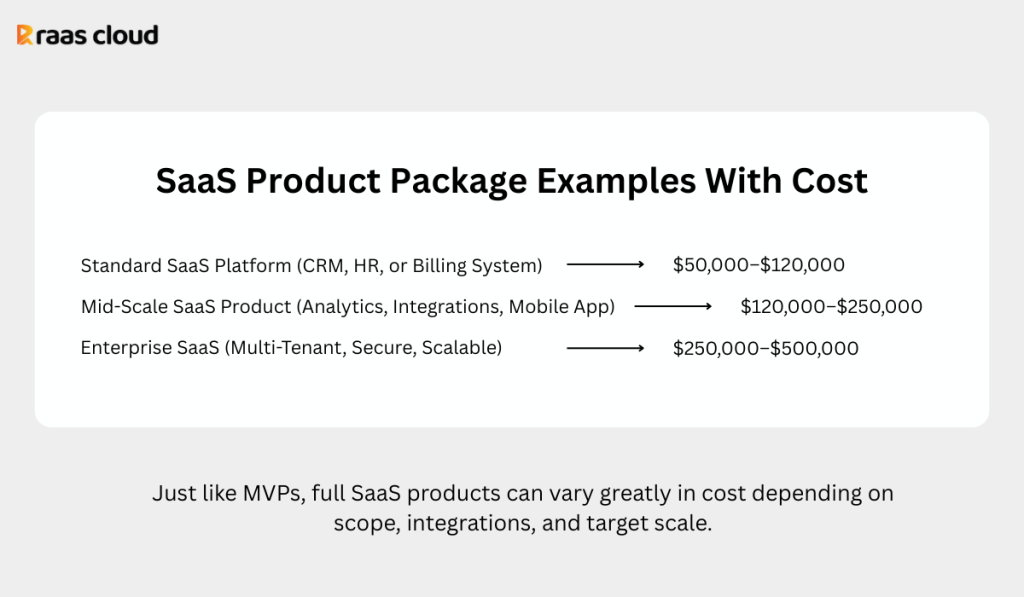
Just like MVPs, full SaaS products can vary greatly in cost depending on scope, integrations, and target scale. To give you a clearer picture, here are some example full SaaS product packages based on different business stages and product goals.
| Product Scope | Estimated Cost (USD) | Notes |
| Standard SaaS Platform (CRM, HR, or Billing System) | $50,000–$120,000 | Includes core modules, user roles, and billing setup |
| Mid-Scale SaaS Product (Analytics, Integrations, Mobile App) | $120,000–$250,000 | Adds advanced workflows, dashboards, and multi-user access |
| Enterprise SaaS (Multi-Tenant, Secure, Scalable) | $250,000–$500,000 | Built for high availability, automation, and enterprise compliance |
At RAAS Cloud, we design SaaS products that grow with your business. Whether you want to build your full product from scratch or expand an existing MVP, our team ensures the right mix of technology, performance, and scalability to make your SaaS platform market-ready.
Cost Difference Breakdown by Development Approach
The cost of your SaaS development can vary depending on how you choose to build it. Different approaches come with different trade-offs in terms of control, scalability, speed, and pricing. Here are the most common development approaches and how their costs typically compare:
| Build Model | Average Cost (USD) | Best For |
| Hiring Freelancers | $20,000–$80,000 | Early prototypes or small MVPs with limited scope |
| In-House Team (USA/UK) | $300,000–$800,000+ per year | Funded startups and enterprises needing full-time resources |
| Dedicated Remote Team | $8,000–$25,000 per month | Long-term projects requiring consistent development and iteration |
| Full Outsourcing (End-to-End Development) | $60,000–$300,000 | Businesses looking for complete product delivery under one partner |
RAAS Cloud offers the flexibility to choose between both models. You can either outsource your entire SaaS development to our in-house experts or build a remote team with dedicated developers, designers, and DevOps engineers. Get in touch with our team to discuss your goals, timelines, and the most cost-effective development setup for your SaaS project.
SaaS Feature Cost Impact Matrix (Very Insightful)
Every feature in a SaaS product adds value, but also impacts cost, timeline, and maintenance effort. Understanding which features drive higher costs helps founders plan smarter and prioritize what matters most for their MVP or full product build. Here’s a breakdown of how different SaaS features typically influence development costs.
| Feature | Cost Impact Level |
| User Management & Authentication | Low |
| Subscription & Billing System | Medium |
| Admin Panel & Analytics Dashboard | Medium |
| Multi-Tenant Architecture | High |
| Workflow Automation | High |
| Third-Party API Integrations | Medium–High |
| Data Encryption & Compliance (GDPR, SOC 2, HIPAA) | High |
| Mobile App Extension | High |
| AI or Predictive Analytics | Very High |
Knowing the cost impact early helps align your feature roadmap with available resources, so you can make strategic decisions about what to build now and what to add later.
Also Read: How Much Does It Cost to Hire Dedicated Developers in the USA?
How RAAS Cloud Builds SaaS Efficiently
The RAAS Cloud team has worked with over 50+ SaaS businesses across the globe, helping startups and enterprises turn their product ideas into scalable digital platforms.
We make sure to follow an efficient and predictable development process — MVP Launch → Iterate → Scale.
This allows our clients to test quickly, learn from users, and grow confidently. Our proven SaaS development frameworks (which we often walk clients through during discovery meetings) ensure faster delivery, stronger architecture, and long-term scalability.
Here are some of our key advantages:
- Top 1% Vetted Developers For Hire
- Free 7-Day Trial to test talent and process before committing
- 48-Hour Developer Match for urgent hiring needs
- Trusted SaaS Development Services for full product builds
- Flexible Engagement Models to fit any business stage or budget
Our experts are ready to help you design, build, and scale your next SaaS success story. Let’s build the next category-defining product together, faster, smarter, and cost-effectively with RAAS Cloud.

Dhanalakshmi Kadirvelu is a Business Intelligence and Data Analytics expert with a strong focus on software development and data engineering. She creates efficient data models, builds interactive dashboards, and integrates analytics into software systems using Power BI, OBIEE, and SQL. Her work helps development teams use data effectively to create smarter software solutions and improve business performance.