

In this listicle roundup, we bring together the most important tech industry hiring statistics to show how the job market is changing across roles, skills, regions, and experience levels.
We collect this data from trusted online sources, including industry reports, labor studies, and global research platforms. For full transparency, all source URLs are attached at the end of the article so that readers can verify every data point.
Key Tech Hiring Statistics and Highlights for 2026
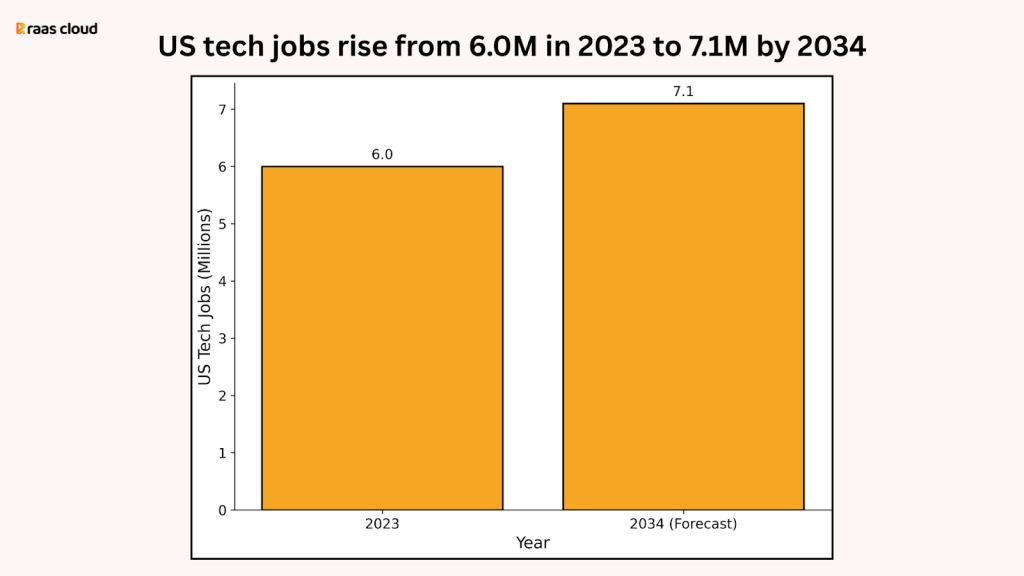
- US tech jobs are projected to reach 7.1 million by 2034, up from about 6 million in 2023, showing sustained long-term demand.
- The tech workforce is growing twice as fast as the overall labor market, making it one of the fastest-expanding employment sectors.
- Employers posted over 2.53 million tech job openings in 2024, and annual postings are projected to rise to 7.0 million by 2035.
- Hiring for a tech role takes an average of 5.4 months, with 64% of companies taking more than 4 months to fill positions.
- 76% of IT employers struggle to find skilled talent, confirming a persistent skills shortage.
- 70% of technical workers received multiple job offers when accepting their most recent role, showing strong competition for talent.
- 86% of employers expect AI to significantly reshape their business by 2030, directly influencing hiring priorities.
- Job postings requiring generative AI skills increased by over 1,800%, highlighting explosive demand for AI capabilities.
- 38% of new tech hires leave or are laid off within six months, contributing to an annual tech workforce turnover rate of 43%.
- The global cybersecurity workforce gap stands at 4.76 million unfilled roles, making security one of the most critical hiring challenges heading into 2026.
Tech Workforce Size and Long-Term Growth
The US tech workforce rebounded after the 2020 decline and has returned to steady growth. Tech jobs are expanding much faster than the overall labor market and now represent a meaningful share of total employment. Future hiring will remain strong, driven by both new role creation and the need to replace workers who leave the industry each year.
- After a sharp decline in 2020, the US IT workforce steadily recovered and reached nearly three million employees by the end of 2024, showing long-term resilience in tech employment.
- Over the next decade, the US tech workforce is expected to expand at twice the speed of the overall workforce, indicating sustained structural demand for tech roles.
- Forecasts show US tech jobs growing from about six million in 2023 to 7.1 million by 2034, reflecting continued expansion across digital and software-driven industries.
- Tech jobs currently account for 5.8% of the total US workforce, underscoring the sector’s importance to the broader economy.
- Between 2025 and 2035, employers will need to replace roughly 352,000 tech workers each year due to retirements and workforce exits, adding steady replacement demand.
Hiring Volume and Job Posting Activity
Tech hiring activity reflects both short-term market cycles and long-term demand. After a slowdown in 2023, hiring rebounded in 2024 as employers reopened roles. Job postings remain high and are expected to grow steadily, but posting volumes often overstate actual hiring because many roles are reposted, delayed, or remain unfilled due to competition and turnover.
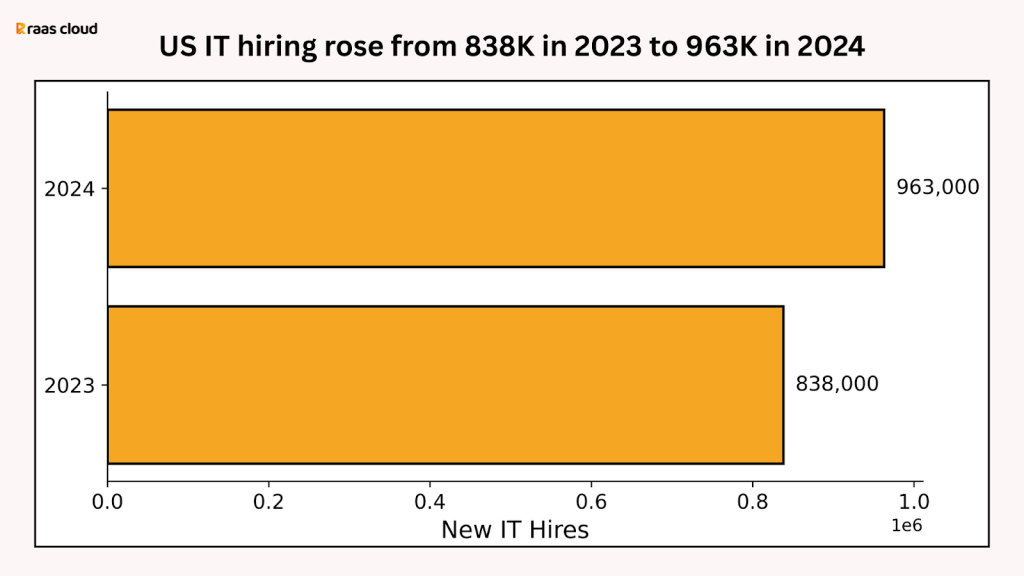
- New IT hiring in the US dropped to 838,000 in 2023 before rebounding to 963,000 in 2024, marking the strongest post-slowdown recovery since 2020.
- Employers posted more than 2.53 million tech job openings in 2024, showing continued hiring intent even amid economic uncertainty.
- Annual tech job postings are projected to rise from 6.1 million in 2025 to 7.0 million by 2035, signaling long-term hiring scale.
- Job posting volumes do not directly translate into hires because many roles are reposted, competed for, or left unfilled due to churn.
Employment Structure and Experience Levels
Employment in the tech sector is largely structured around full-time, long-term roles rather than contract work. Hiring favors experienced professionals, which limits entry-level opportunities. While large enterprises employ the biggest share of tech talent, smaller companies, startups, and scale-ups remain active employers and continue to drive a meaningful portion of overall hiring.
- Full-time roles dominate tech hiring, with 91% of professionals employed full-time and only 9% working as contractors or freelancers, showing a preference for stable employment.

- Senior professionals dominate the workforce, with more than 75% of tech workers having over six years of experience, limiting entry-level hiring.
- Smaller companies showed strong hiring activity, as 49% of organizations with under 250 employees increased their tech headcount in 2023.
- Startups and scale-ups employ over 21% of tech professionals, while large consulting firms and corporates employ nearly 50% of the workforce.
Roles, Occupations, and Functional Demand
Hiring demand is concentrated in core technical roles supporting product development, infrastructure, and security. Developer positions make up the largest share of hiring, while DevOps and cybersecurity roles remain essential for system stability and risk management. Demand for AI, data, and machine learning talent continues to grow, reinforcing the shift toward automation and data-driven operations.
- Developer roles continue to lead hiring, with full-stack, back-end, and front-end positions accounting for more than half of all developer jobs.
- DevOps talent remains widely adopted, as 51% of organizations employ DevOps professionals to support automation and system reliability.
- Cybersecurity hiring remains a priority, with 49% of organizations actively staffing security roles due to rising threats and compliance needs.
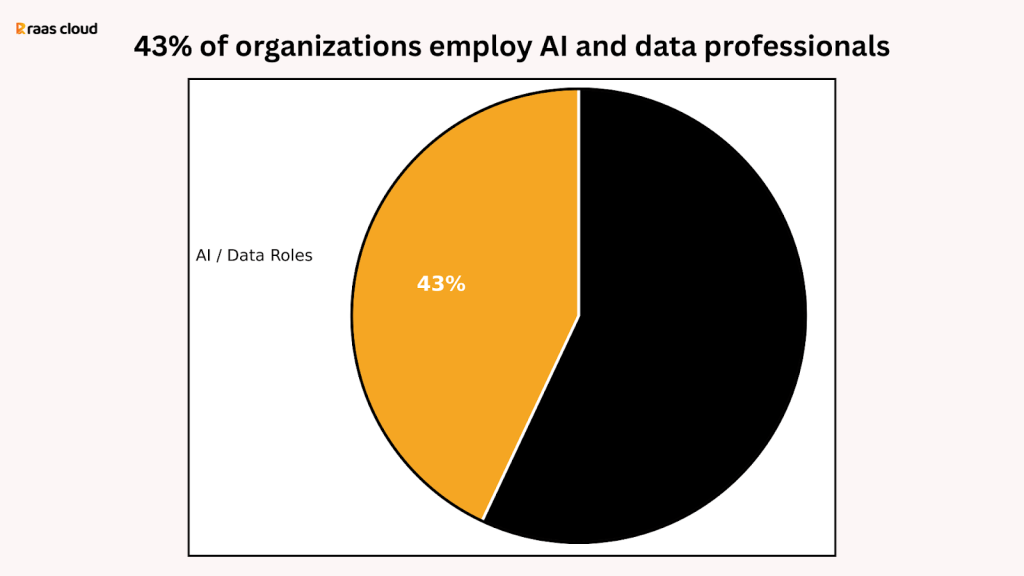
- Advanced data and AI roles continue to expand, with 43% of organizations employing AI, machine learning, data, and analytics professionals.
- Cybersecurity Engineer roles grew by 3% year over year, showing steady investment in security capabilities.
- DevOps Engineer roles grew by 0.8% year over year, reflecting stable but slower infrastructure hiring growth.
- DevOps skills appear in 6% of tech job postings, confirming consistent demand for deployment and cloud operations expertise.
- Recruiters report that full-stack and back-end developers are the most sought-after roles for 2025, while AI and ML specialists rank third in demand.
Occupational Growth Projections by Category
Long-term growth is uneven across tech roles. Software, AI, and data-focused positions are expanding much faster than the overall labor market, while cybersecurity and IT management roles show steady demand. Network and support roles continue to grow at a slower pace. Over the next decade, data, security, and software occupations are expected to see the strongest growth rates.
- Software development, programming, web, QA, and AI roles together account for over two million jobs and are growing at 2.5 times the national average.
- Data science, analytics, database, and machine learning roles exceed 412,000 jobs and are expanding at 2.6 times the national average growth rate.
- Cybersecurity, systems analysis, and IT project management roles account for more than 1.1 million jobs with steady projected growth.
- Network, cloud, and IT support roles total over 635,000 jobs and are expected to grow more slowly compared to other tech occupations.
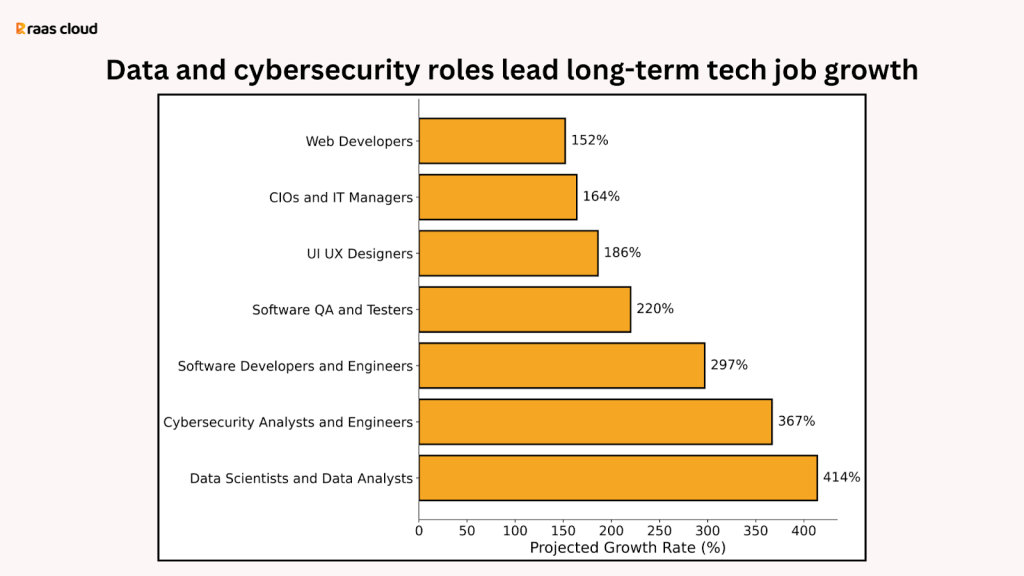
- Fastest-Growing Tech Occupations (10-Year Outlook):
- Data Scientists and Data Analysts 414%
- Cybersecurity Analysts and Engineers 367%
- Software Developers and Engineers 297%
- Software QA and Testers 220%
- UI UX Designers 186%
- CIOs and IT Managers 164%
- Web Developers 152%
AI, Automation, and Emerging Skill Demand
AI and automation are reshaping how companies hire, what skills they prioritize, and how they organize work. Employers are increasing demand for AI and digital skills while facing growing skill gaps. At the same time, automation is changing workforce size, pushing companies to reduce some roles and reskill employees into higher-growth tech positions.
- A strong majority of employers, 86%, expect AI and information processing technologies to significantly reshape their business by 2030, driving new hiring needs.
- Two-thirds of employers plan to hire professionals with AI-specific skills, showing AI is now a mainstream hiring requirement.
- Nearly half of leaders report that skill gaps are a major barrier to AI adoption, slowing down AI-focused hiring.
- In 2024, 27% of hiring managers expected generative AI to reduce their workforce, while 29% expected no change, suggesting mixed impact expectations.

- US job postings that require generative AI skills increased by more than 1,800%, reflecting explosive growth in AI-driven demand.
- Some technology skills now have a half-life of just 2.5 years, forcing companies to reskill and rehire continuously.
- 70% of employers expect to hire workers with new technology skills between 2025 and 2030.
- 40% of employers anticipate reducing staff in roles where automation makes skills less relevant.
- Half of employers plan to move workers from declining roles into growing tech roles through internal reskilling.
- 4% of tech workers fear AI will make their skills obsolete.
Hiring Speed, Competition, and Talent Shortage
Tech hiring is slow and highly competitive. Open roles often stay vacant for months as companies struggle to find candidates with the right skills. Strong competition among employers gives skilled workers multiple job options, while most leaders continue to face persistent challenges in attracting and retaining qualified tech talent.
- Filling a technical role takes an average of 5.4 months, highlighting slow and competitive hiring cycles.
- 64% of organizations take more than 4 months to fill open tech positions.
- A large majority of IT employers, 76%, report difficulty finding candidates with the right skills.
- 70% of technical workers had multiple job offers when accepting their most recent role, showing strong competition for talent.

- Nearly 90% of tech leaders say recruiting and retaining talent remains a moderate to major challenge.
Attrition, Turnover, and Retention Pressure
Employee movement is high across the tech sector. Many new hires leave within months, while overall turnover remains elevated year after year. Retention is influenced by workplace culture, relationships, and employee experience, with younger workers especially sensitive to poor environments, forcing companies to replace and rehire talent constantly.
- Early attrition is high, with 38% of new tech hires leaving or being laid off within six months.
- In the UK, 62% of tech firms struggle to retain talent, leading to ongoing replacement hiring.
- 47% of IT workers plan to look for a new job within the next six months.
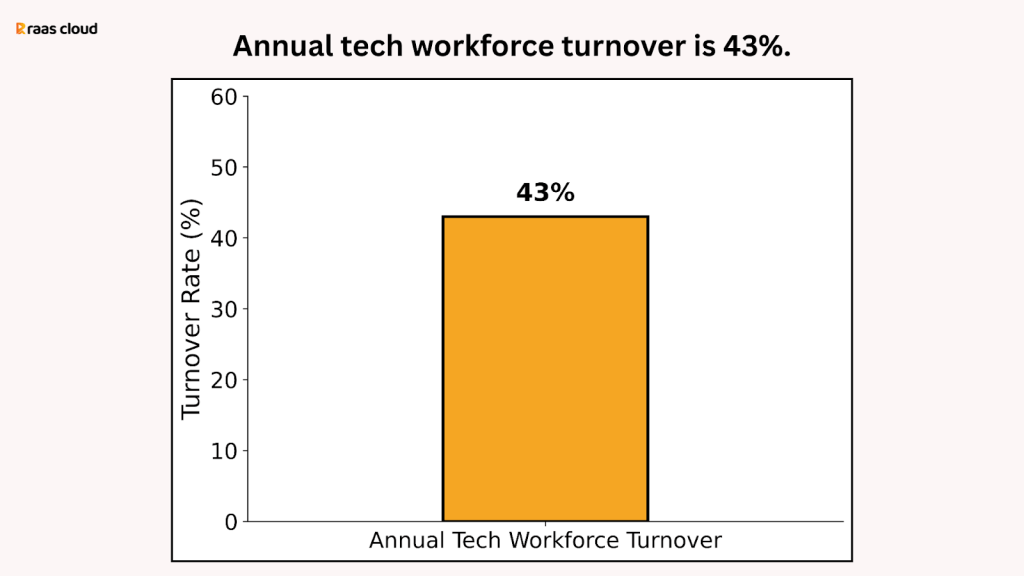
- The annual tech workforce turnover rate is estimated at 43%, reflecting constant labor-market turnover.
- Almost half of tech workers say strong relationships with colleagues are a key reason they stay in a role.
- Among young tech workers aged 18 to 28, 50% left or considered leaving due to an unhealthy workplace culture.
Compensation, Pay, and Work Expectations
Pay levels and expectations influence both hiring and retention decisions in the tech industry. Senior IT leadership roles command the highest salaries, while developers and project managers also earn well above average wages. However, compensation works alongside work-life balance, as many professionals now evaluate roles based on overall lifestyle fit rather than salary alone.
- IT management roles were the highest-paid in 2024, with average salaries of around 168,000 dollars per year.
- Software developers and project managers earned average annual salaries exceeding 120,000 dollars.
- Salary expectations and work-life balance are the top factors influencing recruitment and retention for 58% of IT professionals.
Diversity, Gender, and Inclusion Challenges
Gender balance and inclusion remain ongoing challenges in the tech workforce. Developer roles remain heavily male-dominated, while efforts to diversify cybersecurity teams face hiring barriers. Employers report difficulty attracting veterans’ spouses and minority candidates, showing that structural and pipeline issues still limit progress on workforce diversity.
- In 2024, approximately 80% of the global developer workforce identified as male, while only around 19% identified as female, showing continued male dominance in the developer population.

- In 2024, 40% of global cybersecurity employers reported difficulty hiring veterans’ spouses, while nearly 30% reported challenges hiring minority candidates, highlighting persistent inclusion gaps in cybersecurity hiring.
Remote, Global, and Cross-Border Hiring
Work location has become more flexible across the tech industry. Remote roles continue to expand as office-based positions decline. Companies increasingly hire across borders, and most tech professionals are open to working for employers in other countries, widening the global talent pool and reducing reliance on local hiring markets.
- Fully remote tech roles grew by 3.3% year over year, while office-based roles declined by 2.5%, reshaping hiring models.

- Cross-border employment is rising, with 18.6% of tech professionals working remotely for companies in other countries.
- 80% of tech professionals are open to working remotely for foreign companies, even if they are not currently doing so.
Regional and Market Specific Trends
Hiring conditions vary by region and industry, reflecting local market confidence and business demand. UK employers expect stable conditions and plan moderate headcount growth, while Global Capability Centres increasingly drive India’s hiring. Across sectors, IT leads hiring intent, outpacing industries like financial services and real estate in overall employment outlook.
- In the UK, 60% of tech firms expect stable or improving market conditions by 2026.
- More than half of UK employers plan to increase permanent tech headcount in early 2026.
- Global Capability Centres expanded their role in India, accounting for 27% of IT hiring demand in 2025.
- The IT sector leads all industries with a 35% hiring outlook, followed by financial services and real estate at 32%.
Cybersecurity Workforce Gap
Cybersecurity talent demand continues to exceed supply. Skills shortages have grown since 2024, leaving millions of roles unfilled worldwide. Most organizations struggle to staff security teams, even as some companies reduce headcount. This imbalance shows a market where long-term demand remains strong despite short-term hiring and layoff fluctuations.
- Since 2024, the cyber skills gap has widened by 8%, with 66% of organizations reporting moderate to critical shortages.
- The global cybersecurity workforce gap now stands at 4,763,963 unfilled roles.
- Two-thirds of organizations report active staffing shortages in cybersecurity teams.
- Despite shortages, 25% of organizations reported cybersecurity layoffs in 2024, which was 22% in 2023
Layoffs, Unemployment, and Workforce Reductions
The tech labor market has faced periods of contraction alongside ongoing hiring. Large-scale layoffs reflect cost control and restructuring across major companies, while rising unemployment in the information sector signals short-term market pressure. These trends show that tech employment remains sensitive to economic cycles even as long-term demand persists.
- Technology companies globally experienced significant layoffs in 2025, including a 30,000-employee reduction at Amazon.
- US information sector unemployment rose from 3.1% in late 2023 to 3.9% in late 2024.
Structural and Green Tech Shifts
Technology and sustainability trends are reshaping how work is created and how jobs are displaced. Large-scale structural change will alter a significant share of global jobs, while climate pressures are pushing many employers to invest in green technologies. Together, these forces are driving new types of roles even as traditional jobs evolve or disappear.
- Between 2025 and 2030, technology and structural change will affect 22% of global jobs, creating a net gain of 78 million roles.
- Between 41% and 47% of employers expect climate trends to reshape business and increase green tech hiring.
👉 Want to explore the tools and platforms we use across frontend, backend, and cloud development? Here is the list:
1. Full Stack
2. Frontend
3. Backend
Final Words
These statistics show clear patterns in tech hiring, skill demand, and workforce movement. Employers can use them to plan hiring volumes, prioritize skills, and reduce attrition. Professionals can use them to identify in-demand roles, decide which skills to learn, and choose markets with stronger opportunities. Together, the data helps both sides make informed, long-term decisions.
FAQs
Is the tech workforce still growing after recent layoffs?
Yes. The US tech workforce reached nearly 3 million employees by the end of 2024 and is projected to grow twice as fast as the overall workforce. Demand is expected to rise from 6 million jobs in 2023 to 7.1 million by 2034, driven by digital expansion and replacement hiring.
Why are tech job postings high if hiring feels slow?
Employers posted over 2.53 million tech job openings in 2024, yet hiring remains slow because roles take time to fill. The average hiring time is 5.4 months, and 64% of organizations need more than four months due to skill shortages, competition, and repeated reposting of roles.
Which tech roles are most in demand today?
Developer roles dominate hiring, with full-stack, back-end, and front-end roles making up over 51% of developer jobs. Recruiters rank full-stack and back-end developers as the top roles for 2025, followed by AI and machine learning specialists, reflecting strong demand across core engineering and AI functions.
How strong is the demand for AI skills in tech hiring?
AI demand is rising sharply. 86% of employers expect AI to transform their business by 2030, and two-thirds plan to hire AI-skilled talent. Job postings requiring generative AI skills increased by over 1,800%, while 46% of leaders say skill gaps are slowing AI adoption.
Why is attrition so high in the tech industry?
Attrition remains elevated, with 38% of new tech hires leaving within six months and an annual turnover rate of 43%. Additionally, 47% of IT workers plan to change jobs within six months, driven by competition, culture issues, and frequent skill shifts across the industry.
💡 Further statistical reports:
- Mobile App Development Statistics
- 50+ Important IT Outsourcing Statistics
- Software Development Statistics
Data Sources
- https://www.statista.com/topics/5275/employment-in-the-it-industry/?srsltid=AfmBOoqHMomHTEOlrRW3eWhd6c8elmN0A9Hb1Hq_wrA7Mp3dDS-m990d#topicOverview
- https://www.statista.com/statistics/1446245/worldwide-developer-gender-distribution/
- https://campaign.landing.jobs/hubfs/Tech%20Talent%20Trends%20Report%202025.pdf?hsLang=en
- https://www.oecd.org/content/dam/oecd/en/publications/reports/2024/09/bridging-talent-shortages-in-tech_983d7ca6/f35da44f-en.pdf
- https://training.linuxfoundation.org/wp-content/uploads/2024/04/2024-Tech-Talent-Report-FINAL.pdf
- https://www.intapeople.com/wp-content/uploads/2025/10/Tech-guide-2026-compressed.pdf
- https://www.mckinsey.com/~/media/mckinsey/business%20functions/mckinsey%20digital/our%20insights/the%20top%20trends%20in%20tech%202025/mckinsey-technology-trends-outlook-2025.pdf
- https://www.thehindubusinessline.com/info-tech/india-sees-16-growth-in-it-hiring-in-2025-report/article70425755.ece
- https://www.manpowergroup.com/en/insights/report/global-insights-it-world-of-work-2025-outlook
- https://www.isc2.org/Insights/2024/10/ISC2-2024-Cybersecurity-Workforce-Study#CyberSecurityCareer
- https://www.isc2.org/Insights/2024/10/ISC2-2024-Cybersecurity-Workforce-Study#CyberSecurityCareer
- https://www.statista.com/statistics/199999/worldwide-tech-layoffs-covid-19/
- https://www.statista.com/statistics/199995/rates-of-jobless-persons-in-the-us-information-sector/
- https://www.statista.com/statistics/1367003/in-demand-it-roles/
- https://www.statista.com/statistics/1222132/it-staff-recruitment-struggles-worldwide/
- https://www.statista.com/statistics/200008/number-of-hires-in-the-us-information-sector/
- https://www.statista.com/statistics/1554312/impact-genai-global-tech-hiring-worldwide/
- https://www.statista.com/statistics/1317816/global-companies-challenges-on-it-employment-diversity/
- https://www.statista.com/statistics/1293871/us-salaries-in-the-it-industry-by-job-type/
- https://www.statista.com/statistics/1332197/factors-influencing-recruitment-retention-problems-worldwide/
- https://uk.grafton-recruitment.com/en/it-global-hr-trends-report
- https://lecbyo.files.cmp.optimizely.com/download/808ea63053b111f08b6ca695fc160b1a
- https://www.deloitte.com/us/en/insights/topics/talent/overcoming-the-tech-talent-shortage-amid-transformation.html
- https://www.ilo.org/sites/default/files/wcmsp5/groups/public/@ed_emp/documents/publication/wcms_840767.pdf

Dhanalakshmi Kadirvelu is a Business Intelligence and Data Analytics expert with a strong focus on software development and data engineering. She creates efficient data models, builds interactive dashboards, and integrates analytics into software systems using Power BI, OBIEE, and SQL. Her work helps development teams use data effectively to create smarter software solutions and improve business performance.