
The legal industry is one of the fastest adopters of AI. What started with basic chatbots and document automation has evolved into AI agents that can manage complete workflows with minimal human involvement. Today, law firms are using AI agents to improve productivity, reduce turnaround times, automate repetitive tasks, and give attorneys more time to focus on complex legal work and client relationships.
However, building an AI agent for a law firm involves much more than connecting a large language model to your existing systems. It requires secure data management, seamless integration with legal software, well-designed workflows, and human oversight to maintain accuracy, compliance, and client confidentiality.
In this guide, our AI developers and engineers at RAAS Cloud explain the most practical AI agent use cases for law firms, the key factors that impact development costs, and what it takes to build a secure, scalable solution that delivers measurable business value.
What Is an AI Agent for a Legal Firm?
Before exploring the use cases, let’s understand what an AI agent actually is.
An AI agent for a legal firm is an AI-powered system that can complete legal workflows with minimal human involvement. Unlike a traditional AI assistant that only responds to prompts, an AI agent can retrieve information, make decisions based on predefined rules, use connected software, and complete multiple tasks from start to finish.
| AI Assistant | AI Agent |
|---|---|
| Responds to prompts | Completes end-to-end workflows |
| Answers questions | Takes actions based on instructions |
| Requires constant user input | Works with minimal supervision |
| Limited to conversations | Connects with legal software and business systems |
| Generates content | Automates tasks across multiple steps |
How AI Agents Work
Most legal AI agents follow a simple workflow:
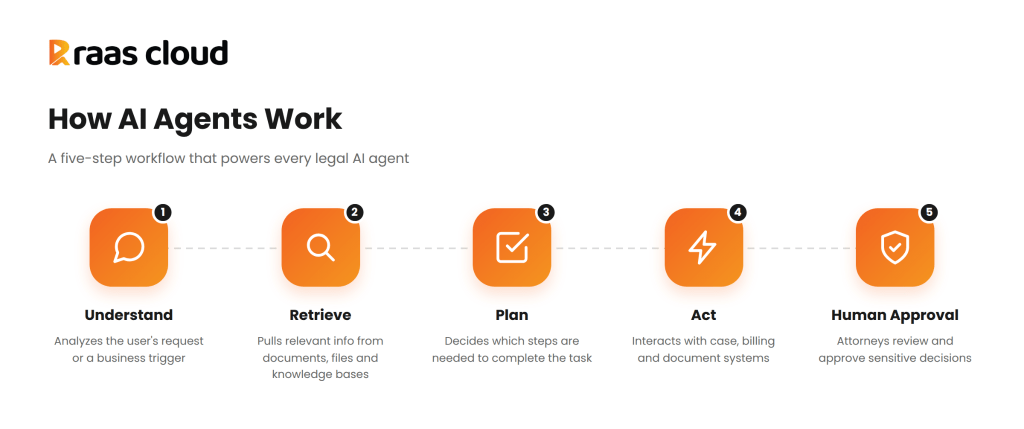
- Understand the request by analyzing the user’s input or a business trigger.
- Retrieve relevant information from legal documents, case files, contracts, or internal knowledge bases.
- Plan the workflow by deciding which steps are needed to complete the task.
- Take action by interacting with connected systems such as document management software, CRMs, billing platforms, or case management tools.
- Request human approval when handling sensitive legal decisions before completing the workflow.
This combination of reasoning, automation, and system integration allows AI agents to do much more than answer questions. They help law firms automate repetitive work while keeping attorneys in control of critical decisions.
8 Practical AI Agent Use Cases for Legal Firms
AI agents can support almost every stage of a legal workflow, from client onboarding to billing. Below are some of the most practical use cases where law firms are using AI agents to improve efficiency, reduce manual work, and deliver faster client service.
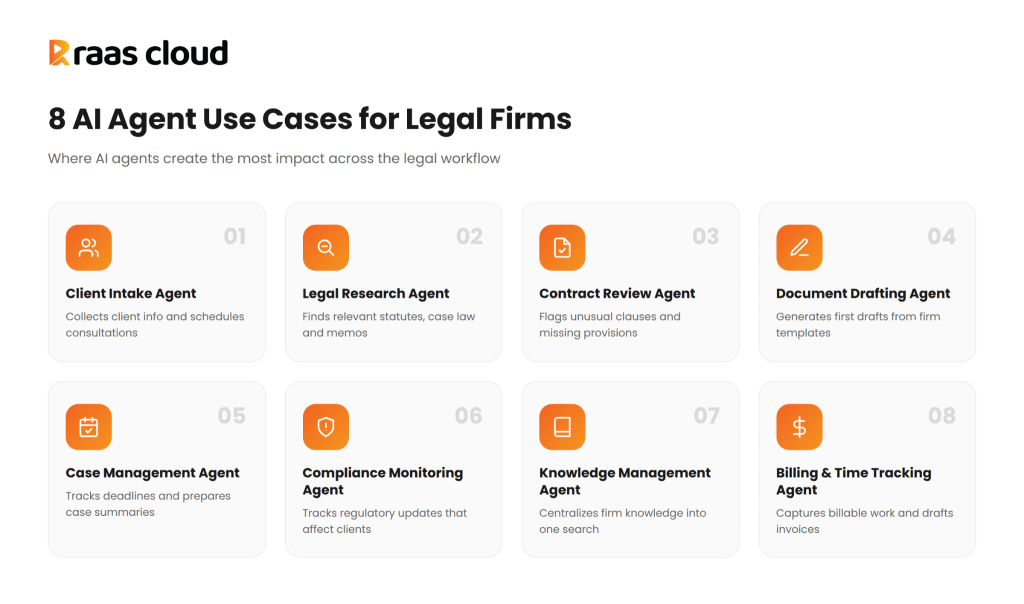
1. Intelligent Client Intake Agent
Every legal matter starts with client intake, but it is often one of the most time-consuming administrative tasks. An AI intake agent can collect client information through your website or portal, identify the practice area, ask follow-up questions based on the case type, schedule consultations, and create a new matter in your CRM or case management system.
Instead of staff spending time collecting basic information over emails and phone calls, the agent ensures every inquiry follows a structured process. This improves response times, reduces incomplete submissions, and helps attorneys begin consultations with the information they actually need.
2. Legal Research Agent
Legal research is one of the most valuable yet time-intensive activities in any law firm. While tools like Claude or ChatGPT can help answer legal questions, they are still limited because they do not automatically understand your firm’s internal knowledge, previous case files, approved templates, or research standards.
A legal research agent goes much further. It searches your firm’s knowledge base, identifies relevant statutes, case law, internal memos, and previous matters, then organizes the findings into a structured summary with references. Instead of searching across multiple databases manually, attorneys receive focused research tailored to the firm’s own legal resources and workflows.
3. Contract Review Agent
Legal teams review hundreds or even thousands of contracts every year. From vendor agreements and NDAs to employment contracts and commercial agreements, every review requires attention to risk, compliance, and consistency.
A contract review agent automatically analyzes agreements, flags unusual clauses, identifies missing provisions, compares terms against approved templates, and highlights potential legal or business risks. Rather than replacing legal review, it gives attorneys a structured first pass so they can spend more time negotiating critical terms instead of searching for routine issues.
4. Document Drafting Agent
Document drafting is another area where AI agents can save significant time. Instead of creating every document from scratch, an AI drafting agent can generate first drafts using your firm’s templates, clause library, writing style, and previous legal documents.
For example, we recently worked with a legal firm in Austin that spent several hours preparing standard legal documents for new client matters. After implementing a custom AI drafting workflow, the team was able to generate structured first drafts in minutes, allowing attorneys to focus on reviewing legal strategy rather than repetitive formatting and drafting.
5. Case Management Agent
Managing multiple cases involves much more than legal work. Attorneys also need to track deadlines, organize documents, assign tasks, monitor case progress, and keep clients updated.
A case management agent continuously monitors active matters, reminds teams about upcoming deadlines, prepares daily or weekly case summaries, assigns follow-up tasks, and notifies attorneys when action is required. Instead of manually checking multiple systems, legal teams receive timely updates that help prevent missed deadlines and improve overall case management.
6. Compliance Monitoring Agent
Compliance monitoring is a common challenge for firms serving highly regulated industries such as healthcare, finance, insurance, or data privacy.
An AI compliance agent continuously tracks regulatory updates, identifies changes that may affect existing clients, maps those changes to relevant contracts or policies, and alerts legal teams when action is needed. This allows firms to respond more quickly to regulatory changes instead of relying on periodic manual reviews.
7. Knowledge Management Agent
Every law firm builds valuable knowledge over the years through previous cases, legal opinions, contract language, and internal documentation. Unfortunately, much of this information remains scattered across folders, emails, and document management systems.
A knowledge management agent centralizes these resources into a searchable legal knowledge base. Attorneys can quickly retrieve similar cases, approved contract clauses, research notes, or internal guidance without spending hours searching through old files. This improves consistency across the firm while making institutional knowledge accessible to every team member.
8. Billing and Time Tracking Agent
Accurate time tracking has a direct impact on revenue, yet many billable activities are never recorded because attorneys forget to log them or enter them long after the work is completed.
A billing and time tracking agent automatically captures billable activities from emails, meetings, document reviews, legal research, and other daily work. It can generate draft time entries, prepare invoices, identify missing billable hours, and produce utilization reports for partners. This reduces manual administrative work, improves billing accuracy, and helps firms recover revenue that would otherwise be lost through untracked time.
How Much Does AI Agent Development Cost for a Legal Firm?
The cost of building an AI agent for a legal firm typically ranges from $10,000 to $100,000+, depending on its complexity and capabilities. A simple client intake or document drafting agent will cost much less than a multi-agent platform that handles legal research, contract review, compliance monitoring, and case management.
The biggest reason for this price range is that AI agents are custom-built for each firm’s workflows. Every legal practice has different business processes, document structures, security requirements, approval workflows, and software stack. Factors such as the number of automated workflows, the size of your legal knowledge base, the number of integrations, and compliance requirements all have a direct impact on development costs.
Based on our experience building 20+ custom AI agents for legal firms and professional service businesses, below are the typical development costs and timelines you can expect.
| Project Type | Estimated Cost (USD) | Typical Timeline |
|---|---|---|
| AI Client Intake Agent | $10,000 – $20,000 | 4-6 weeks |
| Legal Research Agent | $18,000 – $35,000 | 6-10 weeks |
| Contract Review Agent | $25,000 – $50,000 | 8-12 weeks |
| Document Drafting Agent | $15,000 – $30,000 | 5-8 weeks |
| Case Management Agent | $30,000 – $55,000 | 8-14 weeks |
| Multi-Agent Legal Platform | $60,000 – $100,000+ | 3-6 months |
Key Features Every Enterprise Legal AI Agent Should Include
Based on our experience building AI agents for legal firms, these are the core features we recommend for every enterprise deployment. They help ensure the system is secure, reliable, and practical for day-to-day legal operations.
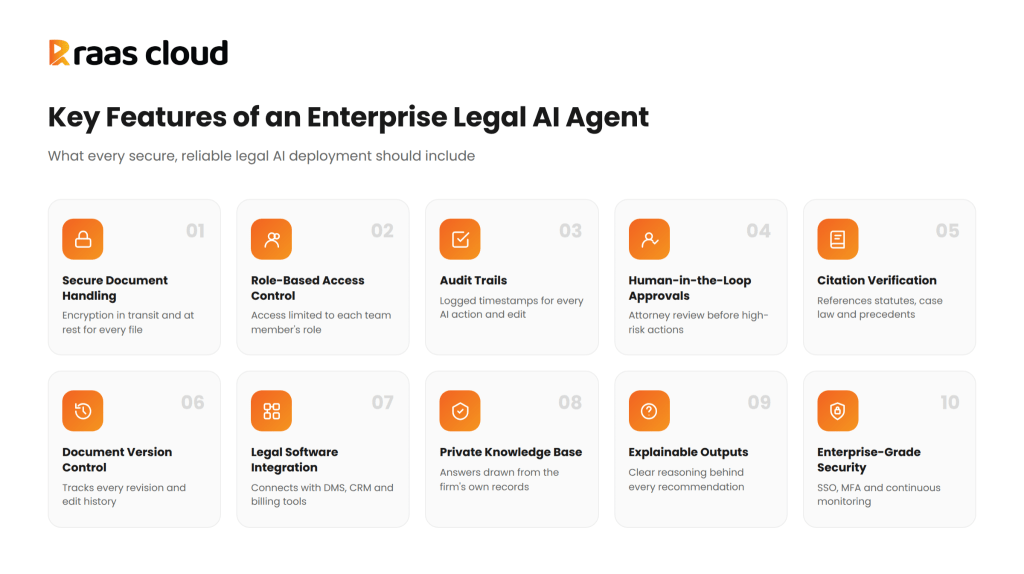
Secure Document Handling
Legal AI agents should encrypt documents both in transit and at rest, support secure file uploads, and prevent sensitive client information from being used to train public AI models. This is especially important when handling privileged communications and confidential case files.
Role-Based Access Control
Not every employee should have access to every matter. Enterprise AI agents should follow role-based permissions so partners, associates, paralegals, and administrative staff only see the documents, workflows, and client information relevant to their responsibilities.
Audit Trails
Every AI-generated response, document edit, workflow execution, and user action should be logged with timestamps. This creates a complete record of who accessed what, which prompts were used, and what changes were made, making internal reviews and compliance audits much easier.
Human-in-the-Loop Approvals
AI should never finalize legal advice or client-facing documents without attorney review. High-risk actions such as filing documents, approving contracts, or sending legal notices should always require human approval before execution.
Citation Verification
For legal research, AI agents should reference statutes, case law, internal precedents, and source documents instead of generating unsupported answers. Wherever possible, attorneys should be able to verify citations directly from the original source.
Document Version Control
Legal documents go through multiple revisions. AI agents should track every version, preserve edit history, and allow teams to compare changes between drafts without overwriting previous work.
Integration with Existing Legal Software
An enterprise AI agent should connect with your existing technology stack, including document management systems, case management platforms, billing software, Microsoft 365, email, calendars, and CRM solutions. This eliminates duplicate work and keeps information synchronized across systems.
Private Knowledge Base
Instead of relying only on public information, AI agents should retrieve answers from your firm’s own contracts, legal opinions, templates, SOPs, research memos, and previous matters using Retrieval-Augmented Generation (RAG). This produces responses that reflect your firm’s knowledge and standards.
Explainable Outputs
Attorneys need to understand how an answer was generated. AI agents should clearly explain the reasoning behind recommendations, identify the supporting documents used, and highlight any assumptions instead of producing black-box responses.
Enterprise-Grade Security
Enterprise deployments should include features such as single sign-on (SSO), multi-factor authentication (MFA), API authentication, data encryption, backup and disaster recovery, and continuous monitoring. These controls help firms meet internal security policies while protecting sensitive client data.
Why Build a Custom AI Agent Instead of Using Generic AI Agent Platforms?
When legal firms reach out to us, one of the most common questions they ask is whether they should build a custom AI agent or use an existing AI agent platform like n8n, Lindy, Gumloop, CrewAI, or Flowise. These platforms are great for building simple automations and testing AI workflows. However, as your firm’s requirements become more complex, they often fall short in terms of customization, scalability, security, and enterprise integrations.
A custom AI agent is built specifically around your firm’s workflows, legal knowledge, existing software, and compliance requirements. Instead of adapting your processes to fit a platform, the AI agent is designed to match how your firm already operates.
| AI Agent Platforms | Custom AI Agent |
|---|---|
| Built using pre-defined components | Built around your firm’s exact workflows |
| Best for simple automations and prototypes | Designed for complex, enterprise-grade legal workflows |
| Limited flexibility for custom logic | Fully customizable business logic and workflows |
| Generic integrations | Deep integration with your existing legal software and internal systems |
| Shared platform limitations | Built to scale based on your firm’s requirements |
| Limited control over infrastructure | Full ownership of deployment, hosting, and architecture |
| Basic security features | Enterprise-grade security, RBAC, audit logs, and compliance controls |
| Subscription-based platform | Long-term solution tailored to your business |
Explore More:
- AI Agent Development Cost By Use Case (Support, Sales, HR)
- How Much Does It Cost to Train a Custom AI Model?
- How to Add AI Features Without Rebuilding Your App (4 Ways)
Build AI Agents That Deliver Real Business Value
AI agents are changing how legal firms operate by automating repetitive work, improving response times, and helping attorneys focus on higher-value legal tasks. Whether it’s client intake, legal research, contract review, or case management, the right AI agent can streamline operations while improving accuracy, consistency, and overall client experience.
If you’re planning to build an AI agent for your law firm, our AI experts at RAAS Cloud can help. From identifying the right use cases and designing secure workflows to developing, integrating, and deploying enterprise-grade AI agents, we work closely with your team to build solutions that deliver measurable business value. Connect with our team to discuss your requirements and explore how custom AI agents can transform your legal operations.

Dhanalakshmi Kadirvelu is a Business Intelligence and Data Analytics expert with a strong focus on software development and data engineering. She creates efficient data models, builds interactive dashboards, and integrates analytics into software systems using Power BI, OBIEE, and SQL. Her work helps development teams use data effectively to create smarter software solutions and improve business performance.