
Clinical trials can cost anywhere from millions to billions of dollars. Yet many organizations still rely on spreadsheets, disconnected systems, and manual workflows to manage study operations. These outdated processes increase the risk of delays, data inconsistencies, compliance issues, and unnecessary administrative work.
A Clinical Trial Management System (CTMS) offers a better way to manage the entire trial lifecycle. It acts as the operational backbone that helps research teams manage studies, track sites and participants, streamline workflows, maintain regulatory compliance, and stay audit ready.
In this article, we explain how much it costs to build a custom CTMS, the key factors that influence development costs, and where your budget is likely to be spent. The insights are based on our experience of building clinical trial software solutions for more than five healthcare and life sciences clients.
What Does a Clinical Trial Management System Actually Include?
A Clinical Trial Management System (CTMS) is a software platform that helps pharmaceutical companies, CROs, research institutions, and sponsors manage the operational side of clinical trials. Instead of relying on spreadsheets, emails, and disconnected tools, a CTMS brings all study-related activities into one central platform, making it easier to track progress, improve collaboration, and maintain regulatory compliance.
While every CTMS is built differently based on business needs, most platforms include the following core modules:
| Module | What It Helps Manage |
|---|---|
| Study Management | Study planning, timelines, milestones, and trial status |
| Site Management | Research sites, site activation, performance, and communication |
| Investigator Management | Investigator profiles, qualifications, contracts, and training records |
| Participant Management | Patient enrolment, visit schedules, retention, and status tracking |
| Visit & Calendar Management | Study visits, appointments, reminders, and protocol schedules |
| Regulatory Management | Ethics approvals, regulatory documents, audit trails, and compliance records |
| Financial Management | Study budgets, site payments, invoices, grants, and financial tracking |
| Monitoring & Quality Management | Site monitoring visits, findings, protocol deviations, and corrective actions |
| Document Management | Trial documents, SOPs, contracts, and version control |
| Reporting & Dashboards | Study progress, recruitment metrics, financial reports, and operational insights |
It is important to note that a CTMS is designed to manage trial operations. It is different from systems such as Electronic Data Capture (EDC), Electronic Trial Master File (eTMF), or ePRO platforms, although these systems are often integrated to create a complete clinical trial ecosystem.
Average Cost to Build a Custom CTMS
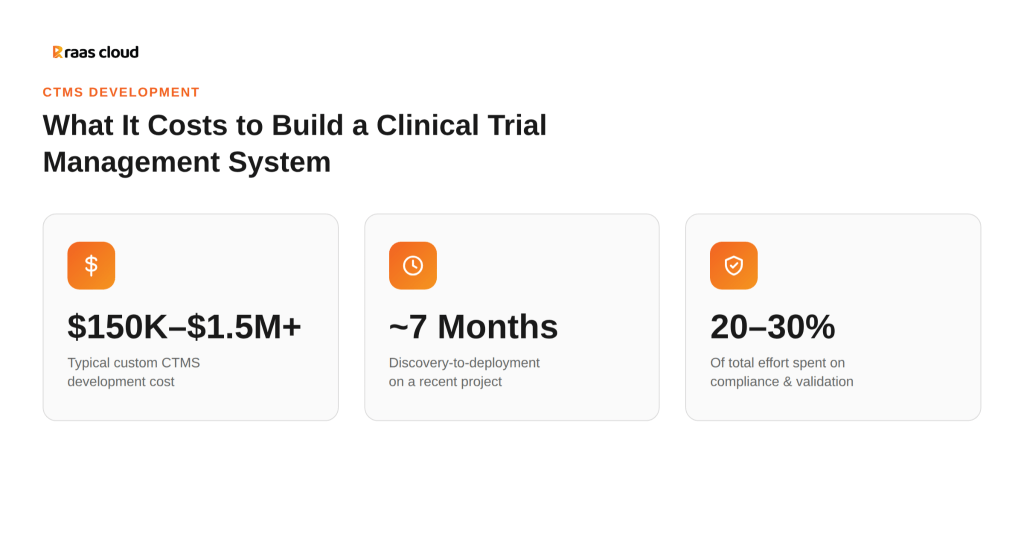
A custom Clinical Trial Management System (CTMS) typically costs between $150,000 and $1.5 million or more, depending on the platform’s complexity, compliance requirements, integrations, and level of customization. In our experience, the most recent CTMS we designed for a healthcare client took around 7 months to develop from discovery to deployment.
The final cost depended on the number of modules, third party integrations, user roles, and regulatory requirements. Below is a general cost estimate based on different project sizes.
| Project Type | Estimated Cost | Typical Timeline |
|---|---|---|
| MVP CTMS | $150,000 to $220,000 | 5 to 7 months |
| Mid-size CTMS for Sponsors or CROs | $250,000 to $600,000 | 8 to 12 months |
| Enterprise Multi-country CTMS | $700,000 to $1.5 million+ | 12 to 18 months |
Important Note: These estimates include product design, development, QA, infrastructure setup, and core compliance features. Full computer system validation (CSV), extensive integrations, and enterprise support can increase costs significantly.
6 Factors That Influence CTMS Development Cost
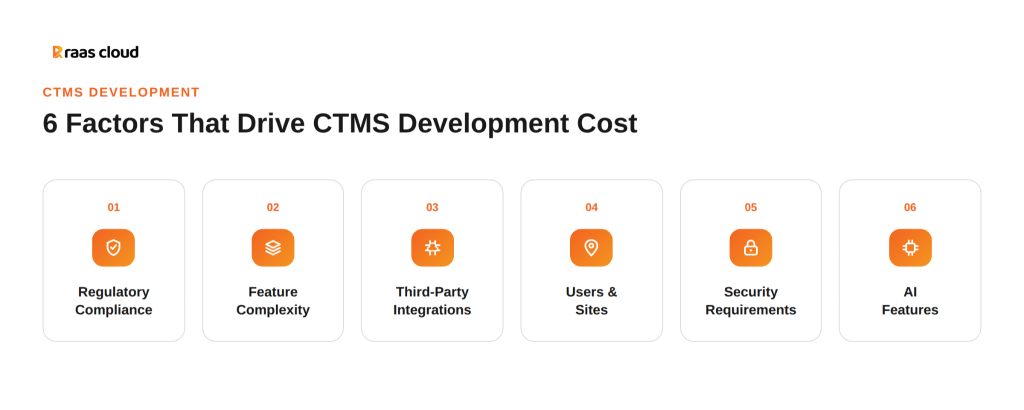
Before requesting a CTMS development quote, it is important to understand what drives the cost. The following six factors have the greatest influence on the project’s budget, timeline, and overall complexity.
1. Regulatory Compliance (Highest Cost Driver)
Building a CTMS that simply works is one thing. Building one that can withstand an FDA inspection is a completely different challenge. For most healthcare organizations, compliance is the single biggest factor that influences both development time and cost.
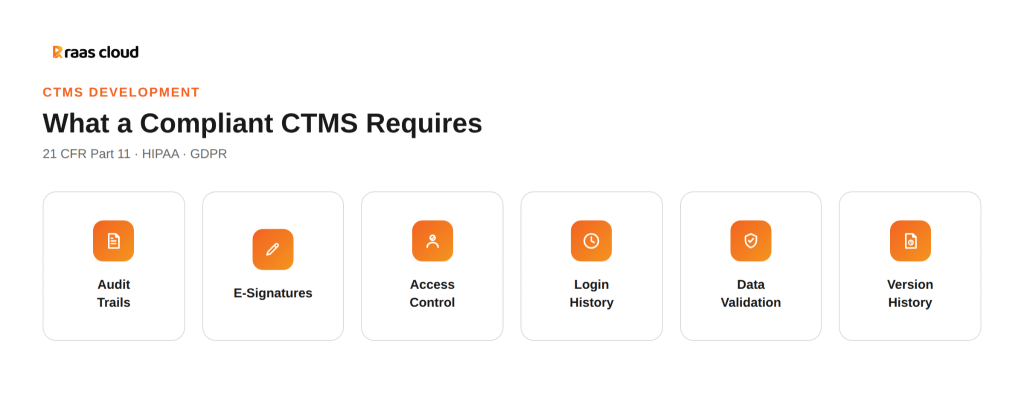
Depending on your target market and study requirements, the platform may need to comply with 21 CFR Part 11, HIPAA, GDPR, and other regional regulations. This means developers cannot simply build forms and databases. Every action performed inside the system must be traceable, secure, and verifiable.
A compliant CTMS typically requires features such as:
- Complete audit trails for every record change
- Electronic signatures with identity verification
- Role based access controls and permission management
- Login history and access logs
- Data integrity checks and validation rules
- Computer System Validation (CSV) documentation
- Secure record retention and version history
For example, if a clinical coordinator updates a participant’s visit date, the system must record who made the change, when it happened, what was changed, and why, without allowing previous records to be overwritten or deleted.
From our experience, compliance related work often accounts for 20% to 30% of the total project effort, especially when formal validation documents, testing protocols, and audit readiness are required before deployment.
2. Feature Complexity
Feature count alone does not determine the development cost. The real cost comes from the complexity behind each workflow.
Basic CTMS platforms usually include study management, site management, participant tracking, scheduling, document management, and reporting. These modules are relatively straightforward because they follow established workflows.
Costs increase significantly when organizations require advanced capabilities such as:
- Dynamic workflow automation
- Multi country study management
- Budget forecasting
- Protocol deviation management
- Risk based monitoring
- Automated payment calculations
- Resource allocation dashboards
- Custom approval workflows
- Advanced reporting with drill down analytics
For example, creating a simple participant visit calendar may take only a few days. Building a scheduling engine that automatically adjusts future visits based on protocol amendments, investigator availability, and participant status is an entirely different engineering challenge.
The more business logic your CTMS needs to automate, the higher the development effort.
3. Integrations
Integrations are often underestimated during project planning, but they can become one of the most time consuming parts of CTMS development.
Connecting with modern systems that provide well documented APIs is usually straightforward. However, many healthcare organizations still use legacy applications, custom databases, or vendor specific platforms that require significant customization.
Common CTMS integrations include:
- Electronic Health Records (EHR)
- Electronic Medical Records (EMR)
- Electronic Data Capture (EDC)
- Electronic Trial Master File (eTMF)
- eConsent platforms
- ePRO systems
- Laboratory Information Systems
- IVRS and IRT platforms
- Financial and payment systems
One CTMS we built required integration with an existing EDC platform, a laboratory reporting system, and a custom financial management application. While the CTMS itself was completed on schedule, the integration phase added several additional weeks because each external system used different authentication methods, data structures, and synchronization rules.
In enterprise healthcare software, integration complexity often depends more on the external systems than on the CTMS itself.
4. Number of Users and Sites
Simply increasing the number of users does not automatically increase development costs. Whether your platform supports 100 users or 5,000 users, the core functionality usually remains the same.
The challenge begins when organizations operate across multiple research sites, countries, or business units with different operational processes.
For example, one study site may require local ethics committee approvals before participant enrollment, while another follows an entirely different approval workflow due to regional regulations. Some organizations also require different permission structures, reporting formats, languages, currencies, and document templates for each region.
Supporting these variations requires additional workflow configuration, permission models, reporting logic, and administrative controls, all of which increase development effort.
Scalability is rarely about handling more users. It is about supporting more operational complexity.
5. Security Requirements
Along with regulatory compliance, security is a critical part of every modern CTMS.
Clinical trial platforms handle sensitive participant information, investigator records, study documents, and financial data. Any security weakness can lead to regulatory issues, operational disruptions, and loss of trust.
Depending on your organization’s security policies, the platform may include:
- End to end encryption for data in transit and at rest
- Multi Factor Authentication (MFA)
- Role Based Access Control (RBAC)
- Automated backup and disaster recovery
- Session management and inactivity controls
- Penetration testing before production release
- SOC 2 aligned infrastructure
- ISO 27001 security practices
- Security monitoring and incident logging
Many of these features are invisible to end users, but they require careful architecture, additional testing, and ongoing maintenance.
Security should be treated as a core platform requirement, not as a feature that is added after development is complete.
6. AI Features
Artificial intelligence is quickly becoming a standard expectation in modern CTMS platforms. However, simply adding an AI chatbot provides very little operational value.
The biggest opportunities come from using AI to reduce manual work, identify risks earlier, and help clinical teams make faster decisions.
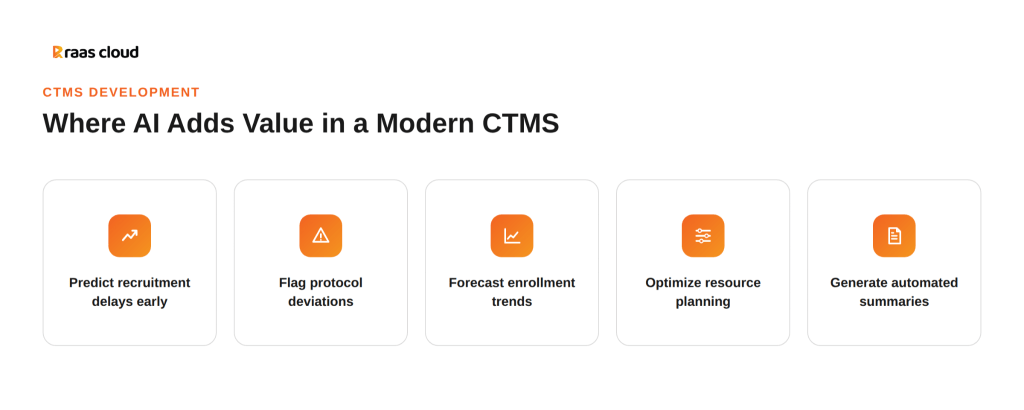
Some of the most practical AI features include:
- Predict delayed participant recruitment before enrollment targets are missed
- Automatically flag potential protocol deviations using participant activity and visit data
- Forecast enrollment trends across sites using historical recruitment patterns
- Optimize resource planning based on study timelines and site workloads
- Generate automated study summaries from operational data for sponsors and project managers
For example, instead of waiting until monthly reports reveal slow recruitment, an AI model can identify declining enrollment trends weeks earlier and recommend which study sites need additional support.
Similarly, AI can review participant schedules and protocol requirements in real time to detect potential deviations before they become compliance issues.
The value of AI is not measured by how many features it adds. It is measured by how many hours of manual coordination it removes from clinical operations every week.
Where Does the Budget Actually Go?
The total development cost of a CTMS is spread across multiple phases, not just coding. Below is a typical budget allocation for a custom CTMS project.
| Development Area | Approximate Share of Total Budget |
|---|---|
| Product Discovery & UI/UX Design | 10% |
| Backend Development | 25% |
| Frontend Development | 15% |
| QA & Testing | 15% |
| Compliance & Validation | 20% |
| Third Party Integrations | 10% |
| Infrastructure & Deployment | 5% |
Related Guides:
- Cost To Develop A Property Management App For Landlords
- Cloud Cost Optimization for SaaS Startups (A Complete Guide)
Build a CTMS That Scales With Your Clinical Trials
Building a Clinical Trial Management System is not just about developing software. It is about creating a secure, compliant, and scalable platform that supports your research operations for years to come. While the total cost depends on your requirements, investing in the right architecture, compliance framework, and integrations from the beginning can save significant time and money in the long run.
At RAAS Cloud, we are a trusted software development partner for healthcare and life sciences organizations across the United States. Our team designs and develops AI powered Clinical Trial Management Systems, along with other healthcare software solutions that meet modern regulatory, security, and operational requirements. Whether you are planning an MVP or an enterprise grade CTMS, we can help you define the right roadmap, estimate development costs, and build a solution tailored to your workflows.
Get in touch with our team today to discuss your requirements and receive a custom project estimate for your CTMS.

Dhanalakshmi Kadirvelu is a Business Intelligence and Data Analytics expert with a strong focus on software development and data engineering. She creates efficient data models, builds interactive dashboards, and integrates analytics into software systems using Power BI, OBIEE, and SQL. Her work helps development teams use data effectively to create smarter software solutions and improve business performance.