
Managing one or two rental properties is usually manageable with spreadsheets, emails, and manual follow-ups. But as your portfolio grows, things become more complex. Every property comes with rent collection, tenant communication, maintenance requests, lease management, accounting, and document tracking.
That is where a property management app can make a real difference. A well-built solution helps landlords automate routine tasks, stay organized, improve tenant experience, and manage multiple properties from a single platform.
Many landlords and property management businesses assume that building a custom property management app will cost a fortune. While development costs can vary based on features and complexity, the reality is that there are practical ways to build a solution that fits your budget and business goals.
At RAAS Cloud, we have prepared this guide to help you understand the actual cost of developing a property management app for landlords. We will break down the key cost factors, feature requirements, development stages, and common mistakes to avoid so you can make informed decisions without spending more than necessary.
RAAS Cloud is one of the leading software development and IT outsourcing companies in the United States, helping businesses build scalable digital products through cost-effective development models and experienced engineering teams.

Mobile Apps That Drive Real Results
From idea to launch, our team builds high quality apps for startups, SMBs, and enterprise businesses.
Free consultation · No commitment
What a landlord property management app actually needs to do
Having developed 40+ custom software solutions across industries, we have seen that the best property management apps focus on solving everyday landlord challenges. Based on our experience, here are the core features a property management app should include.
| Feature | What It Does |
| Property Listings Management | Allows landlords to add, edit, and manage rental properties from a central dashboard. |
| Tenant Onboarding | Simplifies tenant registration, profile creation, and move-in processes. |
| Online Rent Collection | Enables tenants to pay rent online through secure payment gateways. |
| Lease Management | Stores lease agreements, tracks renewal dates, and manages lease-related documents. |
| Maintenance Request Tracking | Allows tenants to submit maintenance issues and track resolution progress. |
| Tenant Communication | Provides messaging and notifications between landlords and tenants. |
| Document Storage | Securely stores leases, invoices, inspection reports, and other property documents. |
| Expense Tracking | Records property-related expenses and helps monitor cash flow. |
| Financial Reporting | Generates reports on income, expenses, occupancy, and property performance. |
| Vacancy Management | Tracks vacant units and helps manage property availability. |
| Tenant Screening | Supports background checks, credit verification, and tenant evaluations. |
| Payment Reminders | Automatically sends rent due reminders and overdue payment notifications. |
| Owner Dashboard | Provides a consolidated view of properties, tenants, revenue, and key metrics. |
| Multi-Property Management | Allows landlords to manage multiple properties from a single platform. |
| Vendor Management | Tracks contractors, service providers, and maintenance vendors. |
| Inspection Management | Schedules inspections and stores inspection records and reports. |
| Analytics & Insights | Provides actionable insights into property performance and rental trends. |
| Role-Based Access Control | Restricts access based on user roles such as landlord, manager, accountant, or tenant. |
| Mobile Access | Enables landlords and tenants to access the platform through mobile devices. |
| Notifications & Alerts | Sends real-time updates for payments, maintenance requests, lease renewals, and other activities. |
Cost To Develop a Property Management App At A Glance By Build Type
Let us start with a quick overview of the typical cost to develop a property management app. The actual investment depends on the features, integrations, platforms, and level of customization required. At RAAS Cloud, we focus on delivering cost-effective solutions without compromising on quality.
| Build Type | Typical Cost Range (USD) | Best For |
| MVP Property Management App | $5,000 – $10,000 | Landlords validating an idea or managing a small portfolio |
| Mid-Tier Property Management App | $10,000 – $30,000 | Growing property management businesses needing advanced workflows |
| Enterprise Property Management Platform | $30,000 – $70,000+ | Large property management companies with complex requirements |
| Subscription-Based Development Model | Starting from $2,500/month | Businesses looking for continuous development, improvements, and support |
These estimates are based on our experience delivering affordable software solutions for startups, SMBs, and enterprises. The final cost will depend on the exact scope, feature set, integrations, and project timeline.
Key Factors That Impact the Cost of a Property Management App
We build property management software using flexible modules, which means the final cost depends largely on the features and workflows you choose to include. In our experience, two apps may look similar on the surface but can have very different development costs based on what happens behind the scenes.
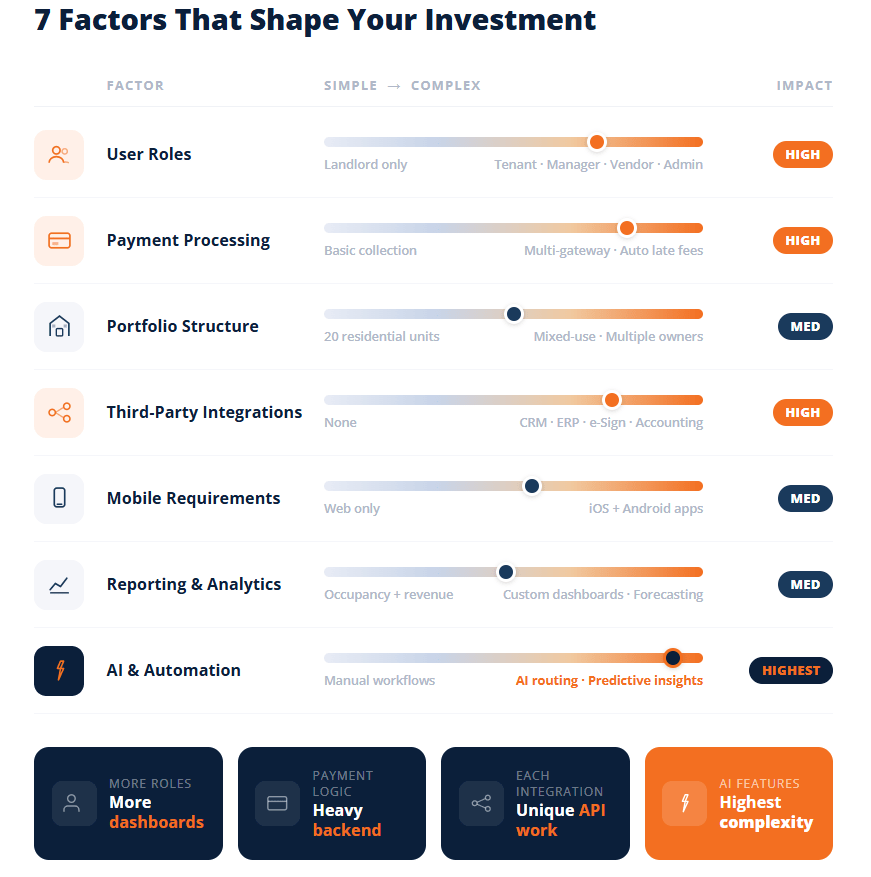
Here are the biggest factors that influence the overall investment.
Number of User Roles
A landlord-only platform is relatively straightforward. Costs increase when you introduce tenants, property managers, maintenance vendors, accountants, and admins. Each role requires separate dashboards, permissions, workflows, and reporting views, which adds development effort.
Rent Collection & Payment Processing Complexity
Basic rent collection is simple. However, costs rise when clients require recurring payments, late fee automation, partial payments, payment schedules, refunds, multiple payment gateways, and accounting reconciliation. Payment-related features often involve significant backend logic.
Property Portfolio Structure
Managing 20 residential units is very different from managing hundreds of residential, commercial, and mixed-use properties. The more property types, units, ownership structures, and lease variations you support, the more complex the database architecture becomes.
Third-Party Integrations
Many property management platforms need integrations with payment gateways, accounting software, e-signature platforms, tenant screening services, CRM systems, or ERP solutions. Integrations often take longer than expected because each platform has different APIs, limitations, and compliance requirements.
Mobile App Requirements
Some landlords only need a web platform. Others require dedicated iOS and Android apps for tenants, property managers, and vendors. Supporting multiple platforms increases development, testing, deployment, and ongoing maintenance efforts.
Reporting & Analytics Requirements
Standard occupancy and revenue reports are easy to implement. Costs increase when clients request custom dashboards, portfolio performance tracking, cash flow forecasting, lease analytics, maintenance trends, and downloadable reports tailored to different user roles.
Automation & AI Features
Many landlords now want automated rent reminders, maintenance ticket routing, document extraction, AI-powered tenant support, and predictive insights. These features can save significant operational time but require additional development, AI integrations, testing, and ongoing optimization.
While these are some of the biggest factors that influence development costs, there are many other requirements that can impact the final budget, including compliance needs, custom workflows, advanced security, document management, integrations, and future scalability plans.
If you would like a more accurate estimate for your property management app, let’s connect on a discovery call. Our team will understand your business requirements, identify the features you actually need, recommend the most cost-effective approach, and provide a realistic development roadmap before you invest in building the platform.
A Practical Cost Estimation Framework for Property Management Apps
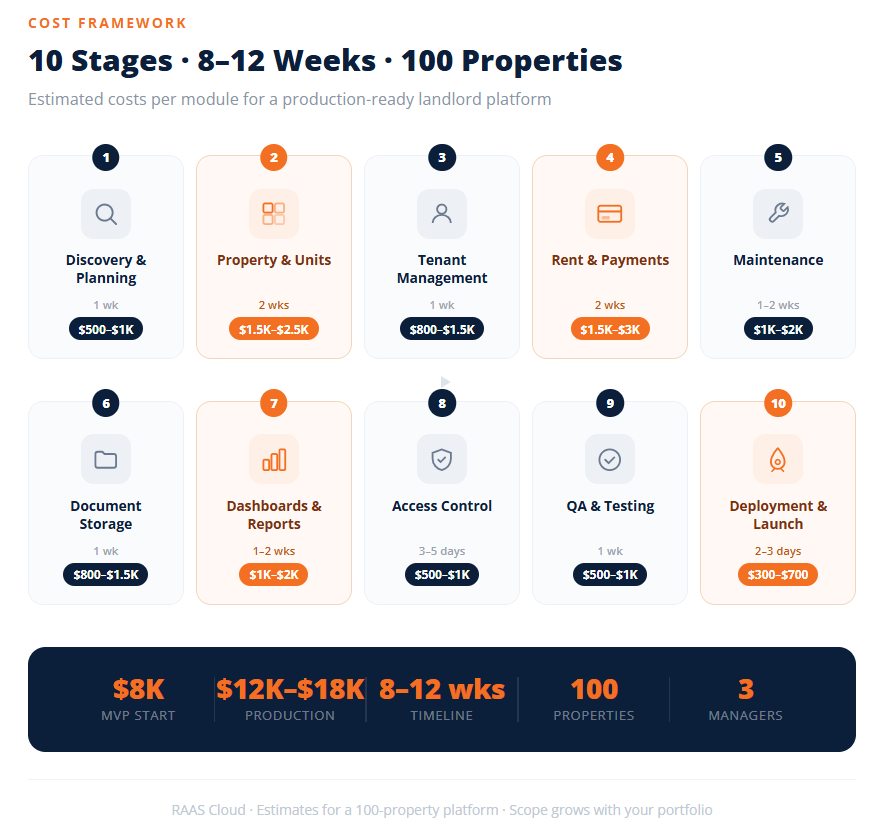
Let us see how a property management app project typically moves module by module and how each component adds to the overall cost. For this example, we will estimate a system designed to manage around 100 properties with 3 property managers, tenant access, rent collection, maintenance tracking, reporting, and an admin dashboard.
Project Assumptions
- 100 managed properties
- 3 property managers
- 1 admin account
- Tenant portal
- Web-based platform
- Payment gateway integration
- Maintenance request management
- Financial reporting
- Document storage
Step 1: Discovery & Planning
This stage includes requirement gathering, workflow mapping, user role planning, wireframes, and technical architecture.
Team Required
- Business Analyst
- Solution Architect
- Project Manager
Estimated Timeline
- 1 week
Estimated Cost
- $500 to $1,000
Step 2: Property & Unit Management Module
This module allows landlords and managers to add properties, units, occupancy details, rental status, lease information, and ownership records.
Team Required
- Frontend Developer
- Backend Developer
- QA Engineer
Estimated Timeline
- 2 weeks
Estimated Cost
- $1,500 to $2,500
Step 3: Tenant Management Module
Includes tenant profiles, move-in records, lease assignments, document uploads, and tenant history tracking.
Team Required
- Frontend Developer
- Backend Developer
- QA Engineer
Estimated Timeline
- 1 week
Estimated Cost
- $800 to $1,500
Step 4: Rent Collection & Payment Module
Allows tenants to pay rent online, view payment history, receive reminders, and generate receipts.
Team Required
- Backend Developer
- Frontend Developer
- Payment Integration Specialist
- QA Engineer
Estimated Timeline
- 2 weeks
Estimated Cost
- $1,500 to $3,000
Step 5: Maintenance Request Management
Tenants can submit issues, upload images, track status, and communicate with property managers.
Team Required
- Frontend Developer
- Backend Developer
- QA Engineer
Estimated Timeline
- 1 to 2 weeks
Estimated Cost
- $1,000 to $2,000
Step 6: Document Management System
Stores leases, invoices, inspection reports, tenant documents, and other property-related files.
Team Required
- Backend Developer
- Frontend Developer
Estimated Timeline
- 1 week
Estimated Cost
- $800 to $1,500
Step 7: Dashboards & Reporting
Provides occupancy reports, rent collection reports, overdue payments, maintenance statistics, and property performance metrics.
Team Required
- Frontend Developer
- Backend Developer
Estimated Timeline
- 1 to 2 weeks
Estimated Cost
- $1,000 to $2,000
Step 8: Role-Based Access Control
Creates separate experiences for admins, managers, and tenants while controlling access to specific features and data.
Team Required
- Backend Developer
- QA Engineer
Estimated Timeline
- 3 to 5 days
Estimated Cost
- $500 to $1,000
Step 9: Quality Assurance & User Testing
This stage ensures all modules work correctly together and identifies bugs before launch.
Team Required
- QA Engineer
- Project Manager
Estimated Timeline
- 1 week
Estimated Cost
- $500 to $1,000
Step 10: Deployment & Launch
Production server setup, security configuration, backups, monitoring, and launch support.
Team Required
- DevOps Engineer
- Backend Developer
Estimated Timeline
- 2 to 3 days
Estimated Cost
- $300 to $700
Estimated Team Structure
| Team Member | Involvement |
| Project Manager | Part-time throughout project |
| Business Analyst | Discovery phase |
| UI/UX Designer | Initial design phase |
| Frontend Developer | Full project |
| Backend Developer | Full project |
| QA Engineer | Testing and validation |
| DevOps Engineer | Deployment and infrastructure |
Recommended Tech Stack
| Component | Technology |
| Frontend | React.js |
| Backend | Node.js |
| Database | PostgreSQL |
| Cloud Hosting | AWS or DigitalOcean |
| File Storage | AWS S3 |
| Payment Gateway | Stripe |
| Notifications | Twilio / SendGrid |
Monthly Infrastructure Cost
| Item | Estimated Monthly Cost |
| Cloud Server | $50 – $150 |
| Database | $20 – $50 |
| File Storage | $10 – $30 |
| Email Service | $10 – $25 |
| SMS Notifications | $20 – $50 |
| Monitoring & Backups | $10 – $25 |
Total Monthly Infrastructure Cost: Approximately $120 to $330 per month.
Estimated Timeline
For a property management platform supporting 100 properties and 3 property managers, the entire project can typically be delivered in 8 to 12 weeks depending on the final scope and integrations.
Estimated Total Development Cost
| Scope | Estimated Cost |
| Essential MVP | $8,000 – $12,000 |
| Recommended Production Version | $12,000 – $18,000 |
| Advanced Version With Mobile Apps & Automation | $18,000 – $30,000 |
Based on our experience, most landlords managing around 100 properties can comfortably start with a solution in the $12,000 to $18,000 range and continue adding features as their portfolio grows, rather than investing in a large enterprise platform from day one.
Explore Further:
- How Much Does It Cost To Build An AI Customer Service Chatbot
- How Much Does It Cost to Train a Custom AI Model?
- Cloud Cost Optimization for SaaS Startups (A Complete Guide)
How RAAS Cloud Approaches Landlord App Development
At RAAS Cloud, we have helped startups, SMBs, and enterprises build cost-effective software solutions without the overhead of maintaining large in-house technology teams.
Depending on your requirements, we offer two engagement models. You can hire dedicated developers and build your own extended development team, or you can fully outsource the project to our team and let us handle everything from planning and design to development, testing, deployment, and support.
One of the reasons we are able to offer affordable development services is our distributed talent model. We work with experienced developers, designers, QA engineers, DevOps specialists, and project managers from across India, where access to highly skilled engineering talent is strong while operational costs remain significantly lower than many Western markets. This allows us to deliver enterprise-grade solutions at a fraction of the typical development cost.
If you are planning to build a property management app for landlords, property managers, or real estate businesses, share your requirements with our team. We will review your goals and prepare a custom proposal tailored to your business.
To help you make an informed decision, we typically provide three different solution options:
- A lean MVP version for faster launch and validation
- A recommended production-ready version for growing businesses
- A fully scalable enterprise version for long-term expansion
This allows you to choose the option that best fits your budget, business stage, and growth plans while having complete visibility into costs, timelines, team structure, and future scalability.

Dhanalakshmi Kadirvelu is a Business Intelligence and Data Analytics expert with a strong focus on software development and data engineering. She creates efficient data models, builds interactive dashboards, and integrates analytics into software systems using Power BI, OBIEE, and SQL. Her work helps development teams use data effectively to create smarter software solutions and improve business performance.